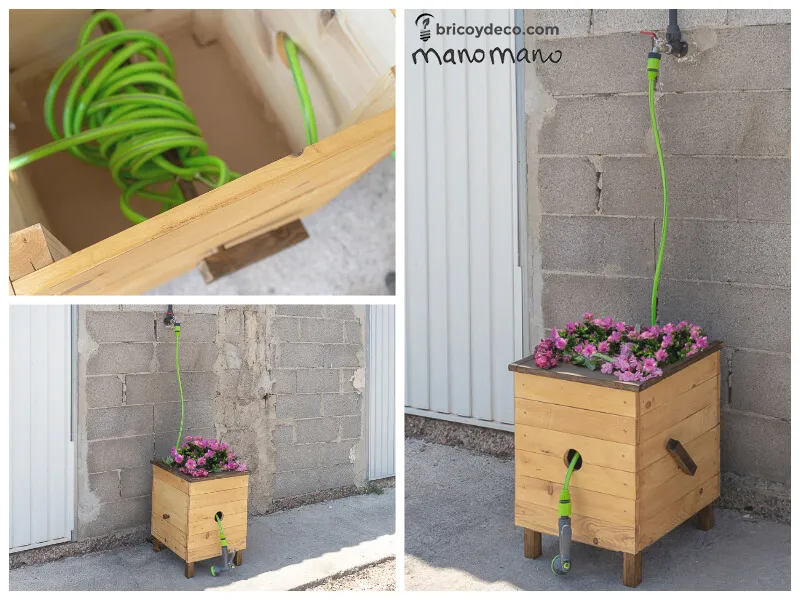
DIY planter box with hose reel
'/%3E%3C/svg%3E)
Guide written on 18 September 2026 by:
Mariluz, Blog writer for Bricoydeco
Tools and materials
To make a garden hose reel DIY planter box you'll need the following tools and materials:
Mitre saw
Drill / screwdriver
Hole saw drill bit cutter
Wood drill bits
Nail gun
Coping saw
Planks and rods of wood and a board of MDF measuring as follows:
5 planks measuring 240 x 68 x 2.1cm
1 plank measuring 240 x 3.2 x 3.2cm
1 rod measuring 100 x1.9cm and another measuring 100 x 2.7cm
An MDF board measuring 120 x 60 x 3cm
Wood screws
Sandpaper
White glue
Screw clamps
Cable ties
Varnish
Brush
Cost, time and difficulty
We've rated this DIY project as having a medium level of difficulty because it requires a certain amount of experience in handling the different tools.
The approximate price of the materials is around £50 although this can be reduced if you use pinewood boards instead of wooden planks, for example.
It will take about one full day's work to complete this project, although this may vary depending on how good your DIY skills are.
How to make a DIY Planter Box with a Hose Reel
This hose reel is really practical, and decorative too. You can use it to both store your hose and as a pretty planter.
Step 1- Cut the parts
Firstly, cut all of the parts that make up the main body of the hose reel. To do this, we used a mitre saw for its speed and precision, but you can also use a hand saw. The parts you need are:
36 planks measuring 40 × 6.8 x 2.1cm
4 planks measuring 40 × 3.2 x 3.2cm
Step 2- Assemble the outer structure
Once you've cut the parts, assemble the outer section of the reel. To do this, screw the sides of each plank measuring 40 x 6.8 x 2.1cm to the planks measuring 40cm in height. The result can be seen in the image below:
Step 3- Hose coiling system
The next step consists of creating the system that lets you roll up the hose, allowing you to easily store it or take it out for use.
Step 3.1.- Creating the hole to pull out the hose
Firstly make a hole with the core drill both at the front and back. The diameter of the core drill should be wide enough that the hose can be inserted along with the connector.
This allows you to pull the part of the hose that connects to the hose gun or sprinkler out through the front hole, and through the back, the part that connects to the tap.
3.2.- Part to coil the hose around
With a rod and plank of wood you will create the part around which to coil the hose. The steps are as follows:
Cut a rod to 45 x 1.9cm and another to 3 x 2.7cm. Join the one measuring 2.7cm in diameter to one of the ends of the 1.9cm one with white glue.
Using a flat drill with the same diameter as the rod, make a hole at each of the sides that haven't been cut with the core drill.
Sand the holes to remove splinters.
With the flat drill start to make a hole in the plank measuring 12 x 3.2 x 3.2cm, without drilling through it completely.
Insert the shaft through both holes and finish with the plank measuring 15cm which serves as the crank, and which you should attach using white glue.
3.3.- Attach the base
To finish off the reel, cut a part of MDF board measuring 40 x 44cm and trim the corners with a jigsaw. Next, nail it to the base using a nail gun. This means you can you use the hose reel as a container to store your watering accessories.
Step 4- Lid and planter
The next step is to make a lid which will also function as a planter. To make it, screw 4 planks measuring 30 x 6.8 x 2.1cm together like a drawer, and nail on an MDF base.
To make sure it fits and stays in place over the main section of the hose reel, you should screw 4 planks to the top as demonstrated in the image below.
Step 5- Treat and colour the wood
The next step is to protect and colour the wood with varnish. This type of finish allows the wood to breathe and helps to regulate interior moisture, making it ideal for outdoors furniture.
In just half an hour the varnish will be dry and you can start to make practical as well as decorative use of this hose reel.
All that's left to do is attach the hose to the shaft using some cable ties, and then turn the crank.
You may be also interested in these guides
Guide written by:
Mariluz, Blog writer for Bricoydeco
This article was written by: Bricoydeco and translated. Mari Luz authors the blog ‘Bricoydeco’, she is a DIY fanatic, lover of recycling and customising furniture. Her passion is giving a second chance to turn once forgotten things into unique pieces!
'/%3E%3C/svg%3E)