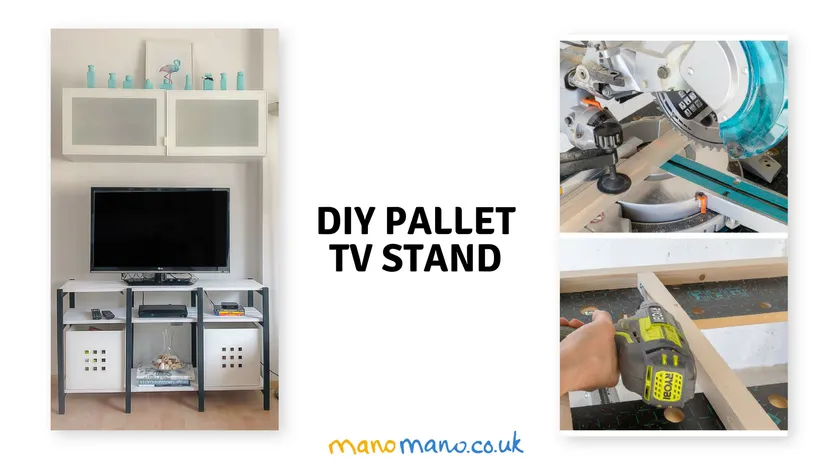
Pallet TV Stand DIY Tutorial
'/%3E%3C/svg%3E)
Guide written on 18 September 2026 by:
Mariluz, Blog writer for Bricoydeco
Tools and Materials
To make this pallet TV stand, you'll need the following materials:
Reciprocating saw
Reciprocating metal and wood saw blade
Orbital sander
Mitre saw
Drill/ screwdriver
Pocket hole jig
Nail gun
Screw clamps
2 pallets measuring 1200 × 1000mm
6 wooden planks measuring 2000 x 270 x 270mm
Cost, time and difficulty
This pallet TV stand is very cheap to make, with the price of materials being no more than £40 depending on what tools you already have. In this link you can access the ManoMano shopping basket where you'll find some of the tools and materials used.
This DIY project is ideal for those who are beginners when it comes to making pallet furniture. While some of the tools used need a certain level of practice, manual tools can be used in their place to make the whole process more simple, albeit longer.
On another note, to make this pallet TV unit takes around one day's work (approximately 10 hours).This time will vary depending on the state of the pallets. In our specific case, the boards had many surface imperfections, meaning it took us 3 hours just to get them sanded.
How to make a Pallet TV stand
When it comes to making a TV unit it is important to make sure it has sufficient storage space. This allows you to house your entire entertainment system, as well as DVDs, games etc.
That's why our pallet TV stand features a shelf with a height of 15cm, ideal for storing your DVD player and streaming devices. The lower shelf space is 35cm high to allow different types of storage.
Step 1- Dismantle the pallets
First, you need to dismantle the pallets to be able to use the boards as shelves. To do so, we used a reciprocating saw, which allows you to cut and separate the boards from the blocks. An alternative to this would be to use a crowbar or other lever, although this requires more brute strength and time.
Note that it is important to use a saw blade which is suitable for both wood and the metal of the nails. Otherwise you run the risk of breaking or warping the blade.
Step 2- Sand the boards
Once you've removed all of the boards from both pallets, sand them to remove roughness and imperfections. In our case, we used an orbital sander or belt sander, which gives a fine finish to large surface areas.
To complete this step, first attach a sheet of course grain (40) sand paper, then give a fine finish with a sheet of 120 grain.
Step 3- Assemble the structure
To assemble the structure for the unit, which serves as a frame for the pallet boards, cut various planks of wood to the following lengths using the mitre saw:
8 planks measuring 70cm
12 planks measuring 37cm
The next step is to join these planks using the pocket hole jig.
An alternative option, if you don't have one of these jigs, is to use brackets to join the planks. In both cases, follow these steps:
Due to the width of the planks, make just a single hole at either end of the 37cm planks using the pocket hole jig. If you're using brackets, screw them on to the ends.
Next, screw the upper plank 2cm from the top edge of the 70cm plank, the middle one at 15cm from this, and the lower one at 36.4cm. If using brackets, screw these to the 70cm plank at the same distances.
On another note, when assembling the frame, it is important that both the diagonal pocket holes, as well as the mounting brackets as the case may be, are on the upper facing section. This allows them to remain hidden under the pallet boards once these are attached to the shelves.
Repeat these steps until you have 4 frames, as per the image below.
Step 4- Paint the parts
Before the final assembly of your pallet TV stand, paint all of the parts. To do this, we chose a mix of matte black paint for the frame and matte white paint for the shelves. This combination gives the TV unit a more modern look, but you can choose any colour to suit your living room.
We also used spray paint to paint the planks, as this makes it much easier to reach all the nooks and crannies of the frame and gives a sleeker finish. For the pallet boards, you can use either spray paint or paint applied with a roller, as in our case.
Step 5- Assemble the TV unit
The final step is to assemble the unit. To do this, attach the boards to the four frames using a nail gun, starting with the lower shelf and working up to the top.
Between each support frame we have left 3 spaces of 36.4cm, which together with the width of the planks, adds up to the total 120cm length of the pallet boards.
Finally, and after all of these steps are complete, your pallet TV stand will look like this:
You may be also interested in these guides
Guide written by:
Mariluz, Blog writer for Bricoydeco
This article was written by: Bricoydeco and translated. Mari Luz authors the blog ‘Bricoydeco’, she is a DIY fanatic, lover of recycling and customising furniture. Her passion is giving a second chance to turn once forgotten things into unique pieces!
'/%3E%3C/svg%3E)