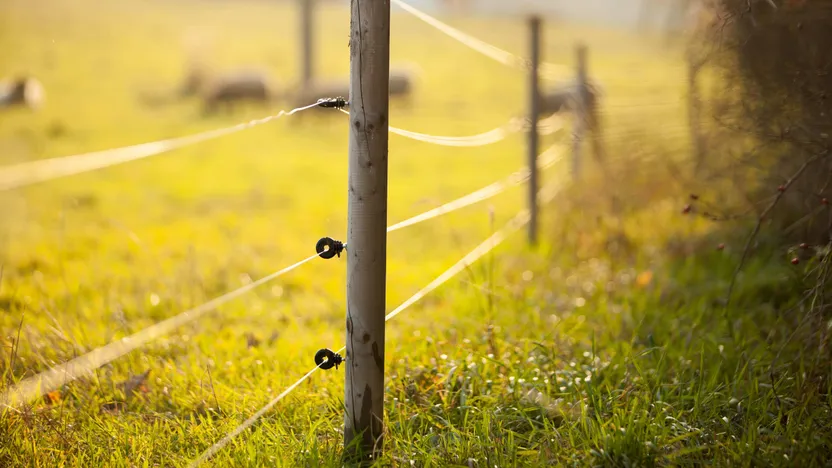
Electric fencing buying guide
'/%3E%3C/svg%3E)
Guide written on 6 February 2024 by:
John, Passionate gardener, Cambridge
Important features
- Wattage
- Voltage
- Conductivity
- Type of animal
Four main parts of an electric fence
An electric fence is made up of four parts all of which are essential for operation:
An energiser which generates electrical pulses.
Conductors (wire, rope, netting, etc.) which mark out the boundary for the animals.
Posts and isolators to prevent current leakage to the ground.
A ground stake or spike.
These components can be purchased individually or as part of an electric fence kit. Either way, it's important to be aware of a few essential parameters before you make your choice.
Electric fence kits
Energisers: the key component
The energiser is the most important component of electric fences. It works to transform low voltage electrical current (220, 12 or 9 volts) to a high voltage current with very low current.
You therefore need to take great care when choosing an energiser. Energisers are defined by two main ratings:
output energy;
output voltage.
Output energy in joules (J)
The output power or power of an energiser is the maximum amount of energy that it can deliver to the conductive material that makes up the fence. This value is measured in joules (J). The stronger the pulse, the more powerful the electric shock.
When purchasing an energiser, don't rely purely on the length recommended by the manufacturer. Instead, look at the output energy rating in joules.
Output voltage in volts (V)
This rating is given in volts (V). The energiser is designed to produce short pulses using high voltage. While a minimum voltage of 2500 volts is required, 4000 volts is usually recommended in practice.
Energisers, conductors and insulators
4 factors for choosing an energiser
There are four key criteria to study when purchasing an energiser.
1. How much power do you need for your animals?
Some animals (such as horses, cows, dogs and cats) are easier to contain than others (such as sheep, goats, chickens and wildlife).
Low power: for animals that are easy to keep in/out
Electric fences with low energy ratings (under 0.5 joules) are designed for animals that are easy to contain and small perimeter fences with little or no surrounding vegetation.
Medium power: for animals that are harder to keep in/out
Electric fences with a medium energy ratings (1 to 5 joules) are suitable for animals that are more difficult to contain and mid-sized enclosures with an average amount of surrounding vegetation.
High power: for animals in large enclosures
Electric fences with strong pulses (5 joules and above) have been designed to contain animals in large enclosures.
2. The length of the electric fence
The perimeter of the fence refers to the basic length of the installation and not the total length of the conductive material. Systems with multiple lines are able to transport current better over the same distance as long as the wires are linked at regular intervals (at least every 200 metres).
You will need 1 joule per mile of fence and at least 3000 volts from one end to the other.
3. Amount of surrounding vegetation
The denser the surrounding vegetation (e.g. tree branches or grass that come into contact with the fence),the higher the voltage required. Any plants that touch the conductor will lead the current back to earth reducing the power of the electrical pulses. It's important to note that manufacturers generally don't mention this parameter.
4. Type of power source
Energisers that run on mains power are more powerful and more cost-effective than battery-operated models. If you don't have access to mains power, you can use a 12 V battery but you will have to charge it regularly. A solar panel can be used to provide cost-free energy when the sun is shining.
It is also possible to find models that run on 9 volt non-rechargeable batteries. While these models are easy to use, they are the most expensive to run and offer limited power.
Electric fence conductors
Electric fence conductors come in rolls of varying lengths (200 m, 400 m, 1000 m, and so on).
How to choose an electric fence conductor
Conductivity: an essential factor
Copper yields the best performance in terms of conductivity. Stainless steel wires are more durable but provide inferior performance. Most conductors use a mix of both copper and stainless steel.
Generally speaking, conductive wires are described in terms of electrical resistance which is measured in ohms. This should be as low as possible and this is particularly important for long fences.
Electric fence visibility: protect your animals
Coloured lines (white, brown, green, yellow, orange, blue, etc.) make it easier for animals to see the boundary. This should help to reduce accidental shocks and limit stress.
Advantages and disadvantages of different conductors
Conductor type | Advantages | Disadvantages |
Metal wire (stainless steel, aluminium or alloys; 1.6 to 3mm in diameter) | Economical Very durable Suitable for large enclosures Fewer posts | Poor visibility Tricky to install Not suitable for moving enclosures Requires solid anchoring at first post and corner posts |
Rope and polywire | Fairly good visibility Easy to install Suitable for moving enclosures | Less conductive than metal wire Less visible than tape |
Tape | Very good visibility if 2 cm+ Easy to install Suitable for large animals (e.g. horses) | Wears quickly around isolators Risk of wind damage for widths of 4 cm+ White tape offers little UV resistance (opt for coloured tape) |
Netting | Good visibility for animals if brightly coloured Suitable for small and medium-sized animals (poultry, rabbits, sheep) Also suitable for protecting crops from pests | More expensive Tricky or lengthy installation; opt for spiked posts Only suitable for smaller enclosures |
Electric fence isolators and posts
The fence posts that support the conductive material can be made of wood, metal or PVC. Acacia wood is a great option as it is environmentally friendly, low cost and highly durable. Metal posts are more expensive. Corner posts need to be larger than those covering the length of the enclosure.
Special isolators have been designed with each type of post and conductor in mind. Avoid so-called multipurpose isolators. Isolators must not feature sharp edges or you risk wearing down the conductor prematurely.
The best isolators are made of polyamide. Black offers better UV resistance.
Electric fence accessories
Some electric fence accessories are just as important as the main components. These accessories have usually been designed to help you set up electric fences easily and safely. Here are a few of the most common accessories and their uses:
Fence post drivers for easy installation
Fence post drivers are used to drive posts into the ground effortlessly. Basically a metal cap with handles, a post driver is designed to be lifted and banged down on the fence post to drive it into the ground.
Tensioners: for a well-tensioned fence
Electric fence tensioners are used to apply the right tension to electric fences. Designed for larger wire fences, tensioners are used to link lines or fit them to posts safely.
Rotating tensioners for smaller wires
Designed thinner wire, rotating tensioners are made up of two brackets held in a rotating cylinder. The wires are held inside the tensioner and tightened when the device is turned.
Electric fence reels: for easy winding and unwinding
Electric fence reels help you to wind and unwind the conductive material evenly and prevent knots. They usually feature a crank handle for ease of use.
Gate handles: for easy access
These insulated handles are used to create a passage in the circuit to cross from one side of the fence to the other. They are mounted with a spring which may or may not be supplied with the handle.
Cut-out switch: to isolate a section of fence
A cut-out or isolating switch allows you to divide your fence into sections meaning you can work on one section without turning the energiser off.
Electric fence tester: to check your voltage
Able to test voltage up to 6000 V, electric fence testers are designed to check the voltage all around the enclosure. These devices usually run on batteries.
Connector clamps: for easy line connections
These conductive connectors are designed to clamp at two points in order to link electrical wires together. Simply position the lines between the plates of the clamp and tighten.
Warning signs: to avoid accidents
Safety signs are used to alert people to the presence of an electric fence. These signs must be clearly visible to neighbours and passers-by.
Electric fence accessories
Ground stakes or spikes
Electric fences are usually earthed by one or several galvanised metal spikes or stakes. It is important that these rods be free of rust and paint as both will act as isolators.
The high voltage delivered by energisers means that they need to be connected using special high voltage lines. Most importantly, the conductive material needs to be made from the same metal as the earthing stakes whether this is steel or aluminium.
Farming equipment
You may be also interested in these guides
Guide written by:
John, Passionate gardener, Cambridge
When I was young, I was already working in the family garden. Perhaps that is where my interest in plants and gardening came from. So, it was logical for me to study plant biology. At the request of various publishers I have, over twenty-five years, written many books on the subject of plants and mushrooms (a subject that is close to my heart). They were mostly identification guides at first, but shortly after they were about gardening, thus renewing the first passion of my childhood. I have also regularly collaborated with several magazines specialising in the field of gardening or more generally in nature. There is no gardener without a garden, I have cultivated mine in a small corner of Cambridge for the last thirty years and this is where I put into practice the methods of cultivation that will I advise you in as well.
'/%3E%3C/svg%3E)