Biomass heating systems: what are the options?
'/%3E%3C/svg%3E)
Guide written on 6 February 2024 by:
Sebastian, self-taught DIY-er, Exeter
Important features
- Fuel type
- Programming and automation
- Room heating or central heating
- Efficiency and performance
What is the environmental impact of biomass heating?
What is biomass?
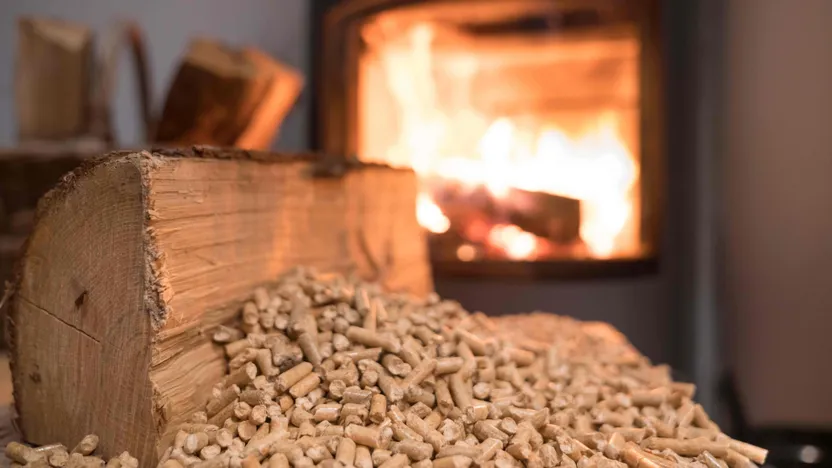
Biomass is a renewable energy source generated from burning organic matter. When it comes to home heating, biomass refers to a range of different wood-based systems which can be fuelled by logs, wood chips or wood pellets.
The main advantage of biomass heating systems is that they are fuelled by renewable materials rather than fossil fuels. These systems are also energy efficient whether you pick a basic wood burner, a pellet stove or even a biomass boiler. While a traditional log burner will be around 75% efficient, a pellet stove or boiler can be up to 95% efficient.
CO2 emissions of biomass
Biomass does emit CO2 when burned, but much less than fossil fuels like coal. However, biomass can only be considered a renewable and sustainable energy source as long as the material being burnt is properly managed (i.e. that trees are being replaced responsibly). For this reason, it is essential to ensure that your wood is properly sourced. If you buy wood pellets, only do so from a registered supplier.
A biomass boiler can save you 20 to 30% on your energy bill.
Biomass boiler
Which biomass heating system is right for me?
First of all, you should consider the heating requirements of your home, as well as the level of comfort you require from your heating system. After all, there's a big difference between using a pellet stove that can be controlled remotely from your smartphone and a log burner that you need to top up every few hours. The same goes for the role of the heating system. From a pellet stove designed to warm up a living room to a ducted stove intended to heat an entire house, the costs are at opposite ends of the scale. When it comes to installation, a boiler clearly won't have the same needs as a wood burning stove in terms of the type and amount of space required.
Questions to ask before investing in a biomass system
Are you looking to heat one room or the whole house? Do you have a back-up heating system? If you are looking to invest in a central heating system, do you already have radiators in place? What about underfloor heating?
Are you looking for an easy-to-use pellet stove or a traditional log burner? Do you want to be able to program your heating from your phone? Are you prepared to top up on a daily basis?
Where do you plan on installing the heating system – in the living room, in a specially designed storage space, in a garage or in an old fireplace?
Do you want to be able to cook over fire? Do you want the system to provide hot water or just heating?
Do you already have a chimney breast and is it up to standard? Are you looking to invest in a heat recovery system?
It goes without saying that there is a huge difference between a central heating pellet boiler installed in the garage and a luxury central fireplace designed to heat one room.
Fireplace
Biomass heating systems: the main options
Biomass heating systems can be used to provide:
central heating: in which case they are linked to an underfloor heating system or central heating radiators (i.e. a biomass boiler or pellet stove with a back boiler);
primary heating: in which case hot air can be taken from stoves through air ducts to heat other rooms (ducted stoves, etc.);
room heating: in which case, the wood burning or pellet stove only heats the room in which it is installed or to nearby rooms (through opening doors, etc.).
The main types of biomass heating systems on the market are as follows:
pellet boilers;
pellet stoves;
biomass boilers;
wood burning stoves;
wood burning cookers;
wood-burning fireplaces.
Hydro stoves can be fuelled by logs or pellets, and are compatible with water heating. Wood pellet stoves and boilers are compatible with heat recovery systems which reclaim heat from flue gases that would otherwise be wasted.
Flue
Pellet boilers
Faced with rising oil and fossil fuel prices, wood pellet boilers are gaining popularity in the UK. These boilers are energy efficient and require relatively little input from the user. They are designed to be used as central heating systems along with plumbed radiators or underfloor heating systems. As fully automated systems, wood pellet boilers offer incredible ease of use. They can also be connected to a hopper which can be filled with enough wood pellets to last an entire heating season. However, these boilers must be installed in a basement, garage or in a specially designed storage room because they do require a lot of space. Wood pellet boilers offer accurate programming and can often be controlled from a smartphone. Finally, these boilers are compatible with flue gas heat recovery (FGHR) systems.
Some pellet boilers are considered multi-fuel (meaning they can burn logs, chips or pellets) and are compatible with water heating.
Flue
Wood pellet stoves
Wood pellet stoves can be used to heat rooms or as a primary heating system. Basic wood pellet stoves are designed to heat individual rooms; ducted pellet stoves can be used as primary heating systems. Just like pellet boilers, pellet stoves are energy efficient. Depending on the type of stove, the set temperature and your own programmed settings, these stoves can run continuously for anywhere from 1 to 5 days. And just like pellet boilers, pellet stoves offer accurate daily programming and smartphone control. They are also compatible with heat recovery systems.
Hydro, or 'thermo', pellet stoves can be used for central heating but won't be as efficient as a boiler. They can also be used for hot water.
Pellet stoves
Biomass boilers
Like pellet boilers, these biomass boilers are designed to power central heating systems. However, they use logs or wood chips to do so instead of pellets. Connected to an underfloor heating system or radiators, these boilers can be used to both heat and produce hot water for an entire home. Contrary to wood pellet boilers, these boilers need to be topped up with logs or wood chips every day though some less common models do offer automatic top-up. Compared to pellet boilers, these boilers are less accurate when it come to programming. Depending on the individual features of the boiler, you can expect the system to be 60 to 90% efficient on average.
A log or wood chip biomass boiler will be less expensive to buy than a pellet boiler.
Biomass boilers
Wood burning stoves
Wood burning stoves, or log burners, are generally used as room heaters. Modern stoves are often equipped with a clean burn, or secondary combustion, system that helps to reduce emissions. Log burners are less efficient than pellet stoves and need to be topped up more frequently. You also need to invest in equipment like a companion set and log basket. The main advantage of these wood burners is that they add a lot of cosy charm to a room. As with the above options, they can potentially be used to provide hot water with a back boiler, though this is not common.
A secondary burn, or clean burn, stove is about 80% efficient.
Wood burning stoves
Wood burning cookers
Wood burning cookers perform two functions: they are used as a heating system and for cooking (oven and hob). They can be paired with a back boiler to heat water for domestic hot water or a central heating system alongside plumbed radiators or underfloor heating. Even if designed to heat only the room in which it is installed, a wood burning cooker will also heat any adjoining rooms by natural convection. Multifuel cookers can be fuelled by wood pellets for automated use and smart control.
Wood burning cookers are about 70 to 85% efficient. They can also be fitted with a back boiler for hot water.
Wood burning cookers
Fireplace inserts
Let's start by defining a couple of different heating systems that often cause confusion.
Fireplace inserts
Fireplace inserts are added to existing fireplaces. They are installed in older open fireplaces in order to turn them into a more efficient closed combustion systems. Unlike stoves, they are do not have legs and basically consist of a sealed firebox.
Inset stoves
Unlike fireplace inserts, which are generally used to renovate old fireplaces, inset stoves are built into walls or false chimney breasts. They tend to be used in new buildings which often do not feature a traditional hearth. Alternatively, you can choose a central fireplace designed to be placed right in the centre of the room or against a wall.
The efficiency of a fireplace insert or inset stove depends on the specific characteristics of each model including size, vent system and features like clean burn.
Fireplace inserts
UK wood burning appliance regulations
HETAS installation
Biomass appliances are subject to Building Regulations. This means that you do need to get in touch with your local authority if you intend to install the appliance yourself. Alternatively, you can have a HETAS-approved installer carry out the work. In this case, the person installing the stove will provide certification that the appliance conforms to code.
DEFRA approval
Bear in mind that if you live in a smoke control area and you want to install any kind of biomass stove or boiler you need to ensure you purchase a DEFRA-approved model. DEFRA certification ensures that the stove has been modified to minimise smoky combustion and can therefore be used legally in a smoke control area in accordance with the Clean Air Act (1993).
Biomass heating systems and energy efficiency
A biomass heating system can be use to make your home more energy efficient alongside measures such as improving your hot water system and insulation, and installing whole house ventilation and a high efficiency heating system. All together, these measures aim to lower energy consumption and reduce household greenhouse gas emissions.
More information
You may be also interested in these guides
Guide written by:
Sebastian, self-taught DIY-er, Exeter
Redo a roof with wooden beams? Check. Advise everybody in the DIY shop? Check. Redo bathroom plumbing? Check. If it doesn't work, try again! I'll do my best to advise you in your projects.
'/%3E%3C/svg%3E)