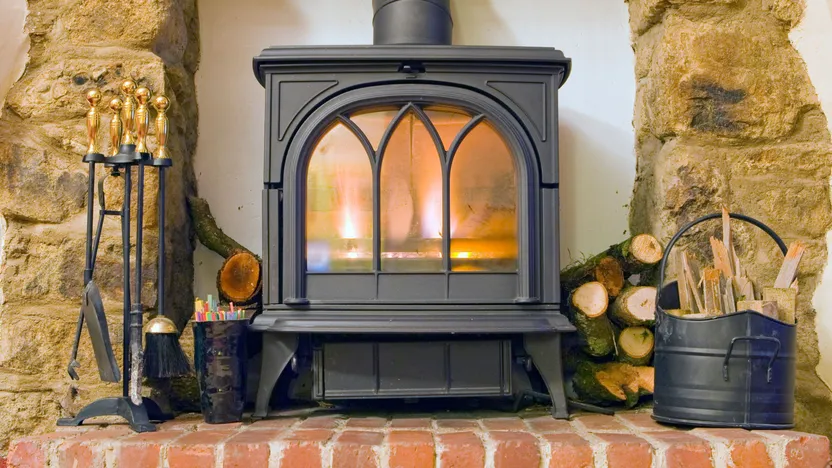
Wood burning stove buying guide
'/%3E%3C/svg%3E)
Guide written on 6 February 2024 by:
Sebastian, Self-taught DIY-er, Exeter
Best sellers in this category
Wood burning stoves: the basics
When setting out to choose a wood burning stove, you'll have to weigh up a few essential criteria. The key factors include whether you are looking to heat a house or a room and the volume and/or surface area of the space you want to heat. When it comes to picking a model, you'll have to think about performance and any additional features you might need.
Primary heating systems vs. room heaters
First of all, you need to think about what kind of wood stove you want:
if you are looking for a primary heating system, choose a catalytic wood burner or a heat storage stove;
if you just want a room heater, you can go for a basic log burner or a non-catalytic wood burner.
What heat output do I need from a wood burning stove?
The heat output of a wood burning stove depends on the quality of your home's insulation. Here are the basic heat requirements per m3 and m² for well insulated homes:
0.4 kW/m3 or 100 W/m² for a home with standard insulation (with a ceiling height of 2.5 metres or less);
0.24 kW/m3 or 60 W/m² for a very well insulated home (with a ceiling height of 2.5 metres or less).
Wood burning stoves: 6 performance indicators
In order to do its job efficiently, a wood burning stove must put out an adequate amount of heat. The heat output should be chosen to match the insulation and volume (in cubic metres) of the space you want to heat. Here are six indicators that should help you determine the performance of a wood burning stove:
heat output: generally measured in kW, this must be chosen to match the size of the space you want to heat;
efficiency rating: this refers to the difference between the energy a stove consumes and the energy it provides (efficient stoves generally start at 70%);
size of the firebox: this dictates burn times;
firebrick material: i.e. vermiculite (+), fireclay (+) or cast iron (++);
stove material: steel (less expensive but retains less heat) or cast iron (more expensive but retains more heat);
DEFRA exemption: required for stoves in smoke control areas.
Additional features for wood burning stoves
Wood burning stoves are designed to burn wood. However, multi fuel stoves can also be used to burn wood pellets. A range of additional features can make a stove more comfortable to use:
water heating (via wood boiler stoves or stoves fitted with back boilers);
oven and/or cooktop (wood burning ovens);
airwash glass system or ceramic glass;
hot air ducting;
air flow control to adjust the fire;
easy ignition and easy access ash tray.
Multi fuel stoves
What is a wood burning stove?
Let's start with a quick definition of a wood burning stove. A wood burning stove is a heating appliance that can be used as a room heater or as central heating to heat an entire home. Wood burning stoves all differ in terms of type, material, shape and design. Additionally, a variety of different specifications – including combustion type (e.g. secondary burn), heat output and efficiency ratings – mean that there's a wood burning stove to match every home.
Wood burning stoves are designed to burn different types of wood and various sizes of logs. This type of heating appliance should be installed by a professional and requires a chimney or twin wall flue for waste air extraction. A wood burning stove also needs regular maintenance including topping up with wood, cleaning out the ash tray and firebox, and sweeping the chimney.
Shop our wood burning stoves
Best sellers in this category
Different types of wood burning stoves
Already got central heating installed but want a secondary heating system for the living room or ground floor? A small log burner or a non-catalytic wood stove is the right option for you. Looking to install a wood burning stove as a primary heating system? The most common solution in this case is to install a catalytic wood burning stove. Another option is to install a heat storage stove which is designed to retain heat and release it gradually to the room. The main benefit of these stoves is that they run for longer with less input from you.
Basic log burners
A small log burner is best used occasionally alongside a main heating system. These wood burning stoves need to be topped up fairly often (they usually won't burn for longer than six hours) and can be made of cast iron or steel. Pay close attention to the recommended room size and efficiency rating. From rustic log burners to contemporary stoves, there's a style to match every home. But bear in mind that the most basic burners (under 5 kW) won't feature secondary burn.
Non-catalytic wood burning stoves
Non-catalytic stoves may also be known as clean burn stoves or double combustion stoves. These stoves feature a second adjustable air vent which injects air into the top of the fire box. This system means that gases pass through the primary combustion zone into a secondary combustion zone where any remaining gases are completely burnt off. These wood burners are therefore more efficient than basic wood burners and producer fewer emissions. This type of combustion also helps to reduce soot deposits in the stove and chimney. Available in a range of materials, these stoves can fit into both traditional and contemporary style homes.
Catalytic wood burning stoves
These wood burning stoves are generally the most economical of the options described above. They are designed to take the gases produced during the first combustion and burn them again in a second combustion chamber. These stoves also feature a catalytic converter which works to reduce pollutants by burning off virtually all the gases and particles released in the first combustion chamber. Eco-friendly and efficient by design, these stoves typically have an efficiency rating of about 80% or even higher. The more waste gas that is burnt, the less pollution there is meaning these stoves are also DEFRA-exempt.
Heat storage stoves
Heat storage stoves are large wood burners which boast long burn times of up to 20 hours. They are made of heat-retaining materials which helps the stove to preserve and convey heat long after the fire is put out. Most heat storage stoves can be loaded with long logs (up to 50cm) and are highly efficient. Heat storage stoves convey heat further than most other stoves.
Shop our wood burning stoves
Cast iron vs. steel wood burning stoves
Most wood burning stoves are made of cast iron or steel. Here is a quick run through of the advantages of each material.
Cast iron wood burners
Cast iron is a robust but heavy material making a cast iron stove tricky to install. This material is excellent at retaining and conveying heat evenly which can save you a lot of money in fuel.
Steel wood burners
Steel is lighter than cast iron, making a steel stove easier to install. Steel is less expensive than cast iron and heats up quickly. However, its performance is inferior to cast iron when it comes to retaining heat.
Fireplace fuel and lighters
Wood burning stove energy efficiency ratings
Energy efficiency is the difference between the energy a wood burning stove consumes and the energy it provides and is indicated as a percentage (%). Wood burning stoves tend to have an efficiency range of 50 to 80%. The higher the efficiency rating, the less fuel the wood burner consumes meaning the more economical and eco-friendly the stove. Any wood burning stove with an efficiency rating over 70% can generally be considered efficient.
That said, a good quality stove should be around 80% efficient. In real terms, this means 80% of the heat that is being produced by the stove is being used to heat the room. The higher the efficiency rating, the more economical the stove is to run.
Shop our wood burning stoves
Wood burning stove UK certifications
What is HETAS?
HETAS is the UK's official body for testing and approving solid fuel domestic heating appliances. It works to ensure the safe installation, operation and maintenance of wood burning stoves and boilers.
What is a DEFRA-approved appliance?
DEFRA (the Department for Environment, Food & Rural Affairs) is the part of the government responsible for limiting air pollution. Some parts of the UK are subject to smoke controls meaning a traditional wood burning stove cannot be installed. Most of these areas are found in built-up towns and cities.
A DEFRA-approved appliance can be used to burn firewood in a smoke control area.
These stoves have been rigorously tested to ensure they meet the government's criteria for emission levels. This generally means that the stove has been modified by the manufacturer to limit the amount it can be starved of air which is what creates smoky combustion.
DEFRA-approved stoves don't produce unnecessary smoke meaning they comply with the Clean Air Act.
If you are unsure whether or not you live in a smoke control area, contact your local council for more information.
Don't get caught out purchasing a wood burning stove you aren't allowed to use! Be sure to keep up to date with regulations concerning wood burning stoves as these can change.
Shop our wood burning stoves
How to size a wood burning stove
Picking the right heat output for a wood burning stove means selecting an appropriately sized heating appliance for the space you want to heat. Heat output is tested and regulated according to standards BS EN 13229 and BS EN 13240.
The heat output of a wood burning stove is given in watts (W) or kilowatts (kW) (1000 W = 1 kW). The heat output required from a stove depends on the volume of the space you want to heat which is measured in cubic metres (m3). A room may also be measured in surface area which is given in square metres (m²). The heat output of a stove affects how much fuel it requires.
Picking the right type of heat output is essential if you want to heat your home properly. There's no point in getting a wood burning stove that is too powerful nor to hope that a powerful stove will make up for poor insulation. There are two basic methods for calculating the heat output of a wood burning stove and this largely depends on the quality of your home's insulation.
Homes with standard insulation
For homes with a fairly good level of standard insulation, you'll need 0.1 kW (or 100 W) per m². For example, to heat a home measuring 100 m², you'll need a 10 kW wood burning stove (provided your ceilings measure no more than 2.5 metres in height). For more accurate results (for example, if you have higher ceilings), you can work out the heat output by volume in which case you'll need 0.04 kW per cubic metre (m3).
Homes with high-quality insulation
For very well insulated homes, you'll need 60 W per m² or 0.6 kW per m². For example, if you are hoping to heat 100 m², you'll need a 6 kW stove. If you want to work out heat output by room volume (e.g. for ceiling heights over 2.5 metres), calculate 0.024 kW per cubic metre (m3).
Fireplaces and stoves
Firebox size and firebrick materials
The firebox is the part of the stove that holds the wood. The size of the firebox dictates the size of the logs it can hold which, in turn, affects burn time. Burn times and heat output are also affected by the type of wood used. For example, oak (a deciduous hardwood) has a higher calorific value and a longer burn time than any type of conifer (i.e. softwood).
Generally speaking, a wood burner should be able to run for any time between 6 and 12 hours. Never overestimate the size of firebox you need. With regards to heating performance and emissions, it is always better to have a steady fire going in a small fire box rather than a slow fire burning in a large fire box. This will also help to keep soot deposits down. Of course, the best option is to get a wood burning stove with just the right firebox volume for your home and heating requirements.
The firebox can be formed of firebrick (like fireclay brick or vermiculite) or cast iron. No matter the type of material used, the role of this part is to protect the firebox and help to distribute heat.
Vermiculite firebricks
Vermiculite offers high-quality insulation, quick heat-up times and decent heat retention. Vermiculite firebricks are also lightweight.
Fireclay bricks
Fireclay is a shock- and scratch-resistant material but has an average level of insulation compared to vermiculite. Fireclay bricks are fairly heavy.
Cast iron firebricks
Cast iron firebricks offer the best characteristics of all. Cast iron retains heat well, and offers optimum levels of insulation and efficiency. Cast iron firebricks are very heavy.
Advantages and disadvantages of a wood burning stove
One thing is for sure – the cosy charm of a burning wood simply cannot be beaten! From maintenance to comfort, here is a quick run through of the main pros and cons of wood burning stoves.
Advantages of a wood burning stove
Wood is considered by some to be a renewable and environmentally friendly energy source. It can be affordable depending on the type of wood you use, how it is cut, the quantity you purchase and where you live. Bear in mind that the smaller the logs, the more expensive they'll be. Your choice of firewood affects how dirty your stove gets as well as the burn times of your stove. That said, the calorific value of woods per weight doesn't vary much.
The heat produced by a wood burning stove is concentrated and pleasant, and the smell of burning wood evokes cosy winters indoors. The flames produced by a wood burning stove vary depending on the type of wood being burnt and the air flow to the firebox. A wood burning stove can be considered part of a home's décor and is only enhanced by the spectacle of the flames themselves.
The highest quality wood burning stoves can be very efficient. Depending on the type of stove, and its heat output, you can use a wood burner as a primary heating system or a room heater. It's important to position your wood stove correctly the heat produced is conveyed directly to the room. Wood burning stoves can produce heat by convection (with the addition of ducting) as well as radiant heat (which is emitted by the stove itself as it releases stored heat).
Disadvantages of a wood burning stove
A wood burning stove must be lit and refuelled on a daily basis and the ash tray must be emptied regularly. All wood burning stoves produce fumes which must be extracted via a chimney or balanced flue system meaning regular chimney sweeping is also necessary. Wood burners are bulky appliances and take up a fair amount of floor space. What's more, the flue system isn't always particularly attractive.
Wood itself also takes up a lot of room. You need a space to store the wood and protect it from the elements. Wood deliveries are usually measured in cubic metres and come in bulk bags.
Wood burning stoves have to be installed in accordance with safety regulations – this is especially important if you have children. A wood burning stove releases concentrated heat in the area directly surrounding it meaning the temperature in the room in which it is installed is often higher than in other rooms where the heat is distributed via ducting.
Fireplace fuel and lighters
Heat storage stoves
Heat storage stoves are a big investment. These heavy and solid stoves gather heat before releasing it gradually using special heat-retaining materials (e.g. lava rocks or firebricks). These materials work to store energy and release radiant heat. This means that two to three hours of burn time can heat your home for eight to twenty hours depending on the stove. A heat storage stove can reach temperatures of up to 1000°C as it heats up. The downside of these stoves is that they are heavy and bulky. They can weigh up to 1000 kg (1 tonne) and take up as much as 1.6 m3.
Dimensions, burn time, heat output and efficiency
Once you've decided which type of wood burning stove you need, you can then move on to factors like burn time, heat output and efficiency. Be sure to choose a stove that meets your heating requirements!
1. Wood burning stove size
The size of a wood burning stove depends in part on the material it is made of. Wood burners come in all kinds of sizes. Height can range from 80 to 22cm. Width can range from 48 to 65cm and depth can measure as much as 70cm.
2. Burn time
The burn time of a wood burning stove is important since it dictates the number of times you need to refuel and the length of time you can be away from the stove before the fire goes out.
3. Heat output
Heat output is essential to get right or else you run the risk of overheating or underheating a space. Follow the manufacturer's recommendations closely. It's also important to calculate the volume of your home accurately and to have a good idea of the quality of your home's insulation.
4. Efficiency
Efficiency is an easy factor to evaluate – the higher the efficiency rating, the more economical the stove! Look for a HETAS approved retailer for the guarantee of a safe and efficient stove.
Steel vs. cast iron wood burning stoves: which is best?
A couple of different materials can be used to construct wood burning stoves. The material used – most commonly steel or cast iron – affects both style and usage. Some stoves are better at retaining heat while others have the edge on style. It's up to you to decide but rest assured, some wood burners offer the best of both worlds!
Steel construction
It's worth noting that steel does offer better value than cast iron and it is also a lighter material. Steel is used to make more cost-friendly stoves.
Cast iron construction
Cast iron is better at retaining heat and is much heavier than steel. These two materials are often combined which offers a great compromise between efficiency and style.
Wood boiler stoves: water heating and home heating in one
Some wood burning stoves can also be used to provide your home with hot water. Wood boiler stoves are designed to heat up water which is then fed into a storage tank. A special system is used to monitor the temperature and pressure of the water. This system incorporates an expansion vessel and pressure relief valve to monitor pressure, a temperature valve to control temperatures and a pump to circulate water and prevent corrosion.
The hot water produced can be used to feed a central heating system or to supply hot water taps. This type of system can help you to make real savings and lower your consumption of gas, oil or electricity.
Additional features for wood burning stoves
Wood burning stoves may come with a range of additional features designed to improve user comfort, such as:
access to the ash tray while the stove is burning;
airwash technology to prevent soot build-up and make the glass easier to clean;
an easy ignition system;
reduced CO2 emissions;
an adjustable air vent to control flames; can be controlled manually, automatically or even using a thermostat;
ceramic glass;
some types of multifuel stoves can be fuelled with logs and wood pellets. More commonly used to fuel wood pellet stoves, wood pellets are generally supplied in 15kg bags and are easier to feed into a stove than logs.
a blower can be used to better distribute heat (in which case, we refer to a ventilated wood stove);
a wood burning oven can be featured alongside the stove to heat the home at the same time as you cook. Alternatively, you can purchase a wood burning cooker.
Pellet stoves
How to install a wood burning stove
Wood burning stoves come with several installation requirements and it is important to think about this before purchase. The following criteria must be considered:
the flue in terms of diameter, pipe design (i.e. straight, with elbow, etc.), pipe type (i.e. insulated, twin wall, etc.) and the position of the stove itself (e.g. against a wall, in the middle of a room);
flues and chimneys must adhere to UK building regulations;
wood burning stoves need to be installed away from walls (usually around 30 to 45cm depending on the type of stove) and any combustible surface. Flues also need to be installed in accordance with building regulations since they also emit heat;
the floor must be solid and able to support the weight of the stove. It should also be made of a fireproof material. Wood burners require an air vent in the room in which they are installed (unless you have a stove with a nominal output of less than 5kW and your home was built before 2008).
Flue kits
6 steps to choosing the right wood burning stove
1. Stove type
Choosing the right type of wood burning stove is essential if you want to enjoy the most efficient heat output for your home.
2. Efficiency
An efficient stove will save you money in the long term as the stove will cost less to fuel.
3. Heat output
Selecting the correct heat output ensures you do not underheat or overheat your home. Heat output is provided in kW per cubic metre or watts per square metre. Depending on the heating technology and the stove material, 10 kW should more than suffice to heat 100 m².
4. Firebox size
The size of the firebox dictates the size of logs you can use which directly impacts the burn time of your stove. Go for a bigger firebox if possible and pay close attention to the burn times indicated in the product specifications.
5. Materials
Wood burning stoves come in different materials and this affects the stove's ability to retain heat. Cast iron retains heat better than steel.
6. DEFRA exemption
If you live in a smoke control area, you can only install a DEFRA-approved wood burning stove.
What do I need to run a wood burning stove?
Burning wood is almost a lifestyle in itself. Put safety first by installing smoke detectors and carbon monoxide monitors in every room. These safety devices don't cost a lot but are essential for preventing the risk of something going wrong and protecting your safety. A range of stove and chimney equipment can be purchased to make your stove safer and maintenance easier. This includes things like fire guards, log buckets, ash shovels, heatproof shields, glass cleaner, companion sets and ash vacuum cleaners.
Companion sets
Energy efficiency
Replacing an old stove with a highly efficient stove can help to make your home more energy-efficient alongside measures such as improving your hot water system and insulation, and installing whole house ventilation. All together, these measures aim to lower energy consumption and reduce household greenhouse gas emissions.
More information on heating
For more information on heating and heat pumps, check out the following guides:
More information on wood burning
Companion sets
More information on air conditioning and ventilation
More information on home heating
You may be also interested in these guides
Guide written by:
Sebastian, Self-taught DIY-er, Exeter
Redo a roof with wooden beams? Check. Advise everybody in the DIY shop? Check. Redo bathroom plumbing? Check. If it doesn't work, try again! I'll do my best to advise you in your projects.
'/%3E%3C/svg%3E)