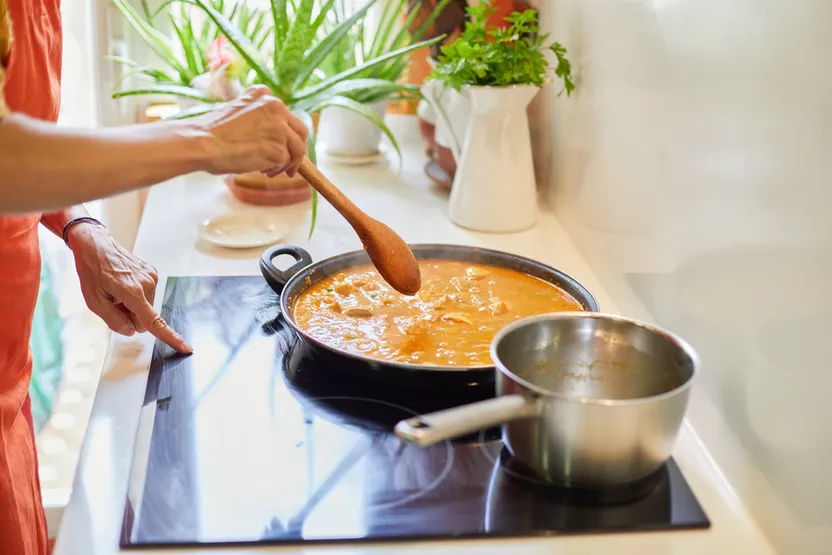
Hob buying guide
'/%3E%3C/svg%3E)
Guide written on 6 February 2024 by:
Anne, Painter
Best sellers in this category
How do hobs work?
The type of energy supply to your house and the existing facilities will determine which type of hob you can choose from. Some houses have a gas supply which is normally also used to heat water and for central heating, while others are only supplied with electricity.
Most UK homes now use electric ovens in the kitchen, although many still have a gas supply, meaning you can choose which type you prefer.
Choosing your hob based on the type of energy used
How your hob works will depend on the energy source used, which reveals the different types available.
With gas, this reaches the burners through pipes. Using the control knobs, the gas flows and a spark (either from a mechanism built into the cooktop or from a lighter) ignites the gas to produce combustion. The flame resulting from this combustion provides instant heat to the pan containing your food.
A ceramic hob features various elements under the ceramic glass surface, one per burner and each with a different size, which are operated using manual (like a gas hob) or digital controls, heating up and radiating heat through the glass. The heat intensity is controlled with the knobs or buttons. Many models also have a timer, as well as other functions.
As for induction hobs, these work on an electromagnetic field between the hob and base of the pot or pan. The hob itself doesn't heat up, but it does heat the metallic pots and pans.
Induction hob
Types of hob
Choosing a hob according to the type of energy it uses will depend on the existing utility supplies to the house. However, you don't have to use a gas stove if you prefer to use electricity (although that isn't generally true the other way around). All you need to do is to block off the gas supply - with the help of an expert - and install an electric hob instead of a gas one.
Electric hob
Best sellers in this category
Gas hobs
Gas hobs are the most traditional and common model. Although most UK households have a gas supply, the trend is moving towards using electric hobs.
Modern hobs have an anti-ignition switch and automatic shut-off to prevent gas from being emitted when the flame goes out. There are also new finishes, such as glass, that makes them easier to clean.
The advantages of a gas hob are that they are easy to use and control, as you only have to turn the knobs for a stronger or weaker flame. All different types of pots and pans can be used with them and they maintain an even temperature. They also consume less energy and tend to be lower in price, although there's not much difference compared to the cheapest ceramic hobs.
Ceramic hobs
Ceramic hobs
These are most suitable for homes with no gas supply, however they're becoming more widespread and slowly replacing older types of stove. They tend to go together with an electric oven, meaning it's easier if both appliances are electric, rather than using different sources of energy.
Available in both manual and digital formats, the touch controls are built into the glass. They come with a range of functions, such as several heat settings or independent ones for each burner. One practical function is the safety lock feature which is used to set the programme so it remains unchanged, or to prevent the hob from being turned on and avoiding burns.
The advantages are the easy-to-clean surface and the temperature controls, although it's a bit more difficult to calculate cooking times, especially if you're used to a gas hob. Once it's turned off, the residual heat can be used to finish cooking. They are also affordable and look sleek.
Induction hobs
Induction hobs are an electrical alternative to ceramic hobs. As we've already mentioned, the main difference lies in the technology used, with the former generating a magnetic field under the glass, and the latter using electrical elements.
They also look very similar and are easy to mix up because of their smooth surface.
The main advantage is that they use less electricity (around 40% less) and are more energy-efficient, meaning you save money off your bills. They are also safer because they don't heat up, thus avoiding the risk of burns. As they're cold, food doesn't get stuck - also making them easier to clean.
The drawbacks are the higher price point and the fact that you either need specific pots and pans (with an iron or stainless steel base) or to use an adaptor. However, it's getting much easier to find pans suitable for all types of hob.
Dual fuel hobs
Although not so common, some hobs are available that combine gas and electric burners. This gives you the best of both worlds, depending on what fuel supply you need each time you're cooking.
Solid plate hobs
Solid plate hobs use electricity to heat any type of pan. Although these are one of the cheaper models, they do take longer to heat up.
Additional options
Some of the more technologically advanced hobs come with built-in low-noise extractor fans, making them ideal for kitchens that need to make the most of wall space, or just to improve the overall look. Also, you get two appliances in one.
Hob comparison
Hob type | Pros | Cons |
Gas hob | Easy to light and use Used by professionals | Cannot be used in homes without a gas supply Difficult to clean |
Ceramic hob | Easy to use and clean Affordable | More energy intensive than induction hobs |
Induction hob | Heats up quicker than a ceramic hob (lower consumption) No energy loss because the pot heats up, not the hob. | Requires special pots and pans, or adaptors |
Other hob selection criteria
Hob sizes
As with other appliances, the standard dimensions match kitchen cabinet sizes, in other words 60 cm. However, modular hobs are available measuring 30 cm. These are suitable for small kitchens in flats, and also come in larger sizes in increments of 10 cm (70, 80, or 90 cm).
Kitchen style
Style can also play an important part when it comes to choosing your hob, because the different types will suit certain colours or finishes better. Black, stainless steel, glass... nowadays there's plenty to choose from when it comes to hobs.
Number of burners or cooking zones
Modular hobs can have from 1 to 2 burners, and up to 5 for other models. The most common format is either:
4 burners (1 small, 14 - 20 cm diameter; 2 medium, 21 - 24 cm diameter; and 1 large, 28 - 32 cm diameter)
3 burners (1 small, 1 medium and 1 large).
The more modern induction hobs feature a flexi-induction function, which consists of several connected cooking zones to make one large, more versatile zone when it comes to using pots and pans and making the most of the heat source.
Cleaning
There are other, more important factors to take into account when choosing the most suitable type of hob.
However, it's worth keeping in mind that gas hobs require more cleaning than electric models because bits of food tend to stick to the burners, which need to be kept obstruction-free for the gas to flow properly. A scouring sponge with some soap will usually do the job.
For ceramic or induction hobs, these can be cleaned with a damp sponge or cloth, using a product specially designed for them. Regarding ceramic hobs, there is also a special scraper tool available to remove the remains of stuck-on food, but be careful not to scratch the hob surface. The advantage of induction hobs is that food doesn't stick to them, because the surface doesn't heat up.
Budget
If you're on a tight budget, a basic gas or ceramic hob is best, as they come in at around £100. These are the best option for a second home or rented flat.
If you can afford a bit more, and also want to invest in your kitchen, then opt for an induction hob. These tend to have a wider price range, starting at £200 and reaching up to £500 or more, if they come with the most advanced features. If you're doing a full kitchen makeover, why not treat yourself?
Safety
Preventing the risk of burns is a plus point in homes with children and the elderly. In these cases, hobs with automatic switch-off and safety locks are ideal.
Remote smartphone control
Although this feature might exceed the basic needs of your appliance, in a not-too-distant future in which all appliances will be connected, it's something to keep in mind.
Induction hob
Choosing a hob based on energy consumption
White goods are responsible for a large part of energy consumption in the home (a hob accounts for around 9% overall). It is therefore becoming increasingly important to have energy-efficient appliances.
Electric hobs consume less energy than a gas hob, but depending on the frequency of use and electricity rates at any given time, it's good to crunch the numbers.
Hobs don't have energy labels, although that doesn't mean that they don't have to comply with UK or EU eco design requirements for domestic ovens, hobs and cooker hoods. If the hob comes with an extractor function, that would also have its own energy efficiency label.
How to recycle hobs
As with other household appliances, hobs can be recycled at a local household waste recycling centre or contact your local council to have it collected.
You may be also interested in these guides
Guide written by:
Anne, Painter
After 8 years of trade, I turned professional: I trained myself to be a painter and carpet fitter, either on my own or with 16 year old comrades. 9 months later, following vocational training, I created my company. I’m a self-taught DIYer and decoration enthusiast, I love to find and restore furniture and to create unique decoration pieces. I completed the renovation of my sister’s house with my niece: electrics, tiling, plasterboard...we did it all. And today, if I can share my experience I'm happy to do it. Good Luck.
'/%3E%3C/svg%3E)