Camping stove buying guide
'/%3E%3C/svg%3E)
Guide written on 6 February 2024 by:
Sebastian, Self-taught DIY-er, Exeter
Important features
- Butane, propane or LPG
- Type of stove
- Use
- Material
- Power rating in watts (W)
- Number of burners
- Number of valves
- Number of rings
Best sellers in this category
Why buy a camping stove?
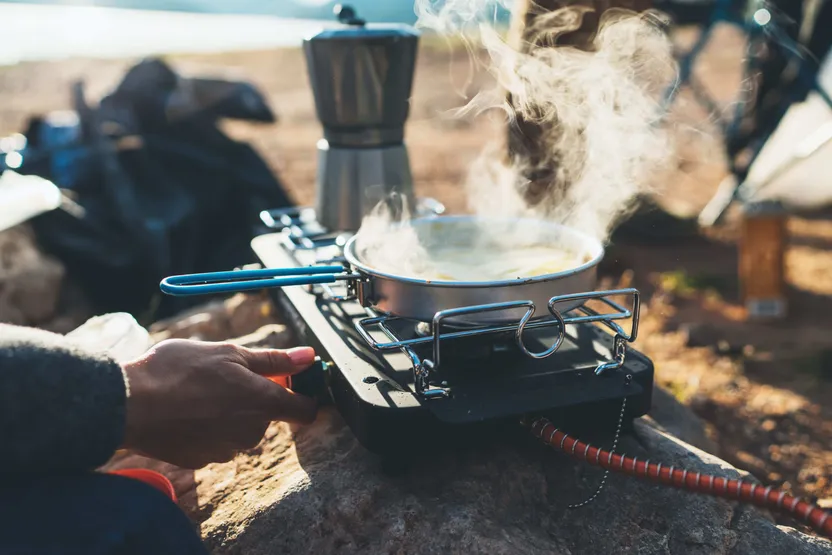
Like barbecues and plancha grills, camping stoves are designed for cooking outdoors and/or occasional cooking-on-the go. Camping stoves can be used for camping, backpacking, dining in the garden, or even for organised events.
Portable gas stoves: powerful, light and compact cooking appliances
One of the main advantages of portable gas stoves is how light and compact they are, meaning they're super easy to transport.
Thanks to their efficiency, portable gas stoves can be used to cook a broad range of dishes.
Additionally, as with any gas hob, the power of the stove is adjustable.
With many portable gas stoves, you can connect and disconnect the gas supply as often as necessary. This way, the burner can be stored away safely when the stove is not in use. This will also reduce the risk of gas leaks.
Use in extreme conditions
Today, there are many different types of portable gas stove available on the market that are suitable for use in adverse weather conditions.
Some portable gas stoves offer excellent efficiency even in extreme cold.
Shop our camping stoves
Which fuel to use with your portable gas stove
Portable gas stoves use a variety of different fuels. Note, however, that each appliance works on a specific type of fuel and must not be used with any gas other than the one indicated:
Butane is not suitable for temperatures below 0°C;
Isobutane is fairly resistant to the cold and can be used up to - 12°C;
Propane offers optimal resistance to cold and can be used in temperatures of up to - 40°C;
Natural gas is used for indoor gas stoves which can be connected to the mains
LPG, or Liquefied Petroleum Gas has a higher energy value for the same volume.
Best sellers in this category
Different types of camping stove
There is a wide range of portable gas stoves available to choose from according to your needs.
Backpacking and camping stoves
Available in two versions:
one is small and light, and works with a C 206 type aluminium canister;
the other looks like a small single-burner hob that works with a returnable gas bottle with 901, 904 or 907 valve types.
Portable gas hob
Like camping stoves, these look like a mini-hob with two or three burners.
They work with a returnable gas bottle with 901, 904 or 907 valve types, or with 8 kg and 13 kg bottles.
Paella burners or tripod gas stoves
Suitable for extended use and with large pots. Compatible with 901, 904 or 907 gas bottles, and 13 kg bottles.
Tripod stoves feature several valves that connect to various burners located on the same hob, letting you increase the heating capacity.
Criteria for choosing the right portable gas stove
When it comes to choosing your portable gas stove, different criteria need to be taken into account in line with your needs.
Size and weight of the stove
If you're planning to take your portable gas stove with you on hikes, choose a model that is small and light and easy to carry in a backpack (stoves with C 206 type canisters).
Number of burners or rings
Depending on the number of users and type of use it will be given, a portable gas stove features differing numbers of rings.
For use when camping or other outdoor activities, opt for a stove with two or three rings.
A stable stove with a cover is ideal (a stove with returnable 901, 904, 907 gas bottles, although it will also work with a standard 13 kg gas bottle, as well as other smaller cylinders or canisters).
Heating capacity
The heating capacity of a stove is expressed in watts (W). The higher this value is, the more heat energy the gas stove releases, meaning it heats up more.
The heating capacity is adjusted by either opening or closing the valves (tripod stove), or by turning the controls (gas hob) or a knob (small camping stove).
The most powerful portable gas stoves reach over 9000 W.
Portable gas stove: stainless steel, cast iron or enamelled steel
Portable gas stoves are made from a variety of materials:
stainless steel - for extra easy maintenance and enhanced durability;
cast iron - sturdy and shock-resistant. Mainly tripod stoves;
enamelled steel - strong and more affordable than cast iron.
Stability: tripod stoves or four-leg stoves
If you don't have any limitations on space and/or weight and to reduce the risk of accidents and burns, go for a totally stable portable gas stove.
Pick a model with four legs to guarantee optimal stability.
Portable gas hobs are the most stable.
Connecting your stove to the gas supply
Portable gas stoves can be connected in several ways:
via a safety valve, allowing the gas canister or bottle to be connected and disconnected as many times as necessary;
mounted on top of the canister. One-off assembly - once the canister is empty, it should be discarded;
with a hose connected via a regulator to the gas bottle.
Using a camping stove safely
Like any appliance that runs on gas, using a gas stove requires constant monitoring.
It is essential to keep children away from gas stoves, as these appliances feature open flames.
When used in the wind, it's vital to check for a flame.
Stoves that are connected via a gas hose and regulator require particular attention, as the hose can wear out.
Do not use your stove for other purposes and only use the type of gas indicated.
Gas bottle hoses
You may be also interested in these guides
Guide written by:
Sebastian, Self-taught DIY-er, Exeter
Redo a roof with wooden beams? Check. Advise everybody in the DIY shop? Check. Redo bathroom plumbing? Check. If it doesn't work, try again! I'll do my best to advise you in your projects.
'/%3E%3C/svg%3E)