How does a solar panel work?
'/%3E%3C/svg%3E)
Guide written on 6 February 2024 by:
John, DIYer & IT developer, Brighton
Important features
- Components
- PV cells
- Atoms and electrons
- Direct current and alternating current
Best sellers in this category
What is a solar panel made of?
Solar panels produce electricity using photovoltaic (PV) cells which are set up in series or parallels. A single one of these cells can produce about 0.5 V.
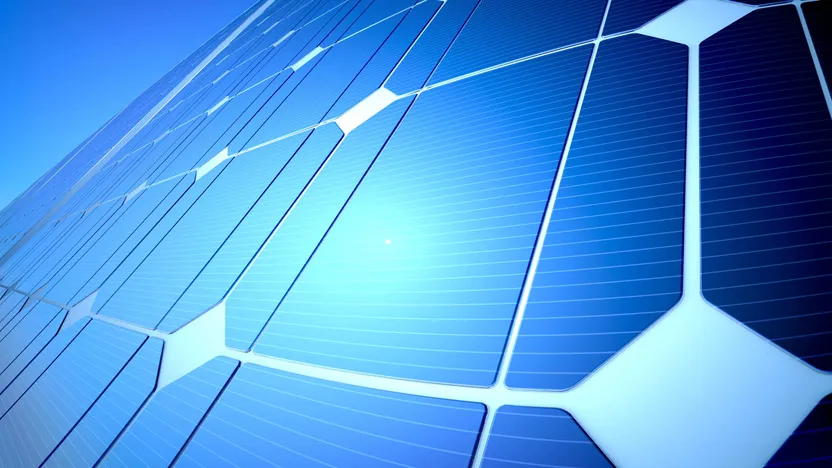
Over these cells is a glass panel which allows the sunlight, and the energy contained within it, to reach the cells. The cells are also connected to an encapsulant which protects the assembly. The whole panel is surrounded by a frame which provides shock protection. Solar panels are easy to recognise as their cells form a grid-like pattern and the material that makes up the cells has distinctive blue-grey flecks. A cable outlet in the frame delivers direct current at a constant voltage.
Solar
Solar panels and atoms: the science of solar power
Without going too far into detail, let's delve quickly into what exactly happens within the layers of material that make up a solar panel. To get to grips with the science, remember that an atom consists of a nucleus orbited by a shell of electrons. The physical properties of the atom depend on the number of electrons moving around the atom.
These physical properties determine the atom's ability to combine with other atoms to form molecules, crystals or ions. An electrical current is produced as the electrons move around from one place to another.
Solar
Best sellers in this category
Photovoltaic cells and semi conductors
Photovoltaic cells, or PV cells, are made up of the same kinds of semi conductors that are found in various electronic components. Semi conductors feature a unique electron structure in that they have four electrons in their outer orbital which is referred to as tetravalency. These electrons have the ability to form bonds with neighbouring atoms to create a crystal formation, known as a lattice.
The main principle in manufacturing semi conductors is to introduce carefully chosen impurities into this lattice structure in a process known as doping. If atoms with three electrons in its outer orbital are inserted into this crystal, there will be an electron deficit. The absence of an electron creates a positive charge and this process is known as P-type doping. Conversely, if atoms with five electrons in their outer orbital are added, there is an excess of electrons. The electrons have a negative charge and this is known as N-type doping. If you put N-type and P-type silicon together, you create a PN junction . At this junction, there is a negative charge on one side and a positive charge on the other which creates an electric field.
How does a PV cell work?
PV cells basically consist of a PN junction with an electrical contact on the top and one on the back. Particles of solar energy, known as photons, hit the N-type conductor material. These photons transmit their energy to the electrons which then come loose from the nucleus around which they gravitate.
The electric field created by the PN junction then pushes the electrons towards the front metal contact. The electrons then circulate through the electrical circuit to which the panel is connected before returning through the back electrical contact where they are attracted back to the nucleus.
Solar
Transforming DC into AC current
The voltage and power of a solar panel depends on the number of PV cells in a panel which are set up in series and parallels. These cells produce fairly constant voltage which makes solar panels suitable for tasks like recharging batteries or powering a camper van. However, to use this current in the home or to sell it back to the grid, you need an inverter which transforms DC current into usable 230V 50 Hz AC current.
Wind and solar power equipment
More information
You may be also interested in these guides
Guide written by:
John, DIYer & IT developer, Brighton
Since I was a child, I was always interested in manual and technical work. Always fascinated by woodworking, I took advantage of my first flat as a playground. On the cards: electricity (of course, safety first!) and some partition walls; but also decorating with the help of the missus, made-to-measure furniture and little tricks to optimise the space, all the while remaining as original as possible. When the little one arrived, I started building bits and pieces for him! Lacking space, I have not got a permanent workshop and certain tools I dream about are not part of my collection. Not to worry, I already know a lot about DIY and I have a high-tech profile that I hope will guide you in your decisions!
'/%3E%3C/svg%3E)