Solar panels for caravans, motorhomes and boats: what are the best options?
'/%3E%3C/svg%3E)
Guide written on 6 February 2024 by:
John, DIYer & IT developer, Brighton
Important features
- Calculating watt peak
- Amorphous silicon solar panels
- Polycrystalline or monocrystalline solar panels
- Inverters and solar charge converters
Best sellers in this category
Why fit your campervan or motorhome with solar panels?
In a motorhome, caravan or boat, a leisure battery can be used to power on-board electrical devices required for essential activity. However, once you start to think about powering larger appliances (such as fridges or TVs), a second source may be required since as soon as you leave the port, or you're not parked at an electricity point, your only option is to rely on the battery. Batteries not only have a limited life and capacity, they must also be charged regularly by your vehicle's alternator which operates while the engine is running. To give you an idea of how long these batteries take to charge, a campervan can provide 6 to 10 Ah per hour which means it would take approximately 10 hours to recharge any battery with a capacity of over 100 Ah. Using a generator can be a good way to get off-grid power. However, generators are bulky, require fuel and, above all, noisy. With few alternatives available, the most cost-effective and comfortable solution is often to install solar panels.
Generators
Solar panel power output: how much do I need for an RV or campervan?
It is important to work out the amount of electricity you need the solar panels to produce in order to comfortably meet your energy needs. Not powerful enough and you're back to where you started: you'll need to connect to mains power or turn on the engine to recharge. All that effort for nothing! On the other hand, go for more power than you need and you'll never be short of electricity which, of course, is a great thing. However, installation will be expensive and your panels will take up more space than necessary which will increase the weight of your vehicle. Not ideal when space is limited! To work out how much power you need, you will have to add up the total amount of power drawn by each appliance in watts (W) and multiply this number by the number of hours of use per day. Add on about 15% to account for losses during battery storage and for the conversion of 12 V DC power into 230 V AC power. Once you have worked out how much power you need, you just need to figure out the power output of your solar panels. Solar panel power is generally given in watts-peak (Wp). On average, a solar panel rated 100 Wp will produce around 100 Wp a day in winter and about 400 Wp in summer. For a 12 V solar panel system, this will provide about 9 to 36 Ah. Of course, a solar panel will be most efficient when it is full south-facing at a tilt angle of 35° from the horizontal in a part of the country with a high number of sun hours.
Best sellers in this category
Parts of a solar panel kit
Solar PV panels
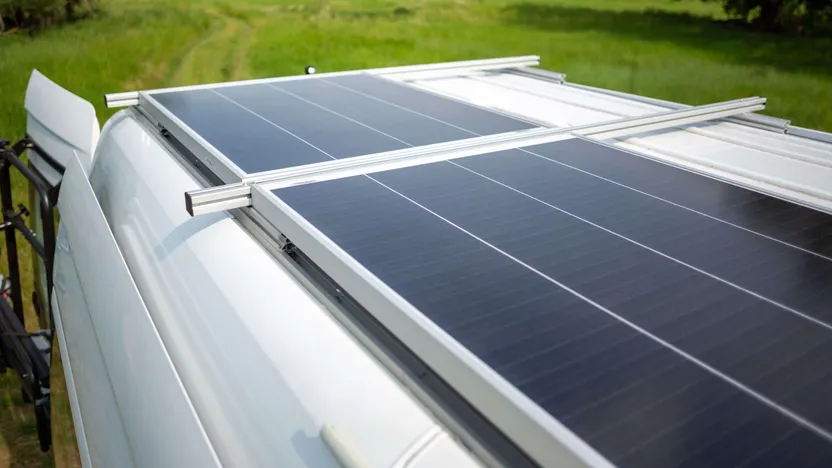
Solar panels, or PV panels, transform energy from the sun into electricity. One option is to invest in flexible solar panels made of amorphous silicon. These panels are affordable but have a relatively low efficiency rating. If you need more energy, go for polycrystalline or monocrystalline silicon for a higher efficiency rating. The panels can feature individual cells which can be fixed to a flexible support to create a semi-rigid panel.
Solar charge controller
A solar charge controller adapts the energy production of solar panels to match the characteristics of the batteries. This helps to prevent overheating and extend their service life.
Inverter
An inverter is used to turn 12 V DC power into 230 V AC power to power your appliances, just like in the house!
Why shouldn't you use a normal solar panel?
Solar panels designed to fit in vehicles and boats are flexible or semi-flexible allowing them to mould perfectly to the contours of their mount. They must also be lightweight and easy to transport. Furthermore panels fitted on boat decks are highly exposed to the elements and can be stepped on. For these two reasons, you need to invest in a tough panel if you want it to last! Solar panel kits can be used for a full solar set-up complete with panels and electronics.
Wind and solar power equipment
More information
You may be also interested in these guides
Guide written by:
John, DIYer & IT developer, Brighton
Since I was a child, I was always interested in manual and technical work. Always fascinated by woodworking, I took advantage of my first flat as a playground. On the cards: electricity (of course, safety first!) and some partition walls; but also decorating with the help of the missus, made-to-measure furniture and little tricks to optimise the space, all the while remaining as original as possible. When the little one arrived, I started building bits and pieces for him! Lacking space, I have not got a permanent workshop and certain tools I dream about are not part of my collection. Not to worry, I already know a lot about DIY and I have a high-tech profile that I hope will guide you in your decisions!
'/%3E%3C/svg%3E)