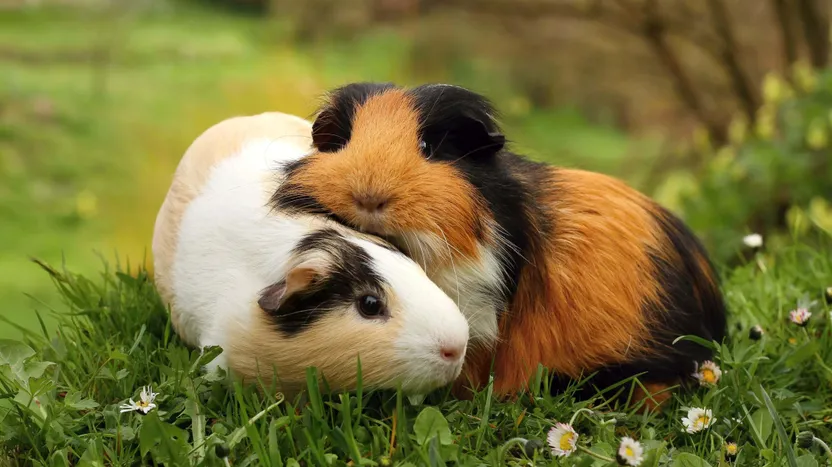
How to care for your guinea pig
'/%3E%3C/svg%3E)
Guide written on 6 February 2024 by:
Jennifer, Self-taught DIY enthusiast, Manchester
Important features
- Cage type
- Accessories
- Bedding
- Food
Caring for a guinea pig: the essentials
In terms of accessories, you'll need two bowls for food, a water bottle and a hay rack. It's also a good idea to provide a little house, nest or hammock, as well as some tunnels and other toys.
Hemp, flax and cotton bedding are all suitable for guinea pigs.
Guinea pigs are strict herbivores and should be fed on a diet of pellets and hay, as well as vegetables and the occasional bit of fruit.
Rodent accessories
Guinea pig cages
As guinea pigs are not big climbers, there isn't a lot of risk of them falling off anything. So while you should get the biggest cage possible to allow your pet to explore, you don't need to worry too much about the height. Your guinea pig hutch or cage should measure at least 100 cm in length and 60 cm in width. That said, guinea pigs are herd animals and need company. It is recommended to keep at least two guinea pigs which will mean a larger cage.
If you plan to keep your guinea pigs indoors, the cage should be easy to dismantle to allow for easier cleaning. That said, guinea pigs do enjoy living outdoors as long as the weather allows it.
Metal bar cages
Inexpensive and practical for attaching accessories, metal bar cages offer good ventilation and allow for easy access to your pet and for cleaning. Cages designed for guinea pigs do tend to be a bit small so you can always go for a rabbit cage instead.
The drawback of these indoor cages is that urine can damage the bars over time. What's more, bad odours will spread more easily, along with dirty bedding.
Wooden cages
While wooden cages are attractive, they are often combined with a material like plexiglass, mesh or bars. It's worth noting that guinea pigs do enjoy chewing on wood and may attempt an escape! You'll therefore have to keep a close eye on your pet.
These cages are also very tricky to clean.
Plexiglass cages
Plexiglass cages usually feature a more intricate design than metal bar cages and are better at keeping the bedding in the cage (along with your guinea pig!). You'll also be able to keep a close eye on your pet. However, you won't be able to hear them as much and, while these cages are equipped with vents, they are not as well ventilated as other models.
Plexiglass may also become less transparent over time and cannot be equipped with accessories.
Hutches and runs
A rabbit hutch is a great option to keep your guinea pig outdoors while it is warm enough. Usually made of wood, hutches are equipped with a mesh door and a hard-wearing roof to keep your pet safe from predators. They are also fitted with a shelter to allow your pet to hide from the rain and wind.
If used under supervision, a run does not need a base. This will allow your guinea pig to eat as much grass as they like.
It is possible to find fold-away runs for easy storage.
Cleaning
Guinea pig accessories
While some accessories, such as a water bottle, are essential, others are optional but recommended for your pet's well-being.
Food bowl, hay rack and water bottle
It's a good idea to have two food bowls: one for guinea pig pellets, the other for fresh fruit and vegetables. Make sure they are heavy enough to prevent your pet from tipping them over (if they are designed to sit on the floor), and that they are easy to clean.
A hay rack should be provided to supply your pet with as much hay as they want. Bear in mind that any hay left on the ground will quickly be turned into bedding.
To provide fresh water, it's best to go for a plastic or glass water bottle designed to be attached to the bars of the cage rather than a bowl that will soon be knocked over into the bedding.
Houses, nests and hammocks
While providing your guinea pig with a house may mean you see them a bit less, it is essential to offer your pet somewhere to relax and hide when they are scared. This is especially important in an outdoor hutch as it provides your guinea pig with a space to shelter from draughts and bad weather.
Nests, usually lined with a little sleeping bag, offer a cosy shelter that your guinea pig will love. Ideally, the cover should be machine-washable.
Particularly popular among rats and ferrets, hammocks are also enjoyed by guinea pigs.
Tunnels and pipes
As guinea pigs tend to get a bit chubby, it's a good idea to encourage them to exercise. They especially enjoy crawling through tunnels and pipes. Be sure to choose the right diameter for your pet so they can slide through easily!
You might also want to add bridges, swings and other little toys to your guinea pig cage.
Guinea pig bedding
For optimum hygiene, you should change your guinea pig's bedding two to three times a week as it will absorb waste. You simply need to choose what kind of bedding you'd like to offer your pet.
Hemp bedding
Made from hemp stalks, this type of bedding forms shavings that won't stick to your pet's fur nor release any dust. Very comfortable, but also very absorbent, this type of bedding may trigger an allergic reaction in sensitive guinea pigs.
Flax bedding
Non-toxic and dust-free, flax bedding is also absorbent but helps to limit odours. Be sure to check that it does not contain any cresyl as this product is toxic.
Corn cob bedding
Corn cob bedding is very absorbent and tends to cling on to odours less than other materials. However, it will be hard on your pet's feet.
Cotton bedding
Warm and soft to the touch, cotton bedding is perfect for the winter or to line the inside of your pet's nest. It is, however, very absorbent and more expensive than other options.
Feeding a guinea pig
Guinea pigs are strict herbivores. Offer a balanced diet composed of a small amount of pellets, alongside hay and fresh vegetables and fruit.
Pellets
It's a good idea to go for a high-quality, uniform pellet rather than a mixture, as your guinea pig will simply pick out the bits they like and leave the bits they don't.
Hay
Hay helps with digestion and wears down your guinea pig's teeth, which grow continuously. It should therefore be given freely.
Fruit and vegetables
Peppers, fennel, chicory, carrots, celery, apricots, oranges, pears... your guinea pig will enjoy a wide range of fruit and vegetables.
Guinea pigs do not make their own vitamin C, meaning you will have to provide some on a daily basis offering either a vitamin solution or foods with a high vitamin C content.
You may be also interested in these guides
Guide written by:
Jennifer, Self-taught DIY enthusiast, Manchester
I didn’t receive any special training, I learned everything on the job. And what a joy it is to be able to do little jobs around the house that we love so much. That is, until the moment we decided to move and had to do everything; from the floor to the ceiling, from the kitchen to the bathroom...In short, you become as good as a pro. So today, my friends don’t hesitate to call me when they need help. And when you dip your toe in, there’s no turning back. It’s a true passion that drives us to take on the challenges, to have an idea in mind and see it come alive with just a few tools. And a passion is even better when you can share it. So, whenever I can give you a little advice, it’s with great pleasure.
'/%3E%3C/svg%3E)