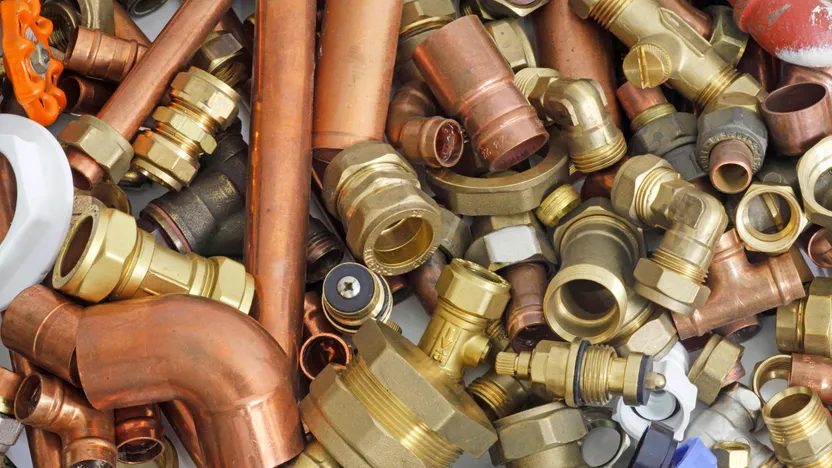
How to choose your plumbing fittings?
'/%3E%3C/svg%3E)
Guide written on 6 February 2024 by:
Jérôme, Construction site supervisor, Cardiff
Important features
- Type of fitting
- Copper
- PVC
- PER
Best sellers in this category
What are the main types of plumbing fitting?
To get stuck in, copper pipe fittings are brazed and require specialized plumbers' tools to install; olive joints, on the other hand, allow you to connect copper pipes without having to do any welding – brilliant! Screw fittings incorporate teflon or hemp fibre as a seal; specific PEX fittings are needed for a PEX installation and PVC fittings, for pressure or wastewater pipes, are glued. 90% of plumbing installations nowadays use copper pipes, so depending on how you rate your skills you'll need to use olive fittings, screw fittings and PVC fittings – typical for the wastewater side.
Welded fittings
Copper fitting
Copper fittings are connected to copper pipes via welding or brazing – a specialized welding technique which can either be 'strong' (hot water and heating pipes) or 'cold' (cold water pipes). Brazing is done with a blowtorch or flame welder and a filling metal chosen to suit the welded material. The fittings are sized to match the pipe and come in a variety of forms to suit your needs (elbow, T-joint, sleeve, etc.).
Making connections without welding
Screw fittings
Screw fittings are of course connected via a screw thread, with a seal formed of teflon or oakum (hemp fibre). Often used in domestic plumbing applications, they are made of brass or galvanized metal and are available with different types of screw thread with sizes expressed in mm or inches. Screw fittings can be male, female or male-female and come in the form of elbows, T-joints, sleeves and bungs and sometimes require washers.
Bicone or 'olive' fittings
A bicone fitting also allows two copper pipes to be connected without welding and is the quickest, easiest solution. Their working principle: a ring deformed by the screwing action forms a seal between the fitting and the pipe. Perfect if you don't have a welder or blowtorch.
PEX fittings
PEX is an abbreviation for cross-linked polyethylene, with specialized fittings for building plumbing installations. It makes a flexible pipe useful in renovation as well as new-build water and heating installations and, again, not requiring welding. There are four main types of PEX fittings: compression fittings, push fittings, sliding fittings and automatic fittings.
Compression fitting
As the name suggests, a seal is formed by compressing the pipe around the fitting. This is achieved with a nut, so all you need in terms of tools is a flat spanner of the right gauge.
Push fitting
A little more complex than the compression type, here a seal is formed by forcing the fitting onto the end of the pipe. This may require the use of a pair of crimping pliers.
Sliding fitting
This is the most reliable type of PEX fitting. It is used in heating applications, among other uses, where the seal must be perfect and durable. Fairly complex to assemble, you'll need some knowhow and the relevant equipment – flaring pliers and a specialized PEX crimping tool.
Automatic fitting
Similar to a compression fitting, the automatic type requires no prior knowledge or specialized equipment to assemble. The seal is formed by a clip activated by turning a nut. Easy to use, but unfortunately the least hardwearing of the PEX fitting options.
Adhesive fittings
PVC wastewater pipe fitting
Wastewater PVC isn't designed to support significant internal pressure; so the water is discharged under gravity. This type of PVC is commonly found in sink and washbasin outflow pipes, showers, baths and toilets.
When constructing an evacuation network, there are various types of PVC fitting at your disposal: elbows, T-joints, sleeves, reducers etc. in a range of diameters. These fittings are assembled with adhesive (specialized PVC glue), ensuring a robust and watertight seal.
PVC pressure fitting
Unlike wastewater PVC, pressure PVC (as the name suggests) supports a certain level of internal pressure; so it can be used on the supply side.
When constructing a pressure PVC network, there are also several different types of fitting to choose from (elbows, sleeves, Ts, reducers, scew fittings, ball valves, one-way valves, etc.).
These fittings are assembled either with adhesive (in the case of a M/F joint) or screwing where some kind of valve or a union joint is involved.
Non-return valve
Properties and uses of plumbing fittings
Type of fitting | Material | Diameter in mm | Diameter in inches | Uses |
Welded | Copper / brass | 10-64 | - | Water / heating |
Screw | Brass / galvanized steel | 8 (13) 12 (17) 15 (21) 20 (27) 26 (34) | 1/4 3/8 1/2 3/4 1 | Water |
Bicone / olive | Brass | 8 (13) 12 (17) 15 (21) 20 (27) 26 (34) | 1/4 3/8 1/2 3/4 1 | Water |
PEX | Brass | 12 (15/21) to 20 (20/27) | 1/2 to 3/4 | Water / heating |
Compression polyethylene | Brass | 12 (15/21) to 20 (20/27) | 1/2 to 3/4 | Water |
Adhesive wastewater PVC | PVC | 32 to 500 | - | Wastewater evacuation |
Adhesive pressure PVC | PVC | 16 to 630 | - | Water supply network |
Best sellers in this category
A typology of plumbing fittings
Shape of fitting | Uses |
Sleeve | Connects two pipes in a straight line |
Elbow | Alters pipe direction by 27°, 45° or 90° |
T-joint | Connects three pipes in a 'T' shape |
Reducer | Connects two pipes of different diameters |
Bung | Stops the end of a pipe or other component |
Culotte | Connects three pipes in a 'Y' shape |
Inspection cover | Point of access for inspecting / repairing a network |
How to choose your welded sockets?
Types of fitting
Elbow
You can get elbow joints in various angles, but the most common are 27, 45 and 90°. These are flared to allow copper pipes to be inserted and welded in place. For ease of assembly, copper elbow joints are mainly used in renovation and repair work; in new-build settings it's easier and more reliable to bend the copper pipe itself – using annealed copper, it can be wrought into the desired elbow shape with a roll bender. Elbows maintain the same pipe diameter.
T-joint
A T-joint is a fitting in the shape of a 'T' which allows three pipes or other components to be fitted together. This can either connect three elements of the same diameter or incorporate a reduction.
Screw fitting with beaten collar
This type of fitting lets you attach a rigid copper pipe to another element or screw fitting. The term «beaten collar» refers to the end of a rigid pipe onto which the screw fitting is connected – requiring a joint which is located on the flat part created by the collar.
Sizes and uses
Size in mm | Uses |
8 x 10 | WC supply pipe |
10 x 12 | Sink, washing machine, dishwasher |
12 x 14 | Sink, washing machine, dishwasher |
14 x 16 | Shower |
16 x 18 | Bath |
20 x 22 | Water heater |
26 x 28 | Central heating |
30 x 32 | Wastewater evacuation |
38 x 40 | Wastewater evacuation |
Roll bender
How to choose your screw fittings?
Material: brass or galvanized steel?
Galvanized steel offers an impressive level of resistance to oxidation, superior mechanical resistance to abrasion and better shear-resistance and tensile strength. It's not recommended in close proximity to non-galvanized steel elements or in damp areas due to the galvanic corrosion that can occur. It can be used both in drinking water and heating circuits (≤ 60°C); brass is more malleable and offers high corrosion-resistance in damp settings.
Types of fitting
Elbow
An elbow allows you to change the direction of a pipe by a set angle: 27°, 45° or 90°. Like a sleeve fitting, they can be male, female or male/female and can incorporate a diameter reduction.
Reducer
A reducer is a straight fitting that lets you connect two pipes of differing diameters, male or female: M20/27-F15/21; F12/17-M15/21, etc. The two diameters can only differ by one or two sizes.
Bung
A bung lets you end a pipeline or block off a component. It can be male or female, depending on the component it's attached to.
What's an 'olive' fitting?
A bicone fitting is a copper fitting that doesn't require welding. A seal is formed by turning a nut, which deforms the pipe inside the fitting. The main advantage is its ease of use: it can be installed with a simple flat spanner and doesn't require any specialist knowledge; you just need the right diameter for your pipe and you can go straight ahead.This type of fitting doesn't require welding, adhesive or teflon (or indeed, oakum) and is specific to rigid copper pipes (not the annealed type). These fittings can only be used once: If you unscrew them again once installed, they lose their seal and you'll have to change the ring – which can be tedious.
Sizes and uses of bicone fittings
Type of fitting | Diameter Thread & diameter of pipe | Uses |
Straight fitting | 8/13 – 8mm 12/17 – 8mm 12/17 – 10mm 15/21 – 12mm 15/21 – 14mm 15/21 – 16mm 20/27 – 18mm 20/27 – 22mm | Combi fitting used to connect a screw fitting to a copper pipe |
Equal union joint | 10mm 12mm 14mm 16mm 18mm 22mm | Lets you connect two copper pipes of the same diameter |
Reduction union joint | 10 – 12mm 12 – 14mm 14 – 16mm | Lets you connect two pipes of different diameters |
T-joint | 10mm 12mm 14mm 16mm 18mm 22mm | Lets you connect three elements of the same diameter |
Elbow (M/F) | 15/21 – 12mm 15/21 – 14mm 15/21 – 16mm | Lets you make a 90° joint between a copper pipe and a threaded fitting |
Elbow (F/F) | 15/21 15/21 15/21 | Lets you make a 90° joint between two threaded elements |
Shop our copper pipe fittings
What's a PEX fitting?
PEX installations
As we saw above, PEX is a plastic used to make plumbing circuits, both for water supply and heating, and it can be more or less flexible.
Anyone can work with PEX with no specialist knowledge or particular flair for plumbing. There's no need for welding, and not much equipment is required.
Types of PEX fitting
Sliding fitting
This type is principally used in heating installations, since it's highly reliable in terms of robustness and minimizing leaks. The sliding fitting does require a little bit of technique to assemble, as well as a few bits of equipment – flaring and crimping pliers.
Push fitting
Push fittings allow for very thorough assembly of PEX components. The fitting actually deforms under the action of crimping pliers and becomes an integral part of the installation.
Automatic fitting
This is the easiest type to assemble, but also the least reliable! Looks very similar to a compression fitting apart from the fact that the connection is achieved via a special clip mechanism. This is also controlled by a nut.
PEX fitting characteristics
Type of fitting | PEX pipe diameter in mm | Diameter in inches |
Compression | 12 12 16 20 25 | 3/8 – 12/17 1/2 – 15/21 1/2– 15/21 1/2 – 15/21 3/4 – 20/27 |
Automatic | 12 14 16 | - - - |
Sliding | 12 16 25 | 3/8 – 12/17 3/8 – 12/17 3/4 – 20/27 |
Push | 12 12 16 16 | 3/8 – 12/17 1/2 – 15/21 3/8 – 12/17 1/2 – 15/21 |
The sliding fitting
What's a polythene compression fitting?
There is an alternative to metallic fittings for assembling HDPE pipes (high-density polyethylene): polyethylene compression fittings.They work just like other compression fittings, but the seal is obtained by screwing. Generally they're only used in larger diameters (from 16mm up to 90mm). They're often found in water mains supplies for large buildings.
Diameter and uses
Shape of fitting | Diameter in mm | Uses |
Straight sleeve | 16 - 90 | Lets you connect two pipes of the same diameter |
Reducer sleeve | 20 – 16 25 – 20 32 – 20 32 – 25 40 – 25 40 – 32 50 – 32 50 – 40 63 – 40 63 – 50 90 - 75 | Lets you connect two pipes of different diameters |
Straight fitting | 16 (1/2") to 90 (3") | Lets you connect a pipe and a threaded component |
Elbow | 16-16 to 90-90 | Lets you connect two pipes of the same diameter at a 90° angle |
Male elbow | 16 (1/2") to 63 (2") | Lets you connect a pipe and a threaded component at a 90° angle |
Female elbow | 16 (1/2") to 90 (3") | Lets you connect a pipe and a threaded component at a 90° angle |
Té | 16-16-16 to 90-90-90 | Lets you connect three elements of the same diameter |
Bouchon | 16 - 90 | Lets you close off a pipeline |
Valve | 20 to 40 | Lets you stop and start flow in a pipeline |
Polyethylene compression fittings
What's a PVC fitting?
PVC pipes: wastewater vs pressure
Basic PVC as used in wastewater evacuation is a plastic material which doesn't hold up under pressure. Flow in a PVC wastewater network must therefore occur under gravity. It can be used for any domestic wastewater evacuation (sinks, washbasins, showers, baths, rainwater, etc.). It is recognizable by its light grey colour.
Pressure PVC has to be highly resistant, and is therefore much thicker than the previous type. As a result it can be used for water supply pipes (i.e. necessarily pressurized). It can be use to supply drinking water, water for pumping, etc. It is recognizable by its darker grey colour.
See our bathroom sinks and washbasins !
Installing PVC wastewater papers
The whole of your household water evacuation network (kitchen, bathroom, etc.), sewage (i.e. toilet outflows) and rainwater piping can be made of PVC - with a few caveats.
The vast majority of this network will be assembled using adhesive fittings as described above. A minimum gradient needs to be incorporated so that evacuation flows smoothly and to prevent solid waste from causing blockages. All the wastewater pipes are combined into a storage tank before leaving your household water system (i.e. a septic tank), or are pumped directly into the public sewer system.
Rainwater can be distributed, captured, stored or evacuated via a network, an underground tank or an above-ground collector.
Diameters and uses
Diameter in mm | Uses |
32 | Kitchen and bathroom wastewater |
40 | Kitchen and bathroom wastewater |
50 | Bathroom, including toilet macerator |
80 | Combined interior pipe (kitchen + bathroom + appliances) or rainwater |
100 | Toilet(s), wastewater and / or rainwater |
Types of PVC fittings
Fitting | Type | Uses |
Sleeve | Straight male-female | Connects PVC pipes of equal diameter |
Elbow | 15, 27, 45, or 87.5° M/F or F/F | Connects PVC pipes of equal diameter at an angle |
T-joint | M/M/F F/F/F | Connects three PVC pipes of equal diameter (one positioned at 90°) |
Culotte | F/F/F (two positioned at 30°) | Connects three PVC pipes of equal diameter (one at 30°) or two of equal diameter and one different |
Inspection cover | Usually screw-fit (male element glued) | Allows you to inspect the evacuation network |
Ground siphon | Vertical or horizontal outflow | Lets you collect runoff (from garage, utility room, etc.) |
Reducer | M/M M/F F/F | Connects two pipes of different diameters |
Pitting | 90° (usually male) | Lets you connect a second pipe partway without cutting. |
Learn more about DIY topics...
To find out more about DIY topics, follow our editors' advice and check out their other guides:
How to braze copper pipes?How to choose your flame welding equipment?How to choose your flame welder?How to heat your home?How to choose your spanners?How to choose your boiler?How to choose your toilet?How to choose your glue, mastic and resin?How to connect a washing machine or dishwasher?How to connect your electric water heater?How to choose your bathroom heater?How to choose your shower cubicle?How to choose your pump hose and accessories?Shower or bath: which is best?How to choose your freestanding toilet?How to choose your septic tank?How to choose your rainwater collector?How to choose your macerator?How to choose your spanners and sockets?How to choose your bathroom sink?How to choose your bathtub?How to choose your shower column or set?How to choose your bath drainage kit?How to choose your shower drainage kit? How to choose your sink drainage kit?How to choose your plumbing tools?How to choose your locks?How to choose your sink?How to choose your kitchen taps?How to choose your ladders, stepladders and scaffolding?How to choose your hammer?How to connect PVC pressure pipes?How to choose your lawnmower?How to choose your trailer?How to choose your angle grinder?
You may be also interested in these guides
Guide written by:
Jérôme, Construction site supervisor, Cardiff
Electrician by trade, I first worked in industrial estates where I installed, wired and fixed a large number of electrical installations. After this, I managed a team of electricians for this type of work. 10 years or so ago, I turned to building and construction. From the modest family home, to gyms and theatres, I have been able to coordinate, audit and organise all sorts of construction sites. For 4 years now, I am restoring and building an extension to a bungalow in the heart of the Welsh countryside. My experience in manual work and my knowledge means I am proud to be of service. Terraces, interior design, roofing, plumbing, electrics, anything goes! My wife, daughter and I, built almost everything we have from scratch! So to answer all of your questions and advise you on choosing your tools? Easy!
'/%3E%3C/svg%3E)