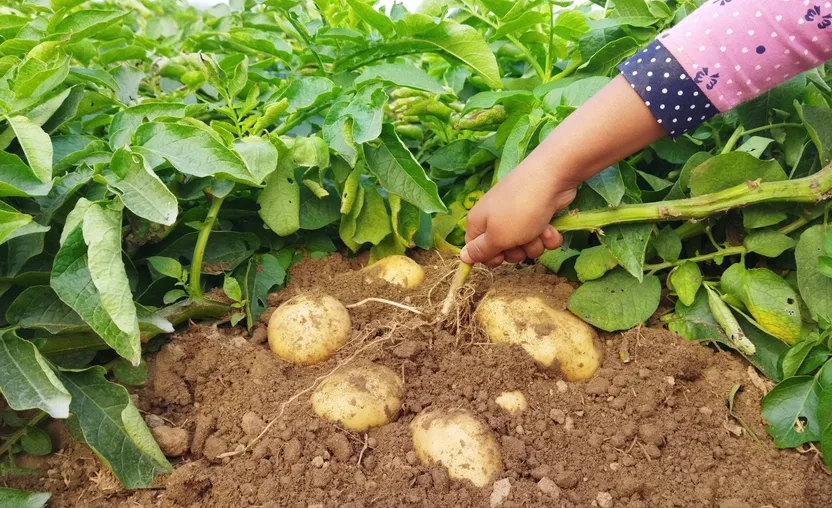
Seed potato buying guide
'/%3E%3C/svg%3E)
Guide written on 6 February 2024 by:
John, Passionate gardener, Cambridge
Important features
- Growing time
- Preservation
- Uses
- Hardiness
- Yield
- Varieties
Best sellers in this category
The characteristics and varieties of potatoes
6 factors for choosing the best potatoes
Firstly, three main characteristics differentiate the varieties of potatoes:
Growing time, from planting to harvest - also referred to as earliness.
Ease of preservation, i.e. how well they keep.
Culinary uses.
A further three factors will influence the growth of your potato crop:
Disease resistance, particularly to blight.
Yield.
The colour of the potato's flesh - which can even be purple or blue.
4 families give over to 100 potato varieties
1. Early potatoes
Early varieties are harvested before the tubers are completely mature, as early as 2 months after planting, so from the end of May in most temperate regions.
Varieties which lend themselves well are: Bea, Starlette, Amandine, Carrera, Charlotte, BF15, Roseval, etc.
To enjoy them at their best, they need to be consumed soon after harvest. These varieties don't keep well. It's a good idea to stagger your planting and mix up your varieties in order to get the best out of your early potato crop.
2. Potatoes to store over winter
These are either mid-late or late varieties, harvested once fully mature when the leaves have already wilted, in September or October. They need to spend 4 or 5 months in the ground, and can then be very successfully stored over winter in a cool, dry, dark location. These varieties include Agata, Artemis, Bintje, Désirée, Monalisa, Samba, Spunta...
As a rule of thumb, the later a variety of potato, the better its crop will store.
3. Firm-fleshed or waxy potatoes
Varieties with a very fine flesh which holds up well in cooking. These potatoes are great for baking in their jackets, steaming, in salads, sautéed, made into hash browns...
Varities in this category include Amandine, Belle de Fontenay, Cherie, Nicola, Pompadour, Ratte, Roseval...
4. Soft and floury potatoes
These tubers are rich in dry material, giving them a 'floury' texture which tends to fall apart when cooked, but nonetheless offer a wide range of culinary uses. They can be divided into two groups:
'melt-in-the-mouth' varieties for gratins, slow-cooked dishes, and in the oven, such as Rosabelle, Samba, Monalisa, Alienor etc.
floury varieties which fall apart when cooked, great for purees, chips and soups, such as Melody, Bintje, Désirée, Vitelotte...
Shop our vegetable plants
Germinated or non-germinated tubers?
All commercially available seed potatoes are certified. This indicates that they are obtained according to strict rules in order to avoid diseased strains. You can choose to buy tubers of different sizes as well as at different stages of germination
Germinated seed potatoes
Seed potatoes can be bought ready-germinated in racks, and hence ready to plant. They should have short, stubby 'eyes' 1-2 cm in length and a healthy-looking colour as these are an indicator of rapid, regular growth. Some seed potatoes are germinated in a single layer, facing upwards, ensuring more regular germination.
Non-germinated seed potatoes
These are sold in sacks or cardboard boxes, and are kept at a low temperature so that they don't germinate prematurely. It's then up to you, the gardener, to let them germinate by exposing them to light at a moderate temperature (ideally 5 - 8°C) for one month, before planting them out.
Tuber size
Seed potatoes are classified according to their size - between 25 and 50 mm. In general, the smaller ones put out fewer tendrils, thus producing fewer, though larger, potatoes. Conversely, larger seed potatoes will produce a greater number of smaller potatoes. Larger seeds are worth using if you want an early crop; the size of the seed potato also varies depending on variety.
Best sellers in this category
You may be also interested in these guides
Guide written by:
John, Passionate gardener, Cambridge
When I was young, I was already working in the family garden. Perhaps that is where my interest in plants and gardening came from. So, it was logical for me to study plant biology. At the request of various publishers I have, over twenty-five years, written many books on the subject of plants and mushrooms (a subject that is close to my heart). They were mostly identification guides at first, but shortly after they were about gardening, thus renewing the first passion of my childhood. I have also regularly collaborated with several magazines specialising in the field of gardening or more generally in nature. There is no gardener without a garden, I have cultivated mine in a small corner of Cambridge for the last thirty years and this is where I put into practice the methods of cultivation that will I advise you in as well.
'/%3E%3C/svg%3E)