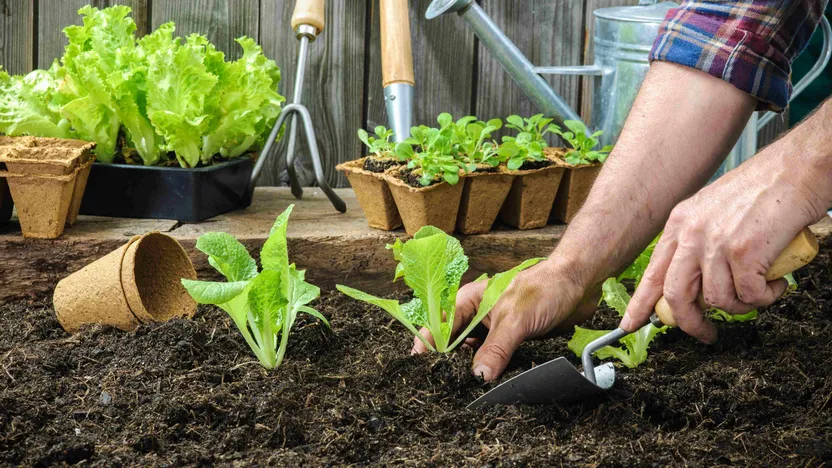
What to plant in the vegetable garden in March
'/%3E%3C/svg%3E)
Guide written on 6 February 2024 by:
John, Passionate gardener, Cambridge
Important features
- Temperature
- Rainfall
- Transplanting
Best sellers in this category
Planting vegetables throughout March
We've put together a selection of nine vegetable crops you can theoretically plant in March. However, it is important to bear in mind that these are just guidelines. Of course, you'll have to consider the conditions where you live (climate, rainfall, etc.) before you start any work. If you want to avoid any slips, you'll also have to prepare your garden properly beforehand.
What to plant in early March
Garlic
Garlic is grown from individual cloves which should be planted in the ground as follows:
Space the rows of cloves 30 cm apart;
Push the cloves into the soil taking care to cover them well with soil; the tip of the clove should barely emerge from the surface;
Line the cloves up around 10 to 15 cm apart.
Asparagus
Asparagus is not an overly demanding crop. It can be planted in all climates and in most types of soil but it won't cope well with excessive moisture; well-drained soil is therefore best. However, this vegetable is greedy in terms of space: 10 m² of land is required to harvest 5 kg of asparagus per season. That said, asparagus plants should not be removed at the end of each season as it can remain productive for up to ten years. Asparagus crowns should go in the ground as follows:
Dig trenches 15 to 25 cm deep (depending on soil type);
Space each trench 120 to 180 cm apart;
Line up the crowns 40-60 cm apart in the trench;
Cover the crowns with soil.
Shallots
Shallots are one of the easiest members of the onion family to grow. To ensure your shallots last well after harvest, it's best to avoid any fresh manure. Shallots should be put in the ground the same way as garlic (as set out above). If you want to start your shallots early, you can plant them in modules. This should help to protect them from very humid soil (from the rain, excessive watering, etc.). Each plant should produce about 5 to twelve bulbs.
Lettuce
Lettuces need a soil that is rich in humus (3% to 5% minimum). Of course there are many varieties of lettuce, each of which has its own season for sowing and planting. Butterhead or divina varieties should do well when planted out in March (after sowing indoors). Follow these three tips for healthy lettuces:
Transplant shorter lettuce varieties with as little intervention as possible;
Trim any plants that have wilted before transplanting; simply remove the upper parts of the leaves;
Be careful not to bury the stem.
Onions
Onions follow more or less the same planting method to shallots and garlic.
Trace out rows around 20-25 cm apart, according to the amount of space you have available;
Plant the onion sets around 4 cm deep with just the tip showing;
Leave 10 cm of space between onion sets.
See our soil-working tools!
Best sellers in this category
What to plant in late March
Cauliflower
Cauliflowers do best in very fertile soil that is watered consistently. You will therefore have to ensure you add enough compost or organic matter to the soil. Early summer varieties such as Mayflower can go in the ground in late March. To encourage your cauliflowers to thrive, it's important to:
Keep your rows around 60 to 80 cm apart;
Transplant your plants once they have 3-4 leaves;
Give the cauliflower heads about 10 to 12 cm of space each.
Cabbage
Cabbage generally enjoys cool, rainy climates and deep, fertile soil. Once the plant has around six to eight leaves, it is time to transplant. Before transplanting, it can be a good idea to coat the young roots in a fertilised mud solution to promote plant growth and ensure proper rooting. After planting, you should:
Use an overturned crate to keep your plant in the shade;
Water generously;
Mulch all around the plant.
Potatoes
Potatoes are easy to grow and are ideal for clearing land. Proceed as follows:
Space out your rows about 45 cm apart;
Dig holes using a bulb planter or hoe;
Place the potatoes about 1 or 2 cm below the surface of the ground;
Leave about 35 cm of space in between each potato;
Do not pack down the earth;
Protect the plants under cloches or a polytunnel.
Shop our greenhouses
More information
It's that time of year again... After more gardening tips? Follow the links below for advice from our editors and more helpful guides:
You may be also interested in these guides
Guide written by:
John, Passionate gardener, Cambridge
When I was young, I was already working in the family garden. Perhaps that is where my interest in plants and gardening came from. So, it was logical for me to study plant biology. At the request of various publishers I have, over twenty-five years, written many books on the subject of plants and mushrooms (a subject that is close to my heart). They were mostly identification guides at first, but shortly after they were about gardening, thus renewing the first passion of my childhood. I have also regularly collaborated with several magazines specialising in the field of gardening or more generally in nature. There is no gardener without a garden, I have cultivated mine in a small corner of Cambridge for the last thirty years and this is where I put into practice the methods of cultivation that will I advise you in as well.
'/%3E%3C/svg%3E)