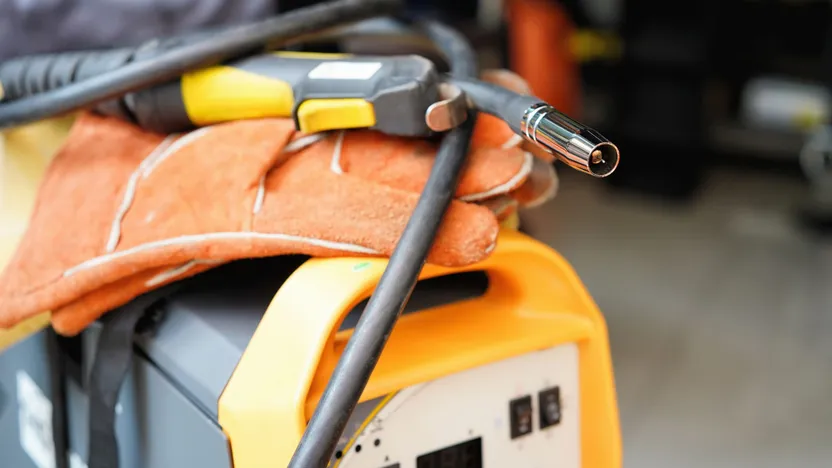
How to get started with MIG-MAG welding
'/%3E%3C/svg%3E)
Guide written on 6 February 2024 by:
Michael, Professional and passionate welder, Sheffield
Important features
- Welders
- Welding torches
- Welding wire and gas
- PPE
Best sellers in this category
Why choose a MIG-MAG welder?
Arc welding is the most popular type of welding among DIYers mainly thanks to the kind of versatility it offers. In fact, most ferrous metals can be welded using this technique.
What is the Difference Between MIG and MAG welding?
Metal inert gas (MIG) welding: a continuous solid wire electrode is used to produce the weld under the protection of an inert gas such as argon or helium.
Metal active gas (MAG) welding: a continuous solid wire electrode is used to produce the weld under the protection of an active gas such as an argon/CO2 or argon/oxygen mix.
Gasless MIG welding: welds are produced using a flux cored welding wire.
Once you've really got the hang of manual arc welding, it's only naturally to want to explore new horizons. This usually means moving on to so-called semi-automatic welding. MIG-MAG welding is the most commonly used welding process among both professionals and hobbyists – and with good reason. Let's take a look at the various equipment used for this type of welding and try to draw up a reasonable budget to get you started.
Discover our welding machines!
Semi-automatic welders
While manual metal arc (MMA) welding is somewhat limiting when it comes to thin materials, MIG-MAG welding can be used to tackle sheet metals such as bodywork panels. That's why most auto mechanic repairs rely on this type of welding. In fact, all types of metalworkers, from welders to blacksmiths, use MIG-MAG welding to construct all manners of structures and vessels.
In terms of performance, a machine-fed wire rod system translates into increased productivity. What's more, the absence of a flux coating makes welds easier to clean. It's even possible to use welding wire up to 3mm to assemble large components.
Metals like aluminium and stainless steel can also be welded using this process provided you use the right wire and gas. However, it's worth noting that shielding gas – whether you use neutral or active gas – will mean a fairly significant additional expense. Two types of wire can be used in MIG welding:
solid bare wire used with gas (for indoor welding only);
flux core wire with a flux compound inside the electrode for gasless welding outdoors.
Best sellers in this category
Essential equipment for MIG welding
Welding machine
You might be tempted to invest in a welding station that offers both solid wire MIG welding and flux cored arc welding and this is usually a good idea. While it is possible to find low-end welding machines designed exclusively for gasless welding bear in mind that flux cored arc welding does require skill and the welds produced will almost always be inferior to those crafted with MIG welding.
What's more, things can get tricky if you plan to carry out auto body repairs which require a greater degree of precision. Flux core wire usually starts at 0.9mm in size (since the flux compound is contained within the welding wire) while solid wire can be as thin as 0.6mm.
If you are on a 230 V single-phase supply you can choose from a wide range of welders. Opt for mid-range to high-end models based on how often you plan to use the welder and your budget. The most important criteria to bear in mind when choosing a model are power and duty cycle.
Quick note: aluminium welding calls for a powerful welder with a water-cooled torch – you need to be absolutely confident when choosing a welder for this type of application.
Duty cycles
The duty cycle of a welding machine refers to how long the welder can operate safely. A minimum duty cycle of 60 to 70% is recommended for a welding machine supplied by single-phase power. To translate, this means that for 10 minutes of operation at 100A, you will have 6/7 minutes of welding and 3/4 minutes of cooling with a well-ventilated welding station.
Welding torches
Welding torches are designed to cool using air or water. The torch provided with the welding machine can be changed. You can opt to replace the original torch with a higher quality model as long as you ensure it is compatible with the machine and matches your needs. Doing so will only help to enhance your comfort when welding.
Replacement welding torch parts
Don't forget to stock up on spares for any welding torch components designed as wear parts.
Welding wire
Welding wire should always be chosen to match the task at hand. You might want to store a range of different sizes for various welding tasks. Be sure to check that the size of the wire matches the capacity of the feed roller.
Welding gas
Welding gas comes in cartridges, bottles (60 or 120 litres) or even in disposable gas cylinders of 1 to 10 m3. The welder is linked to the gas via a gas regulator. For general use, an argon CO2 mix can be a good option. It is good practice to double check that your bottles are firmly closed when you have finished using them.
Welding helmets
A huge range of LCD welding helmets is now available. Be sure to look for an auto-darkening feature when purchasing.
MIG welding pliers
Welding pliers are multi-purpose tools designed for tasks like cutting welding wire and removing and installing nozzles and contact tips.
Anti-spatter spray
Spraying an anti-splatter spray around your welds will prevent spatter formation which can save you a lot of time.
Welding apron and gloves
When it comes to personal protective equipment (PPE), leather will usually be the safest option. A welding apron and welding gloves must be worn at all times.
Angle grinder
It is essential to have an 115mm angle grinder on hand to fix any mistakes. That said, there's no need to get the fanciest piece of kit out there. To make your choice, think about how often you plan to use the tool.
Flexible gloves
Welding tools, consumables and PPE
Tools | Consumables | PPE |
40 to 160 A MIG-MAG welder | Solid or flux core wire | Welder's apron |
LCD welding helmet | Spare parts, nozzles, contact tips, clear and opaque replacement lenses | Long welding gloves |
Hand-held welding shield | Clear and opaque replacement lenses | Safety goggles |
Gas bottle regulator | Argon/Co2 shielding gas | |
Gas hose | Angle grinder discs and cutting discs | |
Cutter | Anti-spatter spray | |
115 mm angle grinder | Cutting discs | Safety goggles, ear defenders, gloves |
Beginner's MIG-MAG welding budget
Tool | Min-max. price | Average cost |
40 to 160 A MIG-MAG welder | £350 to £1500 | £400 |
LCD welding helmet | £40 to £250 | £100 |
Solid wire | £10 to £120 depending on size | £20 |
Welding mask | £20 to £60 | £30 |
Gas bottle regulator | £25 to £100 | £35 |
Spare part kit for welding torch | £10 to £20 depending on quality | £25 |
Cutter | £15 to £25 | £15 |
Wire brush | £1 to £6 each | £3 |
115mm angle grinder | £25 to £150 | £85 |
How to set up a welding post
If you are planning to set up a little metalworking corner in the workshop or garage, ensure that the space is well-ventilated and kit it out with the following:
a metal workbench or, failing that, a wood workbench with a strong sheet metal top. Bear in mind that the workbench can never be too big. If you have the space, go for a large workbench.
a shelf where your welding machine and angle grinder can be stored within easy reach;
a tool storage system or toolbox with essential tools like a hammer, clamps, spanners, a hacksaw, and so on.
a metal vice with or without a pivoting base;
a pair or several trestles for welding larger items.
Having a dedicated welding area is really handy as you can simply bring anything you want to weld to your welding station rather than having to constantly move around your equipment. Keeping your workshop tidy and clean will reduce the risk of accidents.
Shop our vices
Safety and workwear for welders
The following personal protective equipment (PPE) is essential for any welder:
safety shoes;
welding gloves;
safety goggles
welding helmet;
workwear;
welder's apron.
PPE will make carrying out your work much safer.
Set up a fire extinguisher in the workshop and make sure you have a bucket of cold water nearby to cool your welds if necessary.
You may be also interested in these guides
Guide written by:
Michael, Professional and passionate welder, Sheffield
I was trained as a pipe worker and a pipe-welder and after having travelled for 35 years working around the UK, I became the head of a metal shop, then a designer and in the end the head engineer. I have designed and built a workshop where I make metal sculptures: I managed to find a piece of paradise where I can let my imagination run wild. Auctions and garage sales are no secret to me. I find unusual objects and old tools there that I collect or transform into works of art. I also like decoration, painting on canvas, and gardening. I am developing new technologies concerning tools. To share my passion and advise you in your choice of materials is a real pleasure.
'/%3E%3C/svg%3E)