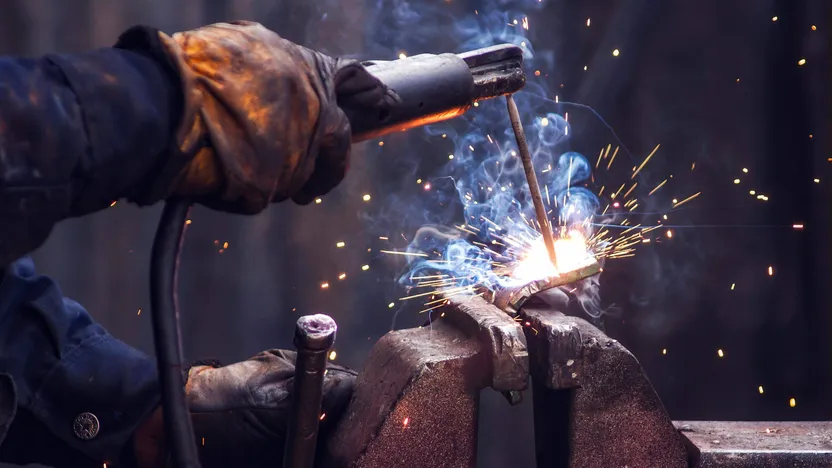
How to get started with arc welding
'/%3E%3C/svg%3E)
Guide written on 25 September 2026 by:
Michael, Professional and passionate welder, Sheffield
Important features
- Arc welder
- Welding safety equipment
- Welding workshop
- Electrodes and welding consumables
Best sellers in this category
Arc welding: how to get started
As any keen DIYer will know, there's always something on hand to create, repair or modify. In fact, many of us do enough of these types of projects that crafting the base materials ourselves can actually save us a fair amount of money. All you have to do is get stuck in and kit yourself out with the right tools!
To use an example, woodworking is generally considered a fairly accessible craft and there are lots of tools on offer to help simplify the task. But in fact, the art of woodworking is more transferable to metalworking than you might think, especially since a range of technology is now available to help you get started.
From metal fences and gates to garden furniture, metal furniture has bags of charm whether you're looking to create rustic or industrial-style pieces. With just a bit of practice you can make a wrought iron table, console table or even a pedestal table yourself!
What can I use an arc welder for?
Arc welding has one big advantage: the welded components can be used almost right away.
Sheet metal (1mm to 10mm), angles, channels and various other profiles can easily be assembled by arc welding. When it comes to pipe, you will need a bit more experience. Stainless steel welding is also possible as long as the correct electrodes are used.
If you plan to tackle any bodywork, please be aware that an arc welder won’t cut it – the material is simply too thin! For this kind of task, you’ll need to turn your attention towards tungsten inert gas (TIG) welding, metal inert gas (MIG) welding or oxy-fuel (oxy-acetylene) welding. The same goes for aluminium and when it comes to copper there's no better option than brazing.
MMA welding electrodes
Best sellers in this category
What tools and equipment do I need for arc welding?
Tools, consumables and PPE
Tools | Consumables | PPE |
MMA inverter welder | 1.6 mm; 2.5 mm; 3.2 mm electrodes | Leather welder’s apron |
115mm angle grinder | 115mm | Welding gloves |
Wire brush | 115mm cutting disc | Transparent safety goggles |
Chipping hammer | / | |
/ | / | Handheld welding mask and/or auto-darkening welding helmet (+ lenses) |
How to choose an arc welder
If you only plan to do basic arc welding, go for a modern welder that is lightweight and easy to handle. If you want to tackle more serious jobs, go for a mid-range model. It'll serve you for many years and you won't be frustrated with performance.
In terms of characteristics, look for an arc welder that offers:
220V;
40 to 130 A;
a minimum duty cycle of 60 to 70%.
The duty cycle of a welder is particularly important. For example, a duty cycle of 60 to 70% means that for 10 minutes of work at 100A, you will have 6/7 minutes of welding plus 3/4 of cooling time for a well-ventilated welding station.
Inverter technology allows you to control the intensity of the welding output depending on whether you are welding corners or flat pieces and the type of electrode being used (which itself should be chosen to match the type of metal being welded and its thickness).
Earth clamps and welding clamps generally come supplied with the welder. But if they don't suit your needs, it is cheap enough to buy your own later on. Remember that the most important thing is to pick the right welder.
To make things easier, manufacturers often offer welding kits which include an inverter welder and all the equipment you need to get started in arc welding such as a helmet or handheld mask, a chipping hammer, wire brush and sometimes even a set of electrodes. These kits are practical and often offer good value for money.
Locking pliers
Arc welding safety equipment
It's not uncommon to hear new welders cursing and swearing because they've got a drop of molten metal on their hand or shoe! To prevent any painful accidents, it is essential to kit yourself out with the right equipment.
Safety shoes, welder's gloves, safety goggles, work clothes, a welder's apron are all designed to keep you safe. Keep a bucket of water on hand to cool your welds if necessary and a fire extinguisher is a always a good idea, too!
Welder's masks and helmets
If you don't fancy investing in a full kit, you can buy all safety equipment separately. In this case, a basic handheld welder's mask in addition to a welding helmet with a fully automatic lens will be a good start.
You can wear the welding helmet as you work and your apprentice can watch you with the handheld mask in hand! The LCD welding helmet is a fantastic invention which prevents beginners falling victim to 'welder's flash' – a serious issue for novice welders in the past!
The LCD lens is designed to auto darken as soon as an electric arc is produced. The choice of LCD welder's helmets on offer is vast and each helmet has its own shade ranges (usually 7 to 13 for arc welding). It is a good idea to have replacement lenses on hand.
Welder's apron and gloves
A leather welder's apron or jacket is an absolute must-have if you don't your work overalls burnt to a crisp. Long leather welder's gloves are also essential to prevent burns.
Flexible gloves
What welding accessories do I need?
Rutile electrodes
Rutile electrodes are ideal for basic metal welding. These electrodes have a high proportion of titanium oxide in their coating which promotes easy arc ignition and operation. The thickness of the electrode depends on the project at hand but it's a good idea to pick a range of sizes (1.6, 2.5 and 3.2mm) to cover any welding task. Be sure to store electrodes in a dry area.
Chipping hammer and wire brush
A chipping hammer has one flat chisel bevelled side and one pointed side and is used to clean and remove slag from welds. A wire brush can be used to finish off welds once the slag has been removed. Be sure to buy a stainless steel wire brush for stainless steel welding.
Angle grinder
A 115mm angle grinder is essential for correcting any mistakes when welding. There's no need to get the fanciest piece of kit out there. Choose your model depending on how often you plan to use it.
Wire brushes
How to set up a welding post
If you are planning to set up a little metalworking corner in the workshop or garage, ensure that the space is well-ventilated and kit it out with the following:
a metal workbench or, failing that, a wooden workbench with a strong sheet metal top. Bear in mind that the workbench can never be too big. If you have the space, go for a large workbench.
a shelf where your welding machine and angle grinder can be stored within easy reach.
a tool storage system or toolbox with essential tools like a hammer, clamps, spanners, a hacksaw and so on.
a metal vice with or without a pivoting base.
a metal box for throwing in used metals and welding rods. You won't have to look too far – an old metal can will do.
one or two trestles for larger workpieces.
Having a dedicated welding area is really handy as you can simply bring anything you want to weld to your welding station rather than having to constantly move around your equipment. Cleanliness is important: a broom, shovel, brush and bin will all be required.
Beginner's arc welding budget
Tool* | Min./max. price | Average cost |
Inverter welder kit and accessories | £220 to £450 | £300 |
MMA inverter welder (alone) | £160 - £770 | £250 to £300 |
Auto-darkening welder's helmet | £40 to £250 | £100 |
Rutile electrodes | £25 to £40 for 230-pack | £25 |
Welding mask | £20 to £60 | £30 |
Chipping hammer | £4 to £25 | £10 |
Wire brush | £1 to £6 each | £3 |
115mm angle grinder | £25 to £150 | £85 |
* excluding workbench, vice and trestles
Brooms
Making a decorative bike plant pot holder
To give you a rough idea of the type of equipment required for a welding project, here is a quick list of all you'll need to make your own decorative bike plant pot holder.
Material, time and cost of project
Equipment
Profiles (round, flat)
Salvaged wrought iron scroll details
40 to 50 2.5mm electrodes
115mm angle grinder disc
125mm cutting disc
White anti-rust paint
Time required
30 hours (for a no-rush job)
Cost
£60 (excluding labour)
Cost of finished product – priceless!
Cutting discs
You may be also interested in these guides
Guide written by:
Michael, Professional and passionate welder, Sheffield
I was trained as a pipe worker and a pipe-welder and after having travelled for 35 years working around the UK, I became the head of a metal shop, then a designer and in the end the head engineer. I have designed and built a workshop where I make metal sculptures: I managed to find a piece of paradise where I can let my imagination run wild. Auctions and garage sales are no secret to me. I find unusual objects and old tools there that I collect or transform into works of art. I also like decoration, painting on canvas, and gardening. I am developing new technologies concerning tools. To share my passion and advise you in your choice of materials is a real pleasure.
'/%3E%3C/svg%3E)