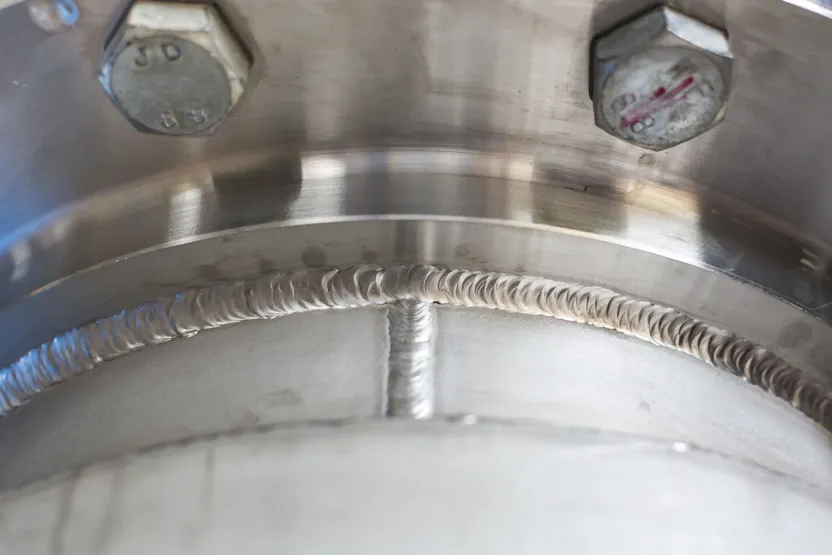
How to weld stainless steel
'/%3E%3C/svg%3E)
Guide written on 6 February 2024 by:
Michael, Professional and passionate welder, Sheffield
Important features
- MMA welding
- TIG welding
- Orbital welding
- MIG welding
- Hot work safety zone
- Welding certifications
Best sellers in this category
Stainless steel: the basics
Of all the metals and alloys available, stainless steel is rightly considered as the most noble of modern steels. Found everywhere in day-to-day life, stainless steel is highly chemical-resistant.
While stainless steel is expensive to buy, the strength, weldability and unalterable qualities of the material mean the investment will quickly be made worthwhile. This alloy is usually just as easy to weld as mild steel and the techniques used have been perfected to make it a safe material to work with. Read on for our round-up on stainless steel welding.
What is stainless steel?
For decades, metallurgists have been breaking ground to find and manufacture cost-effective, highly resistant and unalterable alloys.
Stainless steel was first discovered back in 1913.
It is made from low carbon steel with the addition of things like chrome, nickel and molybdenum. The ratio of these raw materials varies to create four main classes of stainless steel:
Austentic stainless steel
Ferritic stainless steel
Martensic stainless steel
Duplex or ferritic-austensic stainless steel
The most common types of stainless steels are austensic stainless steels like 304, 316, 304L or 316L which are designated by AISI standards originating from the US. The European standard for stainless steel is EN 10088-1.
Best sellers in this category
Different types of stainless steel welding
MMA welding (Manual Metal Arc)
TIG welding (Tungsten Inert Gas)
MIG welding (Metal Inert Gas)
It is possible to braze stainless steel using a 40% silver brazing alloy. However, the process costs more and offers pretty average results in terms of appearance and the strength of assembled components.
MMA welding
MMA welding, or stick welding, is very common, especially when dealing with thick metals. Special stainless steel-coated electrodes vary in terms of composition and standards.
The technique for arc welding stainless steel is the same used to weld mild steel. The only difference is that the electrode holder clamp is connected to the positive pole (reverse polarity). However, some experienced welders make the first pass connected to the negative pole (straight polarity). If you have any doubts, refer to the instructions set out on the electrode packaging. This type of welding is easy to do with the right voltage settings.
Stainless steel filler rods can be handy as you can weld different materials like mild and carbon steels or stainless steel and mild steel.
Cast iron can also be welded using stainless steel but it's important to preheat the cast iron and slow down the cooling process.
Be sure to protect your eyes as weld spatter can spray from the weld bead.
Discover our welding machines!
TIG welding
TIG welding is different in that it requires the use of a torch fitted with a non-consumable tungsten electrode. The torch releases a shielding gas called argon.
The gas flow rate can be adjusted at the bottle depending on the diameter of the ceramic nozzle on the torch. For example, a 8mm nozzle can release 8 litres per minute. This is generally the basic gas flow rate but this can be refined as you gain experience.
To get a nice weld bead, it's important to use a filler metal that is compatible with the materials you want to connect. The bead is laid in a similar way to autogenous welding taking care to protect the molten weld pool using argon.
These days, some advanced TIG welders feature a pre and post flow system which releases shielding gas shortly before and after welding to help increase corrosion resistance.
Shop our arc welders
Orbital welding
Another technique is orbital TIG welding. The process is often used to join two stainless steel tubes without filler metal. In this case, the torch works to rotate the arc automatically around the tube.
This type of welding is used for creating crevice-free inner welds as is often required in the food or medical industry. Using this technique, some experienced welders can create highly impressive work with incredibly even weld beads. At this level, welding is truly an art form!
TIG torches
MIG welding
When you think of semi-automatic welding, you probably think about MIG welding.
This modern welding method has given rise to incredible sophisticated and easy-to-handle MIG welding machines. Stainless steel wire, a good wire feed speed and the right amperage should give you an even bead.
A stainless steel brush must be used to clean welds or you run the risk of seeing your work rust.
Stainless steel welding: hot work safety zone
Stainless steel welding must be carried out in a hot work safety zone clear of any carbon steel.
If you are welding food grade stainless steel, the rules are very strict and it's best to consult sanitary welding standards set out by bodies like the FDA if you are carrying out this type of task.
Welding certifications and training
There are lots of welding training courses available across the UK. These courses can be beneficial to a range of skill levels. Similarly, many welding certifications also exist.
The Construction Skills Certification Scheme is a qualification scheme that awards cards to construction workers as proof that they are fully qualified to carry out safety critical tasks such as welding.
A coded welder, on the other hand, is a welder that has completed a Welding Approval Test which is performed against a particular standard.
In short, there is a huge of welding certifications out there and almost all qualifications will involve carrying out a practical test conducted by a certified welding inspector.
You may be also interested in these guides
Guide written by:
Michael, Professional and passionate welder, Sheffield
I was trained as a pipe worker and a pipe-welder and after having travelled for 35 years working around the UK, I became the head of a metal shop, then a designer and in the end the head engineer. I have designed and built a workshop where I make metal sculptures: I managed to find a piece of paradise where I can let my imagination run wild. Auctions and garage sales are no secret to me. I find unusual objects and old tools there that I collect or transform into works of art. I also like decoration, painting on canvas, and gardening. I am developing new technologies concerning tools. To share my passion and advise you in your choice of materials is a real pleasure.
'/%3E%3C/svg%3E)