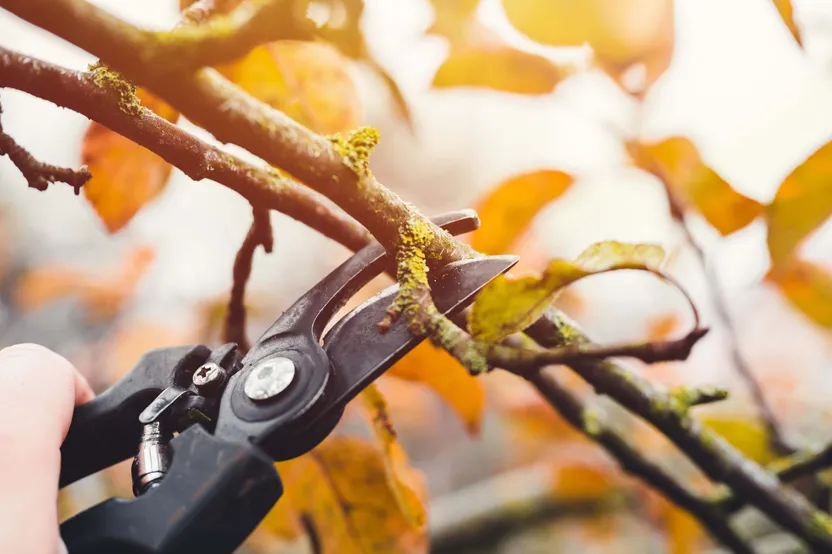
How to prune an apple tree
'/%3E%3C/svg%3E)
Guide written on 25 September 2026 by:
John, Passionate gardener, Cambridge
Important features
- Removing unwanted branches
- Pruning period
- Pruning for fruit growth
- Wound dressing and cleaning up
Best sellers in this category
Why and when to prune an apple tree
When it comes to young trees (central leader or vase-shaped) and espalier trained trees, pruning is performed for a number of reasons:
to ensure steady fruit growth;
to maintain the shape of the tree; regular pruning will help to limit top growth and make harvesting easier;
clearing the centre of the tree of excess branches will ensure light can penetrate the tree and help fruit to ripen;
ensuring air can circulate freely can help to prevent some diseases.
Pruning should be done when your tree is dormant. Ideally, you should wait until the end of winter when the frost has passed but you can prune as early as mid-February.
Required skills
In order to prune an apple tree correctly, you should know how to identify the main types of buds (i.e. fruiting buds and growth buds) and branches (leader, scaffold, fruiting, etc.). As you're looking to encourage fruit growth, it's important to be able to identify the fruiting buds in particular.
Time required
Approx. 1 hour per tree.
Number of people required
One person
Steps
Removing branches from the crown
Pruning for fruit growth
Wound dressing and cleaning up
Tools and equipment
Stepladder (if required)
Branch cutters (or loppers)
Pruning saw
Alcohol solution for tools
Wound dressing
Gloves (optional)
1. Removing branches from the crown
Remove any branches that are growing towards the inside of the tree crown.
If branches are crossing, keep the ones that are facing outwards and get rid of the others.
Cut any shoots that are growing vertically from the base of the tree: these branches are known as 'suckers' and will grow vigorously but won't provide fruit.
Remove any dead or damaged branches. You should aim to keep any short, strong branches. The closer the fruit is to the main branches, the more it is able to benefit from the sap; it will therefore be larger and tastier than the fruit from the ends of long branches.
Best sellers in this category
2. Pruning to encourage fruit growth
Monitor the structure of the tree and cut all branches from the previous year just above the third bud (counting from the base of the branch). Only count the buds that are very clearly visible.
If the bud is not facing outwards, cut the branch just above the second or fourth bud. This will help to prevent any inward-growing branches in the future which will eventually have to be removed from the tree.
Your cuts should be made around half a centimetre from the bud and must always be angled in the opposite direction to the bud.
The overall shape of your tree should be balanced and the branches should be spaced evenly.
Pruning mature apple trees
Mature trees don't necessarily need to be pruned yearly in order to produce fruit. In fact, even if you wanted to prune, it might prove tricky. Pruning should be limited to every four or five years to stop overcrowding. All diseased or awkwardly placed branches should also be removed.
Mature trees usually grow fruit on naturally arching branches. The sap inflow on these branches is slowed down which means these trees will usually flower across the arch.
3. Wound dressing and cleaning up
If you have cut any branches measuring over 4 cm in diameter, add some wound dressing to your cut to stop any harmful fungi or bacteria getting into the wood.
You can buy this type of product in the shops or you can make your own using water, clay soil and a few spoonfuls of oil. You can also add a fungicide such as a Bordeaux mixture to the solution.
Once you've finished pruning, be sure to clear away the cut branches. These branches may be diseased or contain larvae that will hatch once winter is over. If possible, burn the branches.
Pruning tips
It is theoretically possible to prune apple trees from December to March, as long as there is no frost.
However, by pruning later on (around March time), it will be clear which are buds are for growth and which are fruiting buds which will make your job much easier. What's more, if you make your cuts as the sap is beginning to rise, your tree will heal much faster.
Before you start pruning, it's important to sterilise all your tool blades using an alcohol solution. Be sure to repeat the process between trees so as not to spread disease. Don't forget to finish by wiping down your tools with a cloth.
You may be also interested in these guides
Guide written by:
John, Passionate gardener, Cambridge
When I was young, I was already working in the family garden. Perhaps that is where my interest in plants and gardening came from. So, it was logical for me to study plant biology. At the request of various publishers I have, over twenty-five years, written many books on the subject of plants and mushrooms (a subject that is close to my heart). They were mostly identification guides at first, but shortly after they were about gardening, thus renewing the first passion of my childhood. I have also regularly collaborated with several magazines specialising in the field of gardening or more generally in nature. There is no gardener without a garden, I have cultivated mine in a small corner of Cambridge for the last thirty years and this is where I put into practice the methods of cultivation that will I advise you in as well.
'/%3E%3C/svg%3E)