How to scarify a lawn
'/%3E%3C/svg%3E)
Guide written on 25 September 2026 by:
John, Passionate gardener, Cambridge
Important features
- Why scarify a lawn
- When to scarify a lawn
- Scarifier types
- How to scarify a lawn
Best sellers in this category
Why scarify a lawn?
Over time, grass clippings and old dried-up roots in your lawn can form a thick thatch on your turf which will affect the amount of air that gets into your soil – particularly if your soil is heavy, acidic or has to deal with regular footfall.
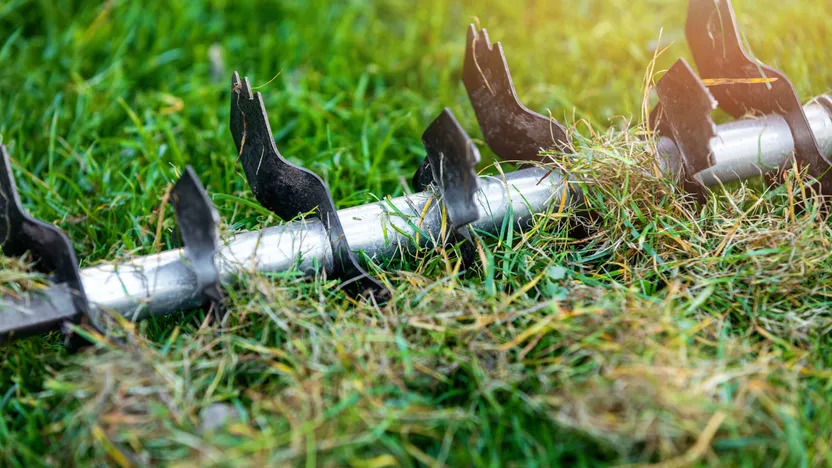
Scarifying consists in cutting through the tangle of old surface roots and thatch in order to inject more air and water into the soil. It also helps to eliminate moss which often builds up over the winter in moist and shaded parts of the lawn; for example, beneath trees or along a north-facing wall. Scarifying an older lawn will help to rejuvenate it.
When to scarify a lawn
A top tip is to use a scarifier at the start of spring, in March or April, or in the autumn, from the end of September to the end of October.
Ideally, you should scarify in dry weather on slightly damp soil. Scarification purists will recommend scarifying twice a year in the springtime and in autumn. But if you only scarify once a year, it's best to do so in spring for the best lawn care.
It's pointless – and potentially even harmful – to scarify a lawn that is less than three years old; after all, the process is fairly traumatic for any lawn. It's best to establish grass growth for the first few years.
Shop our scarifiers
Best sellers in this category
Hand, electric or petrol scarifier
There are three different types of lawn scarifier to choose from according to the size of your lawn.
A hand scarifier will do just fine for a lawn of up to about ten square metres. These scarifiers look a bit like a rake with flat blades which vary in width.
An electric scarifier is suitable for medium-sized surfaces measuring up to around 500 m². These models feature height-adjustable blades that turn on a roller. They look a bit like a lawnmower and may be equipped with a grass box.
A petrol scarifier is the best solution for lawns stretching over 500 m². These scarifiers are powered by fuel, just like petrol lawnmowers.
Given their price (several hundred pounds) and the fact that you will only use the machine around once or twice a year, it may be wiser to rent a petrol scarifier rather than buy one.
Shop our petrol lawnmowers
How to scarify a lawn
Start by mowing your lawn down to about 2 cm. Gather the clippings.
Adjust the depth of your scarifier to match your soil and the state of your turf (this can range from around 2 to 4 cm).
As the blades of the scarifier turn in the soil, they will cut through thatch and weeds and tear up moss. In periods of low rainfall when the soil is very hard, you should water the lawn the night before using a scarifier.
If you opt for a manual tool, move back-and-forth over short distances so that the blades don't dig too deep into the soil.
For the nicest finish, it's best to alternate directions. Your lawn might seem a little torn up at first but your grass will grow much better.
To finish off, if your scarifier isn't equipped with a grass box, use a lawn rake to remove all grass roots, grass plants and moss and place these on your compost pile. Another solution is to mow your lawn again to make the most of its grass box.
Finally, if your lawn is very patchy with dead grass, spread some grass seed and tamp it down using a lawn roller in order to get your lawn looking a bit healthier. This will also help to even out any grass tufts that have been lifted up by the scarifier. If rain isn't on the forecast, it's a good idea to water your lawn on a fine mist setting. Avoid walking on the turf and wait a few weeks before mowing again.
You might want to make the most of your loosened soil to improve it by adding an amendment. This can be something like compost, wood ash (a handful per m²) or lime to rebalance the acidity levels, bearing in mind that an acidic lawn is more likely to form moss. Sand will be a welcome addition to a clay-heavy lawn.
Rakes
You may be also interested in these guides
Guide written by:
John, Passionate gardener, Cambridge
When I was young, I was already working in the family garden. Perhaps that is where my interest in plants and gardening came from. So, it was logical for me to study plant biology. At the request of various publishers I have, over twenty-five years, written many books on the subject of plants and mushrooms (a subject that is close to my heart). They were mostly identification guides at first, but shortly after they were about gardening, thus renewing the first passion of my childhood. I have also regularly collaborated with several magazines specialising in the field of gardening or more generally in nature. There is no gardener without a garden, I have cultivated mine in a small corner of Cambridge for the last thirty years and this is where I put into practice the methods of cultivation that will I advise you in as well.
'/%3E%3C/svg%3E)