Expert lawn care tips
'/%3E%3C/svg%3E)
Guide written on 6 February 2024 by:
ManoMano
What Do I Need?
Equipment
Your most basic and essential lawn care products are certainly your hose and your lawn mower. With these two, you can easily keep your grass hydrated and neat. There is a wide range of mowers available with different abilities, including rollers for those perfect lines and mulching for a fertile boost. Edging shears and an edging iron are important tools to keep the edges of your lawn looking near. The shears can tidy up longer grass that is extending into beds and complete the cut. An edging iron is used to maintain a straight edge to your lawn and prevent it slowly losing shape. It is also important to invest in a good garden rake to collect leaves, grass cuttings and anything else that falls onto your lawn.
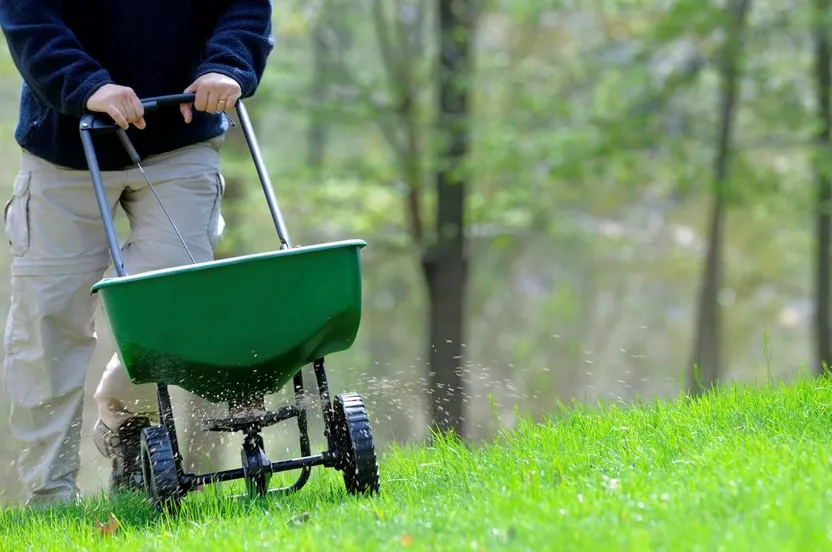
Finally, if you're going all out a scarifier and spreader will give you the healthiest lawn around. A lawn spreader will enable you to spread fertiliser quickly and evenly across the lawn, as wall as saving you time and effort. Although scarifier is used less frequently, usually once a year or once every two, it is an useful piece of equipment. It will cut through the thatch build up in your lawn and aerate the topsoil.
Products
Your basic, go-to lawn product is your fertiliser. Lawns need to be fertilised no more than 1-2 times per year, but it is worth doing some initial research to find the right product for you. If you aren't sure what kind of soil you have or what the pH level it is, it may be worth investing in a soil testing kit before you begin. Mulching your lawn can also help yo nourish it and save you time carrying grass clippings back and forth!
To control your weeds and pests, it can be tempting to use a a pesticide or herbicide. However, regular or repeated use of these kinds of chemicals can heavily damage your soil as they destroy microbiotic life. It is recommended to try more natural solutions unless there is no other option. A mixture of vinegar, water, and dish soap can be used to spot treat noticeable weeds like dandelions. If you are organised at the beginning of the season, corn gluten can also help to prevent weed seedlings becoming established.
Finally, if you are seeing bald patches on the lawn it may be time to reseed. Select your seeds paying attention to the type of seed and the region they are best suited to in order to get the best result possible. Before seeding a bare patch, till the soil slightly. Sow your seeds and then add a thin layer of composts and ensure that the area does not dry out.
Seeds
What Should I Do?
Basic Lawn Care
The key requirements for any healthy lawn are regular mowing and fertilising. To ensure that your lawn care gets off to a good start pay attention to your mower blades. Keeping your mower blades sharp is essential for a healthy lawn as blunt blades can damage grass. If your grass has brown, ragged edges after a cut it is time to sharpen your blades. If you want to avoid this situation it is wise to sharpen blades once a month when cutting grass regularly.
Fertilising your lawn will help to ensure healthy, vigorous growth during the year. When choosing a fertiliser, look for a slow release option as this will avoid wasted runoff. Take the time to clean excess fertiliser off covered areas and into the grass to avoid it running into waterways. If you are concerned about the environment there are a number of organic fertilisers available.
Keeping your lawn free of weeds can feel time consuming, but apply a herbicide as weeds start to germinate can prevent outbreaks later on. However, if your lawn isn't already relatively weed-free it can be more effective to apply spot treatments to weeds. There are even some weeds that can be beneficial for your lawn. Clover can help to introduce nitrogen into the soil and dandelion roots can improve soil structure. As long as you don't let them flower and seed, these weeds can work with you instead of against you.
Advanced Lawn Care
To take your lawn care to the next level you should consider aerating and scarifying your lawn. Aerating your lawn involves introducing holes into the soil to allow air to reach the soil. These holes enable air, water and nutrients to reach the soil and the roots of your grass encouraging it to grow. Aeration is recommended primarily to alleviate soil compaction, so if your lawn is heavily used or has a lot of thatch it may need aerating. To aerate your lawn you can use either a manual or motorised aerator. For small lawns a manual aerator is sufficient, but for larger lawns is may be advisable to rent a a motorised aerator. Your next step is to decide whether punch holes into the lawn or remove cores, both allow air in but holes can further compact soil. Once you're done, make sure to water your lawn.
Scarifying, also called de-thatching, is used to remove thatch, while raking removes moss. Both are a lawn care requirement if you want to maintain a healthy, green lawn. Scarifying involves cutting into the lawn to remove thatch and enable air and nutrients to reach the grass and soil. Raking is used to remove moss from your lawn using wire tines. It is recommended to use a raking machine to de-moss your lawn, as doing it by hand can be exhausting. For both of these activities it is best to do them when your lawn is already growing well, autumn is best for heaving scarifying while spring is preferable to light raking and scarifying.
Mower blades
When Should I Start Lawn Care?
Throughout winter it is wise to remove debris from your lawn, but this is otherwise a very low maintenance period. Come spring your lawn work will really start to pick up. Once you start to see growth this is a good time to apply fertiliser and give your lawn a good feed. At this point you can also do your first cut, but avoid cutting too low in case of frost. Generally grass is best left at around 2.5 inches tall in order to provide adequate cover and flourish.
As your lawn starts to grow faster during summer adjust your mowing frequency appropriately. Your lawn could requiring lowing twice a week once it really gets going. If you are both trimming and mowing your law, it is recommended to trim first. If you trim first you can mow your trimmings, which will keep your lawn looking neater for longer.
Come autumn your work will b slowing down, but this is a crucial period of preparation for the following spring. Take the time to fertilise your lawn now and do any reseeding required. If you decide to fertilise once a year, this is autumn is the best season to promote vigorous growth in spring. Finally, keep your lawn clear of leaves to ensure that the grass gets as much energy as possible before winter. I
You may be also interested in these guides
Guide written by:
ManoMano
ManoMano is the largest marketplace for products and services in the DIY, gardening and home improvement sector in Europe. Together, we are free to invent a sustainable future and committed to build it today. We are hands-on to improve our homes for tomorrow. Bold, from idea to action. Ingenious always & together. Responsible for people & our planet.
'/%3E%3C/svg%3E)