PEX pipe buying guide
'/%3E%3C/svg%3E)
Guide written on 6 February 2024 by:
Jérôme, Construction site supervisor, Cardiff
Important features
- PEX pipe type
- Cross-linking process
- Standard, conduit or insulated
- Pipe diameter
Best sellers in this category
What is PEX pipe?
PEX (Cross-Linked Polyethylene) pipe has been slowly increasing in popularity in recent years and has even come to replace copper in some homes.
Used to carry water to sanitary appliances or heating systems, these semi-rigid pipes bend easily making them very straightforward to install. What's more, the whole system can be set up with special PEX fittings without the need for soldering.
PEX pipe comes in different colours for easy identification and the flexibility of this material can help to reduce the noise of flowing water. PEX pipe is corrosion-resistant and won't suffer from scale build-up. It is also completely smooth which limits any pressure losses. On the downside, PEX pipe is sensitive to UV rays and must usually be installed where it is not exposed. It is usually best to encase it in conduit. Depending on the quality of the cross-linking, PEX pipe can have high thermal expansion and may be oxygen permeable.
While PEX pipe is ideal for installing new systems, it also works very well for renovating older plumbing systems or connecting through to extensions (even if the original system is made using another material).
For residential use, PEX pipe comes in a variety of coils and straight lengths. The most common sizes include 10mm, 15mm, 22mm and 28mm depending on what you are installing.
Three main features of PEX pipe
In order to choose the right PEX pipe, think about the following characteristics:
PEX type: determined by cross-linking method, maximum pressure and temperature, and so on.
Size: 10 to 28mm for domestic applications.
Colour: red or blue.
Shop our PEX pipe
Best sellers in this category
Material designation code
In order to find the right PEX pipe for your needs, you will need to study the material designation code of each product. This code is usually written on the pipe itself and is made up of four digits.
Code | Meaning |
First digit | Chlorine resistance (1-5) |
Second digit | UV resistance (1-5) |
Third and fourth digits | Hydrostatic design stress (numbers vary) |
It's important to note that a specific type of PEX pipe for heating systems has been on the market for a few years in the form of oxygen barrier-type PEX pipe. Most types of PEX pipe are oxygen permeable meaning there is a risk of sludge or algae building up in heating systems. PEX barrier pipe works to resolve this issue.
PEX pipe: what is cross-linking?
The type of cross-linking process used to manufacture PEX pipe doesn't have a huge impact on how the pipe can be used but it does tell us about the manufacturing process. PEX pipe is given a letter to indicate the type of cross-linking method used to make it.
Cross-linking process | Method |
a | Pipe is cross-linked using the 'Engel' process which means Cold Expansion PEX (CEP) fittings can be used. |
b | Cross-linking using the silane method. |
c | Cross-linking by electron beam or gamma radiation. |
PEX pipe: standard, sleeved or insulated?
Insulated pipe and conduits
PEX pipe on its own is fragile. It has low mechanical strength and is highly susceptible to crushing. If you are installing the PEX pipe in a wall, partition wall or under a concrete slab, it must be protected by a conduit. It is possible to find coils of PEX pipe that come ready supplied with sleeves which will save you the hassle of finding conduit yourself.
It is recommended to use insulated PEX pipe for heating systems in order to reduce heat loss and limit energy consumption.
It's worth noting that some manufacturers sell insulated PEX pipe that comes supplied already in conduits for maximum protection.
PEX product specifications
All PEX pipe should be marked with the following information:
name of manufacturer and/or part number;
diameter (in mm or inches) and thickness (in mm) of the pipe;
material designation codes;
maximum pressure rating and temperature;
standards;
date of manufacture;
pipe length.
How to read PEX pipe markings
What size of PEX pipe do I need?
For domestic plumbing and heating systems, most needs will be covered by 15mm pipe. Some installations that need large volumes of water quickly (such as bathtubs or boilers) will work better with 22mm pipe. The most common PEX pipe sizes are 10mm, 15mm, 22mm and 28mm.
PEX sizes per appliance
Sanitary application | Minimum flow rate (litres per second) | Minimum recommended pipe size |
Kitchen sink | 0.2 | 15mm |
Bathroom basin | 0.2 | 15mm |
Bidet | 0.2 | 15mm |
Bathtub | 0.33 | 22mm |
Shower | 0.2 | 15/22mm |
Monobloc tap | 0.33 | 15mm |
Mixer tap | 0.42 | 15/22mm |
Toilet | 0.12 | 15mm |
Washing machine | 0.2 | 15mm |
Dishwasher | 0.1 | 15mm |
In metric sizes, the pipe is measured by the outside diameter (OD) whereas imperial standards will measure the internal diameter.
PEX pipe follows the same outer diameter system as copper pipe. For metric standards, the inner diameter can vary depending on the thickness of the pipe. The thicker the pipe, the better it can withstand pressure and resist deformation, and the lower the thermal expansion.
PEX pipe colours
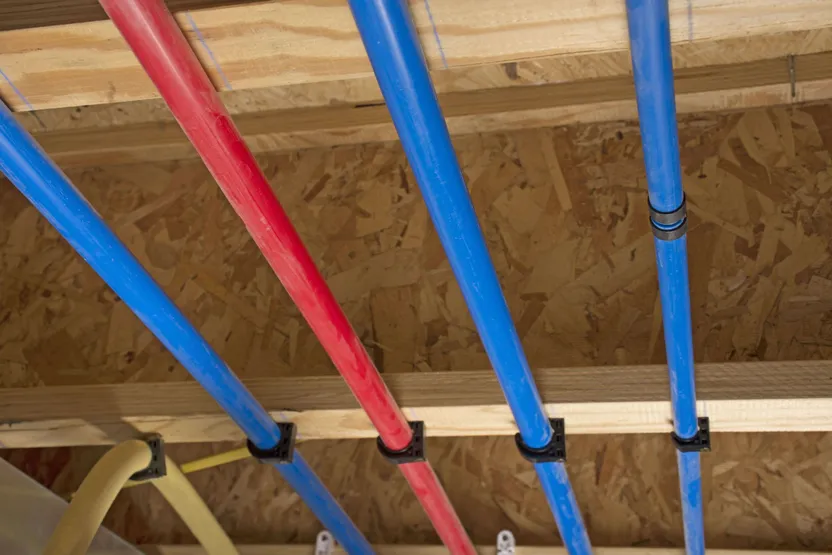
Just like electrical cable, PEX pipe comes in different colours to indicate what it is carrying.
This is very straightforward since:
cold water is supplied by blue PEX pipe;
hot water is supplied by red PEX pipe.
Traditionally, for any type of appliance that is supplied by hot and cold water, the hot water – meaning the red PEX pipe – will be on the left.
Shop our PEX pipe
Standard PEX sizes for residential use
How to bend PEX pipe
There are a few different ways to bed PEX pipe. The method you choose depends on the angle you're hoping to create and available bending length you have (between connections, etc.). Any pipe bend to 45° with an available length of 50 cm can be done by hand without the use of any tools. Any more than that and the pipe is at risk of kinking meaning you should not attempt to bend by hand.
3 ways to bend PEX pipe without kinking
If you want to bend a PEX pipe to a 90° angle without kinking it, you can choose from the following options:
connect two ends of PEX pipe using a brass connector instead of bending;
insert a spring into the PEX pipe, bend it, then remove the spring once it is bended as required;
place a spring around the PEX pipe, bend it then remove the spring once the PEX pipe is bent.
Any bend that needs to be made over an area of less than 5 cm needs to be made using a brass connector.
What is the difference between PEX pipe and multilayer pipe?
Multilayer pipe is made up of an aluminium core held between two layers or PEX. In terms of advantages, multilayer pipe:
is easy to cut and bend by hand;
is resistant to high temperatures and UV rays;
is oxygen impermeable;
has an thermal expansion rate that is up to 10 times lower than PEX alone, depending on the external temperature;
is more attractive and can be exposed (since it is grey in colour).
Multilayer pipe systems are, however, more expensive than PEX pipe systems.
More information on plumbing
You may be also interested in these guides
Guide written by:
Jérôme, Construction site supervisor, Cardiff
Electrician by trade, I first worked in industrial estates where I installed, wired and fixed a large number of electrical installations. After this, I managed a team of electricians for this type of work. 10 years or so ago, I turned to building and construction. From the modest family home, to gyms and theatres, I have been able to coordinate, audit and organise all sorts of construction sites. For 4 years now, I am restoring and building an extension to a bungalow in the heart of the Welsh countryside. My experience in manual work and my knowledge means I am proud to be of service. Terraces, interior design, roofing, plumbing, electrics, anything goes! My wife, daughter and I, built almost everything we have from scratch! So to answer all of your questions and advise you on choosing your tools? Easy!
'/%3E%3C/svg%3E)