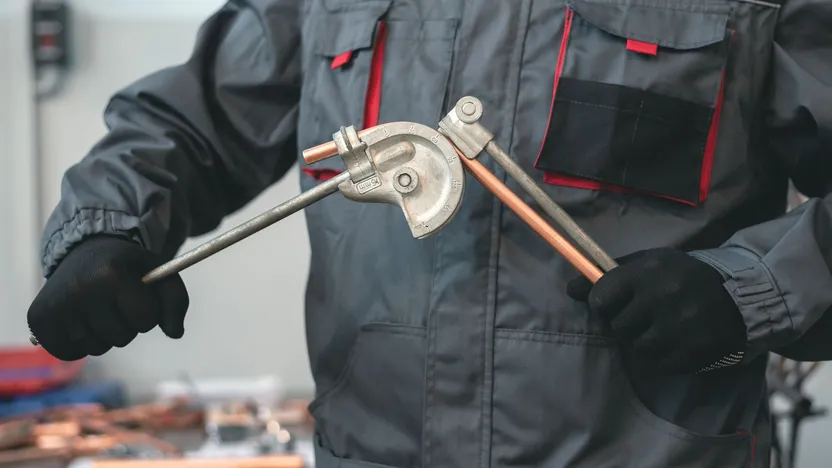
How to bend copper pipe
'/%3E%3C/svg%3E)
Guide written on 6 February 2024 by:
Michael, Professional and passionate welder, Sheffield
Important features
- Pipe bending with sand
- Pipe bending springs
- Manual pipe benders
- Pipe bender type
Best sellers in this category
Copper pipe markings
Copper pipe used in buildings must conform to the requirements set out by standard BS EN 1057. This standard deals with all seamless, round copper tubes for water and gas in sanitary and heating applications. Copper tube should also display a CE marking and the BSI Kitemark. This guarantees that the pipe has been independently tested.
The pipe can display a range of information including:
EN 1057 approval stamp;
manufacturer name;
material analysis (e.g. grade and minimum copper content);
temper condition (i.e. R220/R250/R29);
size (outside diameter x thickness);
kitemarking;
additional factory production line ID
date of manufacture (quarter and year, or month and year);
brand name.
Copper tube
Different types of copper pipe
For installations ranging from 10 x 1mm up to 22 x 1mm (outside diameter x thickness), a few different types of copper pipe or tube can be used:
rigid copper pipe in lengths of 2 to 5 metres (visible installation);
annealed copper tubing: malleable, soft tubing sold in coils of 25 to 50 metres (hidden installation);
plastic covered tubes (EN 1057) for underfloor heating systems.
Best sellers in this category
Different methods for bending copper pipe
There are a few different ways to bend copper by hand. The most common methods include:
bending with sand or salt;
using a pipe bending spring.
Alternatively, specially designed tools can be used for a quick job and neat results; such as:
crossbow-style pipe benders;
manual pipe benders;
benchtop pipe benders;
hydraulic pipe benders;
electric pipe henders.
Using sand to bend pipe
This method should be well known to pipe fitters of an older generation. However, it is rarely used these days, except in exceptional circumstances. The first step involves blocking the end of the tube before filling it with fine sand or salt.
Tapping the tube from time to time helps to compact the grains of sand inside. Once you've filled the pipe, the other end should then be blocked. However, it is necessary to leave a small gap to allow water vapour to escape as the pipe is heated.
The tube should be heated gradually using a torch at the same time as it is bent into the a curved shape. The bend can be measured using a template made out of sheet metal which should be placed on the inside of the pipe.
The final step is to open the ends of the tube to release the sand and to clean the inside of the tube.
Using a pipe bending spring
When using a pipe bending spring it is important to use a spring that matches the tube diameter. Heat the pipe along the length of the bend using a torch until it is dark red in colour.
If using an external pipe bending spring, insert the tube into the spring where you want to bend it before forming the curve using both hands. The spring should prevent the tube from misshaping or crimping up.
You can then slide the spring out of the tube. Be careful – it might be hot!
Pipe benders
Types of pipe benders
Crossbow-style pipe benders
Crossbow pipe benders are so-called as they look just like the medieval weapon. The former can be adjusted for different pipe sizes and is controlled by a screw or by a hydraulic piston. The tube should be annealed before bending.
Manual pipe benders
Manual pipe benders are small devices that feature a roller and a little arm which is used to slide the copper tube as it bends. A gauge is usually included to adjust the bender according to pipe size.
Benchtop pipe benders
Benchtop pipe benders are professional level tools. They come as a tool kit that includes formers and guides to handle tubes ranging from 10 to 22 mm in size.
Pipe bending machines
These machines roll the pipe or tube to bend it and feature an insert to place inside the tube. This insert follows the movement of the curve to prevent kinking. This type of machine is recommended for very thin copper tube.
Hydraulic pipe benders
Hydraulic pipe benders are basically an improved version of manual pipe benders. They allow you to bend pipe or tube effortlessly. A small hydraulic motor is used to push a piston (for crossbow-style pipe benders) or turn a roller.
Electric pipe benders
Electric pipe benders are powerful tools that can bend any kind of copper pipe or tube, including multilayer copper, in sizes ranging from 10mm to 32mm.
Tips for bending copper pipe
Tools to help you bend copper
Pipe cutters designed specifically for copper
An engineer's square
White chalk or a felt marker
Bending radius and neutral line
By bending a copper tube, two phenomena can be observed:
the outside of the tube will stretch and elongate;
the inside of the tube will compress, increasing its mass.
With this in mind, the size of the pipe bender former or roller will differ according to average tube diameter which is known as the neutral line or axis. It is important to pay attention to the bending radius allowed to ensure you get an accurate bend, especially if you are dealing with two consecutive curves. In other words, in order to bend a pipe to 90°, you need to check the bending radius of the pipe bender which varies according to pipe size. The bigger the pipe or tube, the greater the bending radius.
Common pipe bending applications
Pipe / tube type | Outside diameter | Tool / method | Bending radius Neutral line | Comments |
Annealed copper tubing (25 to 50 metre coils) | 10 to 22mm | Bending with sand or pipe bending spring | Outer Ø x 7 | Use a template |
10 to 22mm | Manual, crossbow or benchtop pipe bender | Outer Ø x 3 or 4 | Common heating or sanitary applications | |
Rigid pipe in straight lengths | 10 to 22mm | Rotary pipe bender Benchtop or electric pipe bender | Outer Ø x 3 or 4 | Lubricate pipe measuring over 14mm to facilitate rolling |
Any pipe measuring over 22mm should be bent using a hydraulic or electric machine. It is possible to find heavy-duty floor-mounted machines for this type of bending.
To tackle larger pipe or tube, you can also fill the pipe with and use a crossbow-type pipe bender before following up with a hydraulic pipe bender. You can also find hydraulic pipe benders with gear operated bend arms to form copper tube with diameters of over 22mm.
Measuring squares
Applications for bent copper pipe
Elbows or full or part crossovers are often used in copper pipe installations to change pipe directions or to divert pipe around obstacles. This type of solution is often used by plumbers or heating engineers. As a reminder, there are two solutions to the issue:
purchase pre-formed soldered end feed fittings;
bend the pipe yourself to avoid having to braze the copper pipe. This option saves you time when installing and reduces the risk of leaks.
How to bend copper pipe by hand
More information
You may be also interested in these guides
Guide written by:
Michael, Professional and passionate welder, Sheffield
I was trained as a pipe worker and a pipe-welder and after having travelled for 35 years working around the UK, I became the head of a metal shop, then a designer and in the end the head engineer. I have designed and built a workshop where I make metal sculptures: I managed to find a piece of paradise where I can let my imagination run wild. Auctions and garage sales are no secret to me. I find unusual objects and old tools there that I collect or transform into works of art. I also like decoration, painting on canvas, and gardening. I am developing new technologies concerning tools. To share my passion and advise you in your choice of materials is a real pleasure.
'/%3E%3C/svg%3E)