Pool pH controller buying guide
'/%3E%3C/svg%3E)
Guide written on 6 February 2024 by:
Pauline, Self-taught DIYer, Leeds
Important features
- Automatic pH control
- pH corrector dosing
- Probe
- Consistent water quality
Best sellers in this category
What is the best pH level for a swimming pool?
Before we delve into equipment, it's important to understand what pH means with regards to swimming pools. So, what does pH level change about a pool and what is the ideal level for swimming?
pH stands for 'power of hydrogen'. The pH level of your pool determines whether the water is acidic, alkaline or neutral. This value can affect various factors including:
algae growth;
sanitiser usage;
level of skin irritation;
the service life of your pool equipment.
The ideal pH level for pool water is around 7.4 which is the same pH as human tears. But don't worry – pH level can range up to 7.6 and still be considered 'correct'.
Here are a few things that can affect the pH level of pool water:
external temperature;
pool liner material;
adding water (rainfall or tap water);
sun cream and other products;
organic debris (leaves, etc.);
water hardness.
In order to change the pH level of pool water, you simply need to use a pH increaser or decreaser.
Shop our pH increasers and decreasers
What is a pH controller?
Pool water must be tested on a regular basis using pH test strips, a test kit or a digital tester. This helps to ensure that swimming conditions are optimal and that the water is clean and safe.
Regulating and correcting pH level
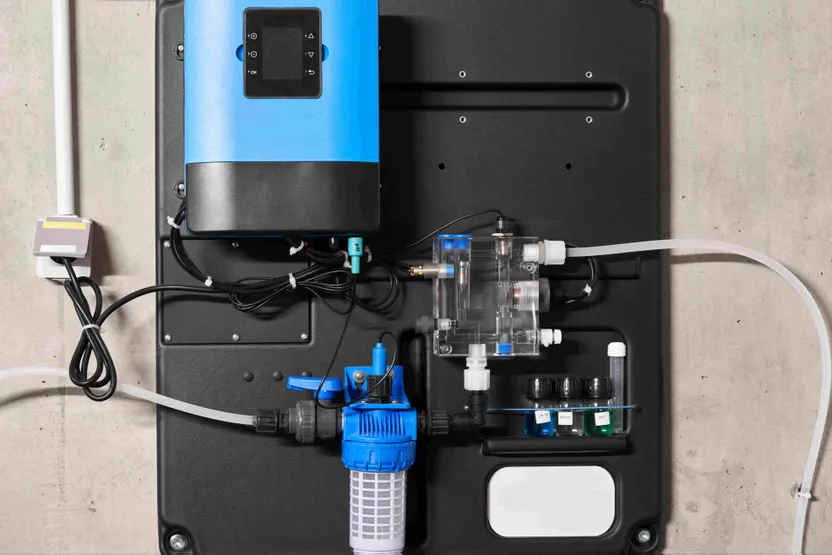
A pH controller saves you the chore of monitoring your pool water manually and works to correct the pH level of the pool without any intervention from you. This type of system measures pH in an instant before making adjustments based on the results. The main role of an automatic pH controller is to keep the pH level of your pool consistent. These devices are made up of a few different components:
a control unit which allows you to input measurements and settings;
a probe;
a dosing system.
The major advantage of this type of automatic device is that it is compatible with all types of pool treatments.
Best sellers in this category
How does an automatic pH controller work?
An automatic pH controller is designed to be connected to the pool filtration system. It automatically measures the pH level of pool water using a built-in probe and doses out a pH corrector (increaser or decreaser) as required. It therefore has two roles:
to analyse the water;
to treat the water.
It's sometimes possible to tell when the pH level of your pool is off just by looking at it (the colour, for example, may change). However, you need to have proper measuring tools for an accurate reading.
Different types of pH controllers
There are various types of pH controllers on the market. Each model differs in terms of the way it analyses the water. It may be equipped with a:
remote probe which is installed in the recirculation system;
or an analysis chamber which collects water to analyse it.
You should also look closely at the type of pump on offer. There are three technologies available:
electromagnetic pumps;
solenoid driven pumps;
peristaltic pumps (functions using rollers and a flexible tube).
PH controllers also differ in terms of their dosing system. Some calculate the volume of water in the pool and adjust doses proportionally. Others will release a fixed dose. Here are the main characteristics to pay attention to when choosing an automatic pH controller:
Feature | ||||
Dosing calculations | Manual (dosing set to specific durations) | Proportional (based on a target value) | Sequential (most accurate) | Predictive (according to pool volume) |
Dosing pump | Peristaltic | Electromagnetic | Solenoid driven | |
Dosing mode | Lowers progressively until desired value achieved | Instant stop | Daily volume limit |
For greater peace of mind, it's best to go for a pH controller that offers sequential or proportional dosing.
pH controllers: advantages and disadvantages
The main advantages of an automatic pH controller are as follows:
pH level is constantly monitored;
pH level is kept consistent;
problems are immediately resolved;
better control over pool care products;
no negative effects on skin or pool equipment;
saves time;
no intervention required.
Disadvantages of pH controllers
These pool devices have a number of benefits. But you still need to remember to fill them up with pH correctors from time to time. Go for a device fitted with an alarm to warn you when you are running low on pH reducer or increaser. It's also important to keep the probe in perfect condition to ensure that your measurements are as accurate as possible.
You may be also interested in these guides
Guide written by:
Pauline, Self-taught DIYer, Leeds
With a handyman-father, I grew up with the soft sound of the sander and hammer on weekends. I am both manual and cerebral, I learned the basics of DIY and the customisation of furniture because I was passionate. The salvage mentality is a true way of life that allowed me to know how to use all the tools and products needed to give something a second life, from a sander to varnish. I have two favourite activities: the transformation of old furniture and decoration tips. I am always ready to lend a helping hand to revamp a table or to restore a mirror that was intended for the tip that will become a friend’s centrepiece. I’m convinced that it’s possible to reinvent an interior by small, regular modifications and I constantly research low-cost ideas.
'/%3E%3C/svg%3E)