Soldering iron buying guide
'/%3E%3C/svg%3E)
Guide written on 6 February 2024 by:
Michael, Professional and passionate welder, Sheffield
Important features
- Power
- Tip
- Simple soldering iron
- Temperature-controlled soldering station
Best sellers in this category
What is a soldering iron?
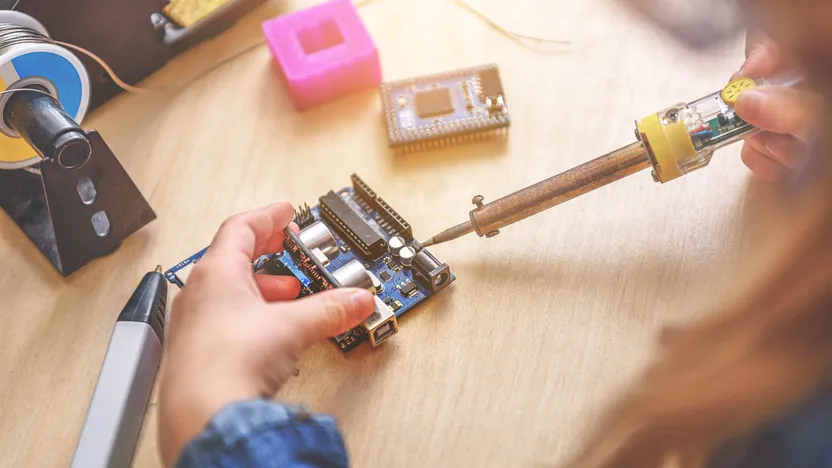
Equipped with a power cable and socket, a soldering iron comprises a handle connected to a metal tube. This protective tube contains a resistive heating element that is used to heat the soldering iron tip. The purpose of soldering is to create a solid electrical bond on a printed circuit board (PCB) or other electronic device. Ranging in power from 20 to 75 watts, simple soldering irons can heat to temperatures of between 380°C and 460°C, which will melt the solder at a melting point of 150° to 200°C. As continuously heated devices, soldering irons must be handled with caution to avoid burns to the hand. When used properly, they are quite handy for the odd repair. Larger models include pistol-shaped soldering guns featuring an on/off trigger that can be connected to a light or torch. Boasting at least 100W of power, these models are best for very high-temperature soldering jobs. Even more powerful models are used in jewellery making.
Shop our soldering irons
Soldering iron or temperature-controlled soldering station
Soldering iron
You can buy a standalone soldering iron or, for a few extra pounds, go for a soldering station with a stable metal base and iron safety rest. Stations often come as a soldering kit with a magnifying glass and tweezers for holding soldering wires or PCB components.
Soldering station
The temperature-controlled soldering station is the most sophisticated model. It comes equipped with a 220V - 24V DC transformer featuring digital temperature display, a potentiometer and a thermostat that lets you control the temperature of the variable heating element from 200°C to 400°C. This full-featured model also includes a safety rest for the heating element, which is smaller and easier to handle than a standard iron.
Best sellers in this category
Heating element: the soldering tip
Soldering iron tips are often interchangeable and adjustable and come in a number of models, each designed for specific joint and temperature requirements. In addition to hot tweezers, a pronged tip used to solder and desolder small parts, you'll also find chisel, conical and bevel models. The options and accessories are endless! Once you've settled on a model, be sure to check the availability of the specific tips you need.
Solder
Tin soldering technique
First, use the iron to heat the connection or workpiece to be soldered, then use the tip to apply the solder. Once it has cooled, the hardened solder should form an electrical bond. It's as simple as that! Bonus: solder is very forgiving. If you mess up, you can always start over!
Solder
Solder wire ranges from 0.5 mm to 3 mm in diameter and is composed primarily of tin (traditionally 60% tin, 40% lead). The solder contains a flux core that acts as a binder for the joint. Rosin is the most common type of flux. Due to its toxicity, lead is gradually being phased out of use and being replaced by lead-free solder wire. A small percentage of copper (3%) can be used instead.
Solder wick
Solder wick is generally made of braided tin-plated metal wires. It can be used to remove solder from tin joints. The wick is held against the solder by the heated soldering tip. The tin is then wicked into the braid while the solder melts. Once the solder has been cleared out of the joint, the component can be disconnected and removed. Solder wick is effective, affordable and easy to use.
Desoldering pump
A desoldering pump looks a bit like a spring-loaded syringe and is used to absorb melted tin during desoldering. The desoldering pump is a handy solution for removing excess solder from a joint.
Final tips for selecting and using your soldering iron
For occasional soldering needs, a simple iron will do the trick. More serious solderers should opt for a temperature-controlled soldering station. For the best results, be sure to use the right tip for your soldering project! Finally, be careful: these tools are hot!
Desoldering pumps
More information
Check out our guides to learn all about welding and soldering:
Flame welder buying guide
Flame welding: gas cylinder buying guide
Welding and soldering
You may be also interested in these guides
Guide written by:
Michael, Professional and passionate welder, Sheffield
I was trained as a pipe worker and a pipe-welder and after having travelled for 35 years working around the UK, I became the head of a metal shop, then a designer and in the end the head engineer. I have designed and built a workshop where I make metal sculptures: I managed to find a piece of paradise where I can let my imagination run wild. Auctions and garage sales are no secret to me. I find unusual objects and old tools there that I collect or transform into works of art. I also like decoration, painting on canvas, and gardening. I am developing new technologies concerning tools. To share my passion and advise you in your choice of materials is a real pleasure.
'/%3E%3C/svg%3E)