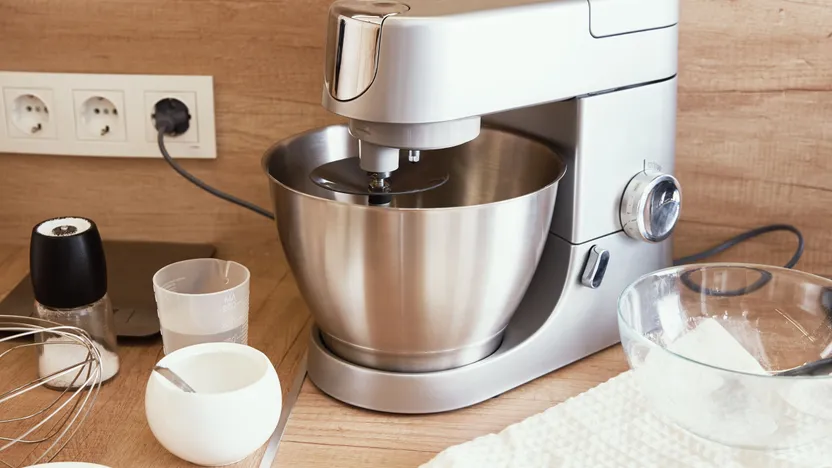
Stand mixer buying guide
'/%3E%3C/svg%3E)
Guide written on 6 February 2024 by:
Jennifer, Self-taught DIY enthusiast, Manchester
Best sellers in this category
6 questions to ask yourself before choosing a stand mixer
Choosing the perfect stand mixer isn't always easy. To help you out, we've come up with a list of questions to ask yourself before you buy.
What type of baking do I want to do? This will help you pick the right stand mixer settings.
How often do I plan to use the stand mixer? This will help you to look at the most suitable ranges.
How much am I willing to spend? This will help you figure out what stand mixers are within your budget.
How many people do I want to serve? This will dictate the size of the bowl.
What level of quality am I looking for? From direct drive to belt drive motors, it's important to understand the key differences between stand mixers.
What colour and style am I after? This will help you pick an attractive stand mixer that matches your style perfectly.
Shop our stand mixers
Stand mixers: what are the main attachments?
Whether you're looking to bake professional cakes or make your own bread dough, a stand mixer can do it all! All stand mixers generally come with a whisk, a flat beater and a dough hook as standard to handle a range of delicious recipes, and stainless steel is usually the material of choice. Below you'll find more information about the role of each type of attachment.
1. Whisks: for everyday mixing
Designed to beat and whip, whisk attachments tend to get the most use. These attachments are wider than regular electric whisks meaning you can incorporate more air into your mixtures. A whisk can be used to make things like mayonnaise, whipped cream and meringue.
2. Flat beater or mixer blade: for normal to heavy consistencies
Flat beaters are used for mixtures with normal to heavy consistencies. They can be used to mix things like crepe, fritter and cake batter. Perfect for smoothing out lumps, these beaters are perfect for creating smooth mixtures. Some models have a silicone spatula component which is great for folding mixtures.
3. Dough hooks: the baker's best friend
A dough hook is key for baking bread. These hooks are used to knead and soften pizza dough or brioche, for example. As the machine runs, the hook works to inject air into the dough.
It moves in a rotating motion to emulate the action of kneading by hand to create a uniform dough, wiping down the walls of the bowl at the same time.
Electric whisks
Best sellers in this category
Stand mixers: frequency of use and budget
A stand mixer that is used every day needs to be more robust than one that is only used occasionally. If you tend to bake from time to time, a low end stand mixer will do the job just fine. A fairly resistant model should provide all the features you need for basic baking.
If you bake on a daily basis or have a large family to feed, it is best to start looking at mid range models. Stainless steel and metal attachments will be your best bet as they are designed to withstand heavy use and regular cleaning.
Here is a quick guide to help you understand the type of price ranges you will be looking at.
Budget: £100 to £200
Mid range: £200 to £600
High end: £600 to over £1000
Bowl-lift vs. tilt-head stand mixers
There are two basic types of stand mixer: bowl-lift and tilt-head models. While the first option is used more by professional bakers, the second is still worth considering.
1. Bowl lift stand mixers: while these stand mixers are a little trickier to fit with additional attachments, they offer excellent stability as they have fixed heads. The bowl is lifted and lowered using a manual lever found on the side of the stand mixer. These mixers are ideal for regular use.
2. Head tilt stand mixers: in this case, the arm is designed to tip back. A 'lock' button is featured to prevent the head from falling back down. While handier for fitting and removing attachments, models with the motor located in the arm do require a bit of strength to move.
What kind of mixing bowl do you need?
The mixing bowl is the most handled part of the machine and can have a volume of 1 to 7 litres. Some bowls feature handles, pouring spouts or measurement markings. For a bowl that is practical and comfortable to use, take the time to consider weight, strength and size.
Volume
It is essential to choose the right bowl size for your stand mixer. If the bowl is too big, some models won't be able to whisk or beat small amounts of ingredients. This is because the whisk, beater or dough hook won't necessarily touch the bottom of the bowl. On the other hand, if you pick a bowl that is too small for your needs, you won't be able to mix enough to feed everyone!
Stand mixer bowl sizes
Number of people | Volume in litres |
2 people | 2 to 3 litres |
4 people | 3.5 to 4.5 litres |
5 people or more | 6 litres + |
Bowl material
While stainless steel is an ever popular choice in kitchens, it is also possible to find plastic, glass, metal or ceramic bowls. Here's a table to help you find the best stand mixer bowl for your needs.
Stand mixer bowl materials
Material | Advantages | Disadvantages |
Plastic | Lightweight | Can't withstand extreme temperatures Will weaken over time Odours can build up |
Glass | Can withstand all temperatures | Heavy Breakable Expensive |
Stainless steel | Resistant Easy to clean Lightweight Does not retain odours | Cannot be used in oven / microwave |
Ceramic | Can withstand all temperatures Can be used in oven and microwave | Breakable Expensive (high end option) |
Choosing a stand mixer motor
Did you know that it's not the power rating that determines the performance of a stand mixer? In fact, it is how the motor works that makes the difference between different models. There are three different types of motor:
Belt drive
Direct drive
High performance
Belt drive
These motors are less expensive and usually used to equip low end to mid range stand mixers. As the motor is found in the base of the appliance, the arm is light and easier to lift. However, these models are noisier and less powerful than other stand mixers.
Direct drive
Fitted in the head of the stand mixer, the motor is directly connected to the attachments. This means that all the power of the motor is transmitted directly to the attachments which makes these models quieter.
High performance
If you are looking for a more eco friendly option, these models are for you! These digital mixers save energy by automatically adjusting the rotational speed settings of the accessory according to the thickness of the mixture. The motor is also located in the arm of the mixer which makes these models quieter to operate.
In short, the greater distance between the belt driven motor and the accessories is the main reason behind power loss. In fact, these stand mixers have to use more energy than direct drive and digital mixers to perform the same task! This distance also has an impact on the noise level of the appliance.
Final tips for choosing a stand mixer
Here are a few final pieces of information worth mentioning. While perhaps not the first thing to look for, these features can be important when it comes to choosing between different models.
Multipurpose food processors feature several outlets which can be used to add attachments to the body of the appliance. Using a multipurpose food mixer, you can benefit from accessories like choppers, blenders or even a dough roller.
Most stand mixers come with a splash guard, but it's also possible to get a pouring shield which allows you to add ingredients to the mixture without splashing.
The heavier the stand mixer, the more stable it is. It's a good idea to go for a model with a metal outer casing. If you opt for a plastic stand mixer, be sure to check that it is heavy enough to withstand kneading without moving around. Be sure to check that it comes with little suction pads for more stability.
Stand mixers have become somewhat of a kitchen accessory in their own right. If your appliance is going to be sitting on centre stage in the kitchen, it's best to pick one you like the look of and can fit into your counter space. Brands offer a wide range of styles and colours so go for a model you love!
Food processors
More information
You have all the information you need to pick the perfect stand mixer – now it's up to you to decide! For more information, don't hesitate to check out our other kitchen guides.
You may be also interested in these guides
Guide written by:
Jennifer, Self-taught DIY enthusiast, Manchester
I didn’t receive any special training, I learned everything on the job. And what a joy it is to be able to do little jobs around the house that we love so much. That is, until the moment we decided to move and had to do everything; from the floor to the ceiling, from the kitchen to the bathroom...In short, you become as good as a pro. So today, my friends don’t hesitate to call me when they need help. And when you dip your toe in, there’s no turning back. It’s a true passion that drives us to take on the challenges, to have an idea in mind and see it come alive with just a few tools. And a passion is even better when you can share it. So, whenever I can give you a little advice, it’s with great pleasure.
'/%3E%3C/svg%3E)