Walk in or wet room shower: which is right for you?
'/%3E%3C/svg%3E)
Guide written on 25 September 2026 by:
Jérôme, Construction site supervisor, Cardiff
Important features
- Available space beneath finished floor surface
- Slope and drain diameter
- Space available
- Preparing the surface
- Installation and finish
- Budget
Best sellers in this category
Walk in showers: comfort meets style
Walk in showers are, by definition, designed for walk in access. This means that there isn't any curb or step to climb over.
As such, your bathroom floor can be completely level which is great for creating a contemporary feel and the illusion of space. What's more, it also makes the shower more comfortable to use.
But depending on the layout of your bathroom there is an important decision to be made: do you want a wet room shower or a walk in shower?
A wet room shower is designed to be completely open with no shower tray while a walk in shower features a low profile shower tray. We'll run through the pros and cons of each option according to your existing layout in terms of both installation and budget.
What is a walk in shower?
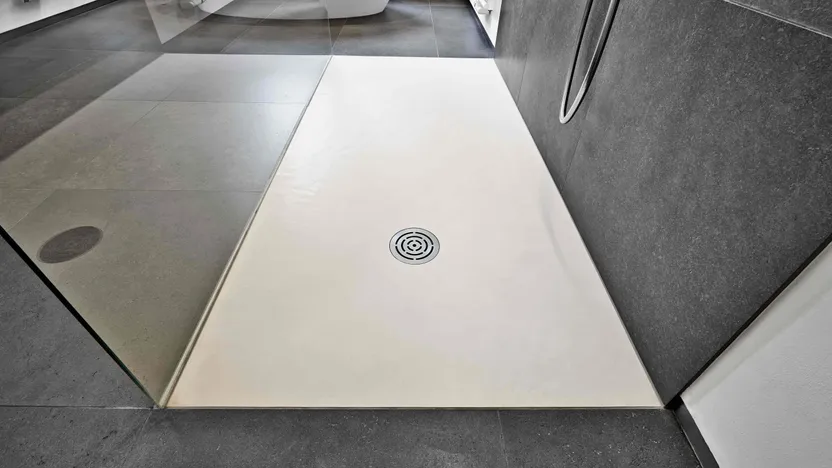
A walk in shower features a shower tray that can be installed in the floor or placed directly on the floor. Fitting a shower tray means less installation work overall and also limits issues relating to overflow or leaks.
Shower trays are pre-designed with the correct slope to direct the water towards a linear or grid drain. What's more, these trays are usually non-slip. A shower tray does not necessarily need to be covered so you can choose whether or not you want to tile over it.
Walk in showers are equipped with special low profile trays. The thickness of these trays is roughly 3 to 5 cm.
Shop our shower trays
Installation requirements
Requirement | Walk in shower | Wet room shower |
Required space beneath finished floor | 50 mm minimum | 100 mm minimum |
Slope | 1.5 to 2% | 2% minimum |
Drain diameter | 40 mm | 40 mm |
Space available | Up to 160 x 100 cm as standard | Unlimited |
Best sellers in this category
Wet room vs. walk in showers: pros and cons
Criterion | Walk in shower | Wet room shower |
Surface preparation | - Can be installed on an unfinished surface. - No work required to make the shower tray flush. - Limited depth for shower waste. - No need to calculate slope, the shower tray is pre-designed with the correct gradient. | - Requires more depth for the shower waste (at least 10 cm). - Preparation required to prevent leaks (extra materials required to ensure watertightness). - Requires slope calculation to direct water towards plug hole. |
Installation | - Simply glue down and seal the shower tray. - Requires steps to seal the base and edges of the tray. - Requires tile laying experience for tile over trays. - Requires grout application. | - Requires use of primer before gluing. - Requires experience in laying mosaic or tiles in the shower base with the correct slope. - Requires grout application. |
Finishes | - Simply need to seal the edges around the shower tray. - Waterproof materials required for the walls. | - Wet room showers do not have any contours. No sealing is required. - Waterproof materials required for the walls. |
Budget | Installing a shower tray is the least expensive option as preparation is quicker and easier, and you don't have to tile over the tray. | This is the most streamlined solution but also the most expensive considering the preparation work required and the cost of installation and materials. |
Mosaic floor tiles
Walk in vs. wet room shower: do I need a shower tray?
In summary, you will have to weigh up a range of technical and aesthetic criteria before making your choice.
You might find that your decision is made for you by the existing layout of your bathroom.
But if you do have the option to choose, go for the solution that best matches your DIY skills (if you are doing the work yourself) as well as your budget and expectations.
If you simply want an inexpensive shower that is quick to set up, go for a walk in shower with a shower tray.
Shop our shower trays
You may be also interested in these guides
Guide written by:
Jérôme, Construction site supervisor, Cardiff
Electrician by trade, I first worked in industrial estates where I installed, wired and fixed a large number of electrical installations. After this, I managed a team of electricians for this type of work. 10 years or so ago, I turned to building and construction. From the modest family home, to gyms and theatres, I have been able to coordinate, audit and organise all sorts of construction sites. For 4 years now, I am restoring and building an extension to a bungalow in the heart of the Welsh countryside. My experience in manual work and my knowledge means I am proud to be of service. Terraces, interior design, roofing, plumbing, electrics, anything goes! My wife, daughter and I, built almost everything we have from scratch! So to answer all of your questions and advise you on choosing your tools? Easy!
'/%3E%3C/svg%3E)