Concrete and mortar buying guide
'/%3E%3C/svg%3E)
Guide written on 6 February 2024 by:
Albert, Manager of a gardening service, Leicester
Important features
- Similarities and differences
- Composition
- Uses
- Proportions
- Mixing
What is the difference between concrete and mortar?
People often get confused between concrete and mortar when starting out in the world of DIY. In fact, even experienced DIYers can have trouble! Admittedly these building materials can cause confusion, especially if you consider the huge variety of different ready-mixed mortars and concretes on the market and the fact that each can be used for a range of applications. In order to find your way, it's important to be familiar with the materials that make up each product. Next, you need to know about the characteristics of the materials. To finish off, you need to learn more about their various uses in building.
To save you getting your trowels in a twist, just remember this basic fact – concrete and mortar both contain sand, cement and water; however, concrete also contains aggregates which mortar does not.
Mortar
What is mortar?
Mortar is a mixture of one or several binders and sand to which water is added. Other elements can be also be incorporated to give the mortar additional properties.
What is concrete?
Concrete is made using just one binder: cement. Sand and aggregates are added to the cement and water completes the mix. Just like with mortar, certain additives can be added to give the concrete special properties.
Concrete and mortar
Different types of mortar
There are several types of mortar each of which has different characteristics depending on the types of binders and materials used. The most common types of mortar are:
Cement mortars
Lime mortars
Cement-lime mortars
Mortar binders
Two main types of binders are used to make mortar:
Lime
Lime can be hydraulic or non-hydraulic. Hydraulic lime hardens upon contact with water while non-hydraulic lime, or 'air' lime, hards upon contact with air. Lime is a flexible and breathable product meaning air and water vapour pass easily through its pores.
Cement
Cement is divided into several grades which define its strength and suitability for different applications (such as indoor or outdoor use). Different types of cement include white, grey and Portland cement. Unlike lime, cement is not very flexible or porous, but it does have high compressive strength.
Mortar is made up of cement and lime, or a couple of binders.
Cement mortars
Cement mortars offer a few different properties:
high compressive strength provided it is applied under a certain thickness;
excellent adhesion which allows different materials to be joined;
good weather resistance provided the right type of cement and waterproof additives are used;
good stability which allows the material to remain compact and rigid for a long time after curing.
These properties can be strengthened with the addition of other materials such as resins, mineral powders and so on. Other properties can be achieved with additives such as:
pigments to mix mortars in a variety of colours and tones;
resins to provide mortars with moisture resistance, enhanced adhesion, greater deformability, and so on.
fibres: natural or synthetic, fibres are used to increase mechanical strength.
Lime mortars
As the name suggests, these mortars feature a lime binder. Depending on the type of the lime, you can get two types of mortar: hydraulic and non-hydraulic.
the binder in hydraulic lime mortar cures upon contact with water. These types of mortar are vapour permeable meaning they allow water to pass through them as a gas and liquid. This makes them weather-resistant;
non-hydraulic lime mortar, or 'air' lime mortar, cures upon contact with the air. It is somewhat vapour permeable but should only be used indoors in dry rooms as it cannot cope with high levels of moisture or weathering;
Cement-lime mortars
Mortars made using both hydraulic lime and cement are called cement-lime mortars and combine the properties of each binder for:
good mechanical strength and weather resistance;
vapour permeability for water in liquid and gas form.
Please note that the amount of lime or cement used can vary which will alter the properties of the mortar.
What is mortar used for?
As already mentioned, mortar can be used for a range of applications. For each task, there is a mortar with the right characteristics and properties to match. Here are a few examples:
Plastering or rendering works: cement, lime or cement-lime mortars can be used depending on the surface. Check product specifications to find the correct product.
Screeding a floor: a cement mortar is recommended in this case. Be sure to choose the right product for indoor or outdoor use.
Building brick or block walls: cement mortar is recommended in this case. The packaging will usually labelled 'bricklaying mortar'.
Anchoring in the ground: grade 2 cement mortars are best in this case thanks to their flexibility.
Adhering materials to the ground or walls: use a cement-based adhesive mortar with additives for greater adhesion.
Pointing masonry joints in brick and stonework. Use a pointing mortar in this case. Designed specifically for this purpose, these mortars are waterproof for outdoor use or use in high-humidity rooms.
How to mix concrete
Concrete is a mix of cement, sand, aggregates and water. The standard ratio is as follows:
3-2-1-0.5. Three parts aggregates, two parts sand, one part cement and a half part water.
Please note that this formula is purely indicative and can vary depending on the task and the location of the work being carried out. The same goes for additives which can be added to strengthen the concrete or achieve certain properties.
Main characteristics of concrete
No matter what, concrete is always a strong material with relatively high compressive resistance. However, it has low tensile and shear strength.
Concrete is often poured with reinforced structures – such as mesh, horizontal and vertical rebars, and pre-fab cages - to make up for these weaknesses. This system is what is referred to as reinforced concrete.
What is reinforced concrete used for?
Reinforced concrete is used to form large-scale structural elements. It can also be used for outdoor landscaping. Here are the main types of applications for reinforced concrete:
floors;
foundations;
columns;
walls and internal walls.
Furthermore, it can be used to create pre-fabricated elements such as beams, lintels and window sills. In landscaping, concrete can form things like concrete slabs, gate pillar footings, wall foundations and so on. It can also be used for patios and can provide the following finishes:
broom finished concrete: a fine-lined texture on the surface;
polished concrete: a very smooth finish created using small aggregates;
exposed aggregate concrete: the top layer of cement is removed to expose the aggregate beneath;
imprinted concrete: moulds are added to the concrete before it cures to form different designs on the surface;
coloured concrete: pigments are added to the concrete to mix the colour of your choice.
How to mix mortar and concrete
Mortar and concrete are formed by mixing the components mentioned above with water. However, it is possible to buy ready-made powders with the correct ratios already worked out. In this case, you simply need to combine the mixture with the amount of water set out by the manufacturer and mix.
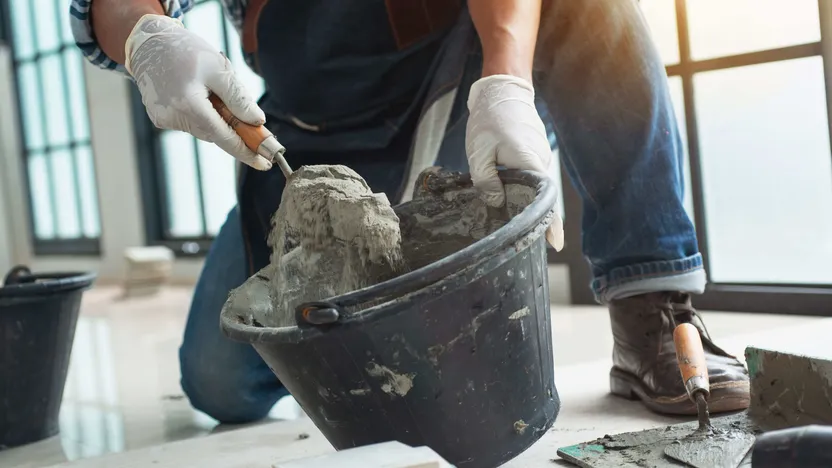
For small quantities of mortar or concrete, you can mix using a mixing tub and trowel. Alternatively, you can use a paddle mixer or a mixing attachment fitted onto a drill.
The advantage of using a ready-made concrete or mortar is that the proportions have already been worked out for you. All bags are guaranteed to be exactly the same product.
Paddle mixers
When do I need to use a cement mixer or concrete truck?
For a medium-sized job you'll need a cement mixer. Start by adding the right quantity of water before incorporating the other components.
For larger jobs, a concrete mixer truck will be the best option. Hiring a concrete truck means you can pour concrete quickly which will come in handy for a range of tasks. You may also be able to order mortar to screed a floor.
Cement mixers
More information on building
You may be also interested in these guides
Guide written by:
Albert, Manager of a gardening service, Leicester
For several years I have been running a garden service with a clientele of both individuals and companies. I manage a team of gardeners and ensure the creation and maintenance of green spaces. At the same time, I bring my expertise to my clients in terms of the maintenance and improvement of their gardens. In fact, as a trainee and working in the hospitality industry at the beginning of my career, I focused on landscaping in a local community where I acquired solid technical skills through in-house training and the follow-up of major projects in a rapidly changing town. On a personal level, I am equally oriented towards the art of gardening. With my wife, I created our garden from start to finish and I maintain it carefully, the same goes for the vegetable garden. As for DIYing, it’s not to be outdone. Yes, gardening is also tinkering: pergolas, huts, pavements, fences, and so on...There is always something to do in a garden. After working well together, my wife and I are proud of the result and delighted to be able to take full advantage of a friendly and warm environment. So, let us give you advice and help you in your choice of tools, maintenance, or the improvement of your garden, nothing could be simpler.
'/%3E%3C/svg%3E)