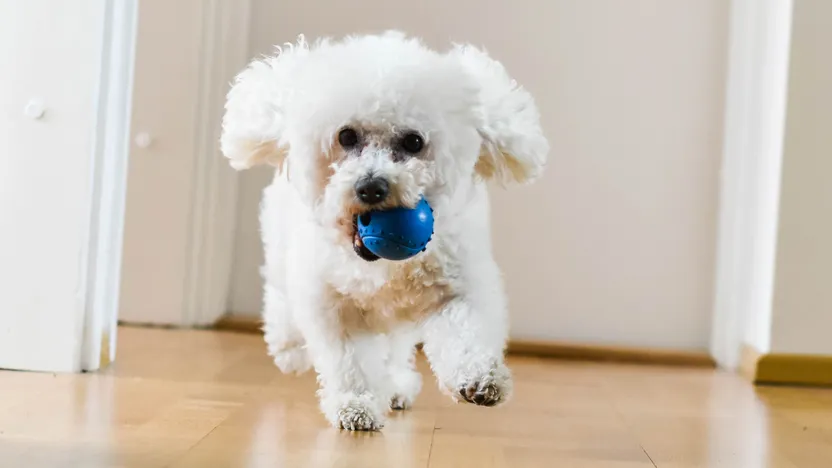
Apartment dogs: 10 best dog breeds for flats
'/%3E%3C/svg%3E)
Guide written on 25 September 2026 by:
Tess, Painting & decorating consultant, Brighton
Important features
- Breed standards
- Grooming and care
- Health
- Temperament
Best sellers in this category
Challenges for dogs living in flats
If you live in a flat or small house, your dog must taken out regularly both for toilet breaks and to burn off energy. Some dogs can learn to live in a flat, but some breeds will do better than others – and this is not necessarily driven by size alone.
For example, while they are both small breeds, a Cairn terrier will fit in better with an active lifestyle while pugs tend to prefer a more laid back approach to life. Always bear in mind that boredom can be a serious issue for dogs. If you have to leave the dog alone on a regular basis – for reasonable periods of time only – choose a breed that is better equipped to cope. A Cavalier King Charles spaniel, for example, may not be the best option. Most importantly, make sure the dog is comfortable being left alone from a young age.
Another factor for flat-living is ensuring that your dog won't bark at the slightest noise. Some breeds are more prone to barking than others.
How to take care of a dog in a flat
No matter how much or how little energy your dog has, any dog kept in an apartment must be taken on regular walks to relieve themselves and let off steam. Regular outings also provide mental stimulation. In short, this means taking your dog out at least three times a day – and that doesn't mean a quick five minutes around the block! Most dogs require at least one long walk of a minimum of one hour a day plus toilet breaks. Of course you need to respect the physical needs and abilities of each individual dog when exercising – for example, some breeds are less able to tolerate the heat while others should not be allowed to jump excessively.
Your dog also needs to play and as dogs are social animals, they need to spend time with other dogs if you want them to live a balanced life. This rule applies even if they live with other animals.
Dogs
Best sellers in this category
10 best dog breeds for flats
Poodle
Maltese bichon
French bulldog
Cairn terrier
Cavalier King Charles spaniel
Chihuahua
Pug
Coton de Tuléar
Pekingese
Lhassa Apso
1. Poodle
While the poodle we know today was standardised in France, the original breed is thought to have come from Germany. Named after the German word 'pudel' (meaning puddle), these dogs were originally bred to hunt waterfowl. However, there is an alternative theory that these dogs are descended from the Barbet, a French water dog. And while the two breeds are considered separate today, they do share a number of similar traits.
Poodle breed standards
Names: toy, miniature and standard.
Origin: Germany/France.
Type: utility. Health: category 1 (currently no points of concern specific to this breed have been identified).
Colour: solid colour (apricot, black, blue, brown, cream, red, silver, white).
Coat: curly.
Size: toy: less than 10 inches; miniature: 10-15 inches; standard: over 15 inches.
Weight: toy: 1.8-2.7 kg; miniature: 4.5-6.8 kg; standard: 27-32 kg.
Body: well-proportioned.
Tail: set high.
Head: in proportion to body, well-chiseled.
Lifespan: over 12 years.
Poodle grooming and care needs
Poodles do not shed their coat in the traditional sense but do need to be brushed and combed regularly.
They should also be fully groomed every two months on average. A wide range of cuts is possible but only some will be accepted for competitions (i.e. puppy, English saddle, continental, sporting).
Poodle health issues
Poodles are robust dogs with long lifespans. They do not have a pre-disposition to any major health issues currently but it's important to keep an eye on their ears as they can suffer from ear infections. As with all dogs, it's important to take care of their teeth to prevent tartar build-up.
Poodle temperament
Affectionate, gay-spirited and playful, poodles are intelligent and easy to train. They tend to be very attached to their owners and will usually get along well with children. Poodles are usually able to adapt to their owners' lifestyle and can be left alone for short periods. However, as they were originally bred to hunt, they need to tire themselves out regularly.
Shop our dog food
2. Bichon Maltese
Despite the name, the Bichon Maltese doesn't come from the Maltese archipelago. In fact the name actually comes from the Phonecian word 'màlat' meaning port or haven. Great numbers of these dogs once lived in seaside cities around the central Mediterranean basin and on boats where they were used to hunt rats. Other bichons include the Bichon Frise, Bolognese and Havenese.
Maltese breed standards
Names: Bichon Maltese, Maltese.
Origin: central Mediterranean Basin.
Type: toy. Health: category 1 (currently no points of concern specific to this breed have been identified).
Colour: white.
Coat: long, straight and shiny.
Size: 8-10 inches.
Weight: 3 to 4 kg.
Body: long.
Tail: wide at the base and tapered towards the tip.
Head: gently rounded viewed from the front and sides. Muzzle never shorter than in the ratio of 1:2.
Lifespan: over 12 years.
Maltese grooming and care needs
Maltese are small dogs that require a lot of care. Their coats must be brushed daily and regular baths are required (around twice a month) to keep them white.
Their eyes should be cleaned daily.
Daily teeth brushing should help to prevent tartar formation.
Maltese health issues
Maltese are generally healthy dogs with long lifespans. However, they can suffer from patellar luxation where the kneecap slips out of place. It's therefore important to keep an eye on their weight– especially since this breed can be greedy! These dogs do best with regular exercise but shouldn't be allowed to jump too high. Maltese dogs are also sensitive to extreme temperatures.
Bichon Maltese temperament
Gay-spirited and calm, Maltese love to take long walks. They tend to be very attached to their owners and get long with children. However, they can suffer from separation anxiety and may not tolerate being left alone for long. These dogs are easy to train using positive reinforcement methods and they don't tend to be big barkers.
Dog flea, tick and worm treatments
3. French bulldog
French bulldogs are one of the smallest members of the Molasser dog family. The breed we recognise today is a result of selective breeding by Parisian breeders in the mid 19th century. First popularised in working class neighbourhoods, this breed eventually worked its way into high society.
French bulldog breed standards
Names: French bulldog, Frenchie.
Origin: France.
Type: utility. Health: category 2 (several points of concern).
Colours: brindle, light brindle, dark brindle, brindle & white, fawn, fawn & white, fawn pied, fawn with black mask, pied.
Coat: short, lustrous, no undercoat.
Size: 11-13 inches.
Weight: 8-14 kg.
Body: compact and muscular.
Tail: short, thick at base and tapering towards tip.
Head: square head in proportion to body size, fine wrinkles over skull and forehead.
Lifespan: over 10 years.
French bulldog grooming and care needs
French bulldogs are small dogs that don't require a lot of grooming. A brush once a week and a bath every three months or so will suffice.
But pay attention to skin folds around the face – they must be checked and cleaned regularly.
These dogs also have delicate eyes that must be closely monitored.
French bulldog health issues
While fairly robust, French bulldogs frequently suffer from respiratory issues due to their flat faces and shorter airways. These breathing difficulties can result in issues like sleep apnea and snoring. French bulldogs suffer from back issues and it is not advisable to let them jump too much. These dogs are not equipped to tolerate the heat.
French bulldog temperament
Affectionate, playful and friendly, French bulldogs tend to be very attached to their owners and usually love children. While they do need to burn off energy, they don't demand a lot of exercise and will be happy with a daily walk. But it will come as no surprise to hear these dogs are not good swimmers. French bulldogs, like all dogs, must be trained from a young age and can suffer from separation anxiety.
Shop our dog toys
4. Cairn terrier
Cairn terriers originate from the Scotland Highlands and are one of the oldest terrier breeds. Originally bred to run around the cairns of Scotland, these working dogs were kept to hunt and chase quarry. They are thought to be descended from number of Scottish breeds, including the West Highland White Terrier and the Skye Terrier.
Cairn terrier breed standards
Names: Cairn terrier.
Origin: Scotland.
Type: terrier. Health: category 1 (currently no points of concern specific to this breed have been identified).
Colour: many including brindle, cream, wheaten, grey and red.
Coat: double-coated. Harsh and thick overcoat with short and close undercoat.
Size: 9-13 inches.
Weight: 6-10 kg.
Body: straight, medium-length.
Tail: short and well-proportioned.
Head: small and well furnished.
Lifespan: over 10 years.
Cairn terrier grooming and care needs
These dogs have medium-length coats and don't regularly shed meaning you can get away with brushing once a week and washing every three months or so. They must be fully groomed regularly but should never be shaved at the risk of damaging their outer coat.
Their eyes and ears should be cleaned regularly.
Cairn terrier health issues
Cairn terriers don't have any breed-specific health issues which explains their longevity – they have been known to live up to 20! However, they can suffer from joint issues like patellar luxation (or dislocated kneecap). Skin issues can also occur, especially as these dogs age.
Cairn terrier temperament
Very active, intrepid and mostly friendly, Cairn terriers can make playful and affectionate companions. They can, however, be strong-willed and need to be trained carefully and allowed to let off steam regularly. This breed will be happy to join a sporty owner in all activities. These dogs can lack patience and should be watched around babies and young children.
Dog travel
5. Cavalier King Charles spaniel
These British dogs are part of the spaniel family. Descended from toy spaniels as far back as the 15th century, King Charles spaniels were named after King Charles II, who was very fond of the breed. The Cavalier King Charles spaniel, which has a longer muzzle than the King Charles spaniel, was officially recognised as a separate breed in 1945 by the Kennel Club.
Cavalier King Charles breed standards
Names: Cavalier King Charles spaniel (erroneously King Charles spaniel, English toy spaniel).
Origin: Scotland.
Type: toy. Health: category 2 (several points of concern).
Colour: bleinheim (chestnut and white), black and tan, ruby and tricolour.
Coat: long, silky, straight.
Size: 12-13 inches.
Weight: 5-8 kg.
Body: straight and well-proportioned.
Tail: proportionate length to body.
Head: small, almost flat between the ears.
Lifespan: over 12 years.
Cavalier King Charles health and care
Cavalier King Charles sheds moderately and should be brushed several times a week or daily.
These dogs should be bathed every two months and their eyes and ears must be cleaned regularly.
Pay close attention to tartar build-up.
Cavalier King Charles health issues
Cavalier King Charles spaniels are sensitive to the cold and humidity, and should be dried off after a rainy walk. This breed has a predisposition to a range of health problems including heart issues; mitral valve disease is particularly common.
Cavalier King Charles spaniels temperament
Calm and very sociable, Cavalier King Charles spaniels love to be surrounded by humans and usually other animals, too. Particularly gentle and affectionate, these dogs make ideal companions for younger children. These dogs generally need a moderate amount of daily exercise, but do not like to be left alone.
Shop our dog training leads, collars and harnesses
6. Chihuahua
One of the smallest dog breeds in the world, these dogs owe their name to the largest Mexican state. Thought to be descendents of the ancient breed Techichi, the chihuahua is one of the oldest dog breeds in the world. The chihuahua was brought to England at some point in the 1800s and gained popularity in the US at the start of the 20th century.
Chihuahua breed standards
Names: Chihuahua, Chihuahueño.
Origin: Mexico.
Type: toy. Health: category 2 (several points of concern).
Colour: all colours and combinations possible.
Coat: smooth coat and long coat varieties.
Size: 6-9 inches.
Weight: 1-3 kg.
Body: compact and well-built.
Tail: medium length set high.
Head: round, apple-shaped.
Lifespan: over 10 years.
Chihuahua grooming and care
While smooth-coated chihuahuas only need to be brushed about once a month, long-coated dogs will need to be brushed about three times a week and will need to be bathed about once a month.
Their nails also need to be trimmed regularly as they don't tend to wear down enough on their own.
It's also important to monitor eye, ear and dental health.
Chihuahua health issues
Despite their small size, chihuahuas are robust dogs with long lifespans and don't have a predisposition to any particular health problems. They can, however, suffer from hypoglycaemia which can affect growth rate. Other common health issues include patellar luxation and skin conditions.
Chihuahua temperament
Lively, or even boisterous, chihuahuas are characterful dogs. They tend to be very affectionate with their owner but may be less so with strangers (particularly men) or other animals if not socialised correctly. It's also important to get them used to being around children, if required. While chihuahuas can be trained out of separation anxiety, they do tend to bark more than other breeds.
Dog bowls and feeding accessories
7. Pug
Originating in China, pugs are small Molossers that were brought to Europe by merchants from the Dutch East India Company. After becoming a symbol of the Dutch royal patriots, pugs moved to the English throne with William III before winning over France under the reign of Louis XV.
Pug breed standards
Names: Pug, Dutch bulldog.
Origin: China.
Type: toy. Health: category 3 (several points of concern).
Colour: fawn with black mask, apricot with black mask, silver with black mask, black.
Coat: short and glossy.
Size: 10-13 inches.
Weight: 6-8 kg.
Body: compact and muscular.
Tail: High set, tightly curled over hip. Double curl highly desirable.
Head: round and relatively large in proportion to body.
Lifespan: over 10 years.
Pug grooming and care
Like most short-coated dogs, pugs require little to no brushing. But beware – these dogs do shed a lot.
It's important to monitor facial skin folds.
As pugs tend to have watery eyes, they must have their eyes cleaned regularly to prevent the risk of infection.
Pug health issues
While robust little dogs, pugs have short muzzles meaning they are at risk of developing respiratory problems and tend to snore. Their flat faces and protruding eyes make them more susceptible to eye infections. They are also prone to bacterial skin infections particularly around skin folds.
Pug temperament
Energetic but calm, these dogs are easy-going and affectionate. They usually enjoy playing with both adults and children. They also tend to get on well with other animals. Intelligent and easy to train, these dogs are usually homebodies and enjoy their sleep. However, they often struggle being left alone.
Shop our dog beds
8. Coton de Tuléar
These little dogs originate from Tuléar, a port city in the south of Madagascar known today as Toliara. Thought to be descended from bichons, the ancestors of these dogs were likely brought over by colonisers or sailors who would have used them to hunt rats. These dogs made their way to France in the 1970s where they were then bred and popularised throughout Europe and the US.
Coton de Tuléar breed standards
Names: Coton de Tuléar, Coton, Cotie.
Origin: Madagascar.
Type: toy. Health: category 1 (currently no points of concern specific to this breed have been identified).
Colour: white, white & brown, white & grey, white & lemon, white & tan.
Coat: soft, supple and cotton-like in texture.
Size: 9-13 inches.
Weight: 3 to 6 kg.
Body: longer than they are tall.
Tail: low set but carried in a gentle curve above the back when moving.
Head: short and triangular when viewed from above.
Lifespan: over 12 years.
Coton de Tuléar grooming and care
With a cotton-like coat which tangles easily, Coton de Tuléars need daily brushing. Regular baths, around once a month, are also required.
These dogs need to be groomed fully about twice a year before their coats get too long.
Their eyes should be cleaned daily and their nails cut short. Their eyes and teeth must be monitored.
Coton de Tuléar health issues
These little dogs tend to be very healthy. What's more, they aren't highly affected by the cold or heat thanks to their cottony coat. Coton de Tuléars can, however, suffer from progressive retinal atrophy and hip dysplasia.
Coton de Tuléar temperament
Affectionate, loyal and playful, Coton de Tuléars usually get on very well with children and other dogs. They don't need a huge amount of exercise which make them ideal pets for elderly people or those with less active lifestyles. However, they are often fearful of strangers and don't generally enjoy being left alone.
Dog clothing
9. Pekingese
Pekingese dogs originated in China where they were considered sacred. During the Anglo-French invasion in the 19th century, the Emperor Xianfeng ordered all the dogs to be killed rather than have them fall into British hands. However, five dogs were found and brought back to England where they were used to carry on the breed.
Pekingese breed standards
Names: Pekingese, Pekinese.
Origin: China.
Type: toy. Health: category 3 (several points of concern).
Colour: all colours.
Coat: moderately long and straight.
Size: 6-9 inches.
Weight: 2-5 kg.
Body: short and level.
Tail: sits fairly high, curved slightly over back.
Head: proportionally wider than deep.
Lifespan: over 10 years.
Pekingese grooming and care
Pekingese dogs have long hair that must be brushed daily to prevent matting. Regular baths (around once a month) are also required.
These dogs need a full groom every two to three months.
Pay special attention to dental and eye care.
Pekingese health issues
While rarely ill – hence their long lifespans – these dogs do not tolerate heat well and females must be monitored very closely while pregnant and giving birth. Pekingese are also susceptible to ear infections and skin conditions.
Pekingese temperament
Lively and intelligent, Pekingese are courageous dogs who take their role as protector seriously. These dogs are strong-minded and will require consistent positive reinforcement training. They tend to get on well with children and other animals, and are more independent than other toy breeds meaning they can tolerate being left along for short periods.
Shop our dog training and sport
10. Lhassa Apso
'Lhassa Apso' (which can be translated to 'Lhassa long-haired dog' or even 'Lhassa goat') are small dogs originating in Tibet. These dogs are known as Apso Send Kyi in Tibet which loosely translates to 'bearded lion dog' presumably owing to their appearance and characteristic bark. Considered sacred in their country of origin, these dogs didn't make their way to Europe until the start of the 20th century.
Lhassa Apso breed standards
Names: Lhassa Apso, Apso Seng Kyi.
Origin: Tibet.
Type: utility. Health: category 1 (currently no points of concern specific to this breed have been identified).
Colour: many solid and mixed including black, tan, white, brindle, brown, cream, gold, golden, grey, honey and sandy.
Coat: long, straight and heavy.
Size: 9-11 inches.
Weight: 4-7 kg.
Body: compact and well-proportioned.
Tail: sits high and carries over back.
Head: well-furnished head that doesn't affect dog's ability to see.
Lifespan: over 12 years.
Lhassa Apso grooming and care
Lhassa Apso require regular care with brushing three to four times a week and a shampoo every one to two months.
Their coat can be kept short which will entail clipping every one to two months.
Their ears, eyes and teeth should be carefully monitored.
Lhassa Apso health issues
While very tolerant of cold weather – owing to their origins and coat type – Lhassa Apso do not cope very well with the heat (like all flat-faced dogs). This characteristic can also lead to respiratory issues. These dogs are also susceptible to ear infections and musculoskeletical problems.
Lhassa Apso temperament
Playful and affectionate, Lhassa Apso don't need a lot of exercise and tend to be independent enough to cope with being left alone for short periods. They get on well with children and other animals but can be mistrustful of strangers. They make excellent guard dogs but this does mean they can be prone to barking.
Dog grooming
More information on dog care
You may be also interested in these guides
Guide written by:
Tess, Painting & decorating consultant, Brighton
'/%3E%3C/svg%3E)