Best alternatives to box hedging for UK gardens
'/%3E%3C/svg%3E)
Guide written on 6 February 2024 by:
John, DIYer & IT developer, Brighton
Important features
- Box tree caterpillars
- Box qualities
- Foliage
- Topiary
- Hedges and borders
Best sellers in this category
Why replace your box hedging?
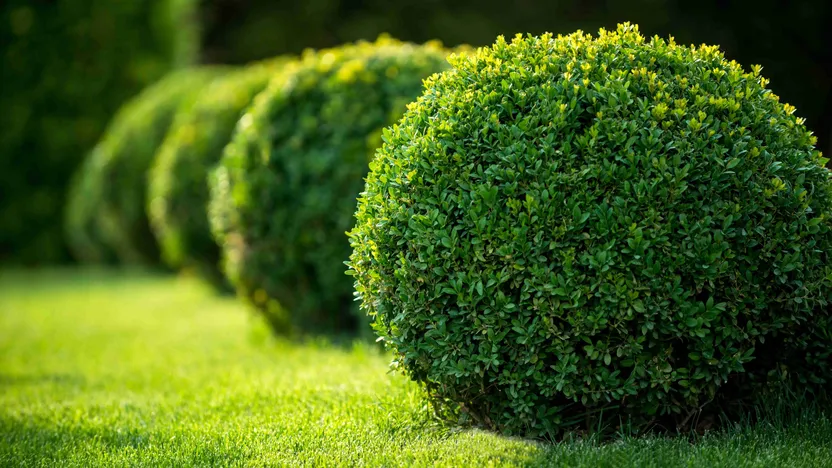
Box is unparalleled in its ability to provide structure and mark out different areas in the garden whether you use it to border a flowerbed, vegetable garden or pathway. You can use it to create a low clipped hedge or a tall hedge, plant it in pots or even sculpt it into the topiary shape of your choice. Box offers a number of qualities that allow it to tick all these boxes:
it has compact, dark green and evergreen foliage;
it can be planted in the ground or in pots;
it responds very well to pruning;
it can be planted in full sun or shade;
it can handle any kind of soil, even chalky soil.
It's no surprise, then, that box plants have been used in gardens for centuries. Box hedging continues to form an important part of formal garden design. However, this shrub has been suffering from box blight (a disease caused by two different fungi) for a number of years. More recently, it has been targeted by the box tree caterpillar which devours its leaves.
You may choose to combat these issues with plant protection products, but these products have only varying degrees of success. Alternatively, you can replace the box altogether with a plant boasting more or less the same qualities – with the important exception that it won't be attacked by pests.
The best alternatives to box hedging
Three main shrubs to replace box plants
Japanese holly (Ilex crenata) is also known as box-leaved holly as it closely resembles box. More recent varieties such as Luxus are particularly convincing. Cold-tolerant, this shrub boasts many of the same characteristics as box plants: a compact shape which lends itself well to pruning and decorative, evergreen foliage which provides small shiny, dark-green leaves throughout the year. However, this shrub won't do well in chalky soil.
Japanese spindle (Euonymus japonicus) 'Microphyllus' has very similar leaves to box plants. Some varieties have variegated white, yellow or pink foliage. Cold-tolerant and able to cope with pollution and coastal environments, these plants are easy to care for. They are quick-growing and work well in all types of gardens as long as the soil is not too chalky.
Honeysuckle shrubs (Lonicera nitida) also provide a great alternative to box with their evergreen, compact, dark green foliage. Best pruned in the spring or autumn, these plants become denser over time. Very easy to prune, honeysuckle shrubs have very similar characteristics to box plants: they're great for creating a low hedge, they don't require a lot of care and are drought-resistant. A wide range of plants can be used to replace box with more and more varieties being produced all the time. The ones noted below are popular choices, but bear in mind that many different plants and varieties can be used.
Best sellers in this category
Replacing low box hedging
Borders measuring under 50cm in height
Fortune's spindle (Euonymus fortunei) 'Emerald Gaiety' has pretty variegated bright green and white-bordered leaves. This cold-hardy plant is often used as ground cover. 'Emerald 'n' Gold' features brighter yellow and green foliage.
Maigrün honeysuckle (Lonicera nitida) which is also known as box honeysuckle.
African boxwood (Myrsine africana) works particularly well for low hedging, but only in regions with milder winters or coastal areas because it is frost-sensitive.
Replacing medium-height box hedging
For medium-height borders measuring 50 to 80cm
Japanese holly (Ilex crenata) 'Stokes' is a small, compact shrub with small, bright green leaves. It is very cold-hardy but slow-growing.
'May green' honeysuckle (Lonicera nitida) features decorative, variegated yellow foliage and small, white fragrant flowers in the spring. It is drought-resistant and can handle temperatures down to -15°C.
Green santolina (Santolina rosmarinifolia) and ground cypress santolina (Santolina chamaecyparissus) are small shrubs with fragrant foliage. They can cope with poor, well-draining soil as well as chalky soil. These shrubs should be pruned at the start of spring before flowering and a second time during the summer to create a compact border.
Replacing tall box hedging
For tall hedges over 80cm
Japanese spindle (Euonymus japonicus) 'Microphyllus Albovariegatus' has variegated white foliage. It can handle part-shade and a slightly chalky but cool soil.
Japanese holly (Ilex crenata) 'Green hedge' is a recent variety with small, glossy leaves. It is fast-growing and needs to be pruned several times throughout the growing season if you want to maintain a compact, well-defined hedge. It should be planted in shade to part-shade.
Honeysuckle 'Red Tips' (Lonicera nitida) is a fast-growing shrub that can handle regular pruning. Cold-hardy, this shrub isn't fussy in terms of soil quality. The young leaves start out reddish purple in colour before turning green in summer.
Common myrtle (Myrtus communis) 'Tarentina' is a low-maintenance aromatic plant that can grow in poor, well-draining soil in the shade. It won't cope with temperatures below -10° C.
Replacing topiary art and topiary balls
Alternative plants for topiary art
Two main types of plant can be used to replace topiary box plants:
Yew: this is the only conifer that regenerates from old wood. Yews can also be shaped into low clipped hedging with the right type of pruning.
Holly ('Green Hedge', 'Maximo', 'Convexa').
Other less common plants can also be suitable such as:
Portugese laurel (Prunus lusitanica 'Angustifolia'.
Shrub honeysuckle ( Lonicera nitida), particularly 'Tidy Tips'.
Alternative plants for topiary balls
Some shrubs are naturally round in shape, including:
some varieties of pittosporum ( Pittosporum tobira 'Nana' or Pittosporum tenuifolium 'Golf Ball');
Japanese barberry (Berberis thunbergii): some varieties feature solid or variegated purple leaves.
More information
You may be also interested in these guides
Guide written by:
John, DIYer & IT developer, Brighton
Since I was a child, I was always interested in manual and technical work. Always fascinated by woodworking, I took advantage of my first flat as a playground. On the cards: electricity (of course, safety first!) and some partition walls; but also decorating with the help of the missus, made-to-measure furniture and little tricks to optimise the space, all the while remaining as original as possible. When the little one arrived, I started building bits and pieces for him! Lacking space, I have not got a permanent workshop and certain tools I dream about are not part of my collection. Not to worry, I already know a lot about DIY and I have a high-tech profile that I hope will guide you in your decisions!
'/%3E%3C/svg%3E)