Carbon brush buying guide
'/%3E%3C/svg%3E)
Guide written on 6 February 2024 by:
Sebastian, Self-taught DIY-er, Exeter
Important features
- Dimensions
- Graphite quality
- Carbon brush type
Best sellers in this category
What are carbon brushes?
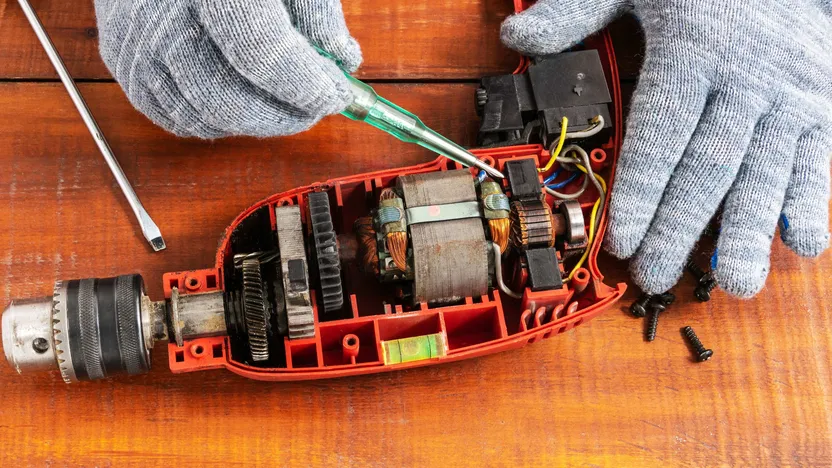
Carbon brushes are electric motor components used for power tools like drills, angle grinders, electric planers, trim routers, circular saws or even dust extractors.
A carbon brush is installed on the static part of the motor to transmit electrical current to the moving part of the motor, the rotor. Carbon brushes ensure spark-free commutation.
These usually parts work in pairs and are wear parts designed to wear away through friction. Carbon brushes are designed to be in permanent contact with the commutator or slip ring assembly. Carbon brushes are made of carbon or graphite and come in a range of different types. They can be fitted with a spring, a holder, a connector (wire and plate) or be sold bare.
Carbon brushes also come in different sizes and shapes (though they are usually square or rectangular) and may feature grooves to guide them into place.
Brushes
Difference between brushed and brushless motors
Not all power tool motors are equipped with carbon brushes. To put it briefly, brushless motors are more hardwearing and will save you money in the long term. However, these motors are less commonly used for power tools and it has to be said that brushed motors do perform very well and shouldn't cause you many issues!
Brushless motors
Brushless, or synchronous, motors feature one or several permanent magnets. Power tools with brushless motors are now considered high-end tools. The advantage of brushless motors is that they heat up less as they do not have to deal with friction. This results in fewer power losses and more efficient performance.
Brushed or asynchronous motors
Brushed, or asynchronous, motors are the original type of electric motor and are still the most common type for power tools. The speed of the motor depends on the generating torque created by the magnetic field. As a result, performance is slightly reduced and the friction generated by the motor can cause the tool to heat up.
Shop our carbon brushes
Best sellers in this category
Features of a carbon brush
There are almost as many types of carbon brush as there are brushed motors. For this reason, you need to consider a few different criteria to ensure you end up with the right carbon brush for your power tool:
the size of the carbon brush;
the type of carbon brush;
the quality of the graphite and voltage.
Carbon brush sizes
Carbon brush dimensions are given in millimetres (mm) and set out the thickness, depth and width of the brush. It's worth noting that these values may vary depending on the manufacturer; for example, depth can be referred to as length, and so on.
Carbon brush types
Carbon brushes with springs
The carbon is attached to a spring. The spring itself is fitted to a plate which is linked to a wire where electrical current is conducted.
Carbon brushes with holders
The carbon is fitted to a brush holder which features a spring used to provide pressure.
Carbon brushes without springs
The carbon is designed to insert into a holder of the correct size.
Voltage and graphite quality
The quality of the graphite used to make carbon brushes depends on factors like RPM, supply voltage, current and so on. Make the wrong choice and you run the risk of the motor heating up or generating sparks.
Brush wear sensors
A brush wear sensor works to cut off the motor before the carbon brush wears out entirely to help maintain optimal machine performance. Some manufacturers start their model numbers with the letter D to indicate the presence of a brush wear sensor.
Brushes
How to choose a carbon brush
Reputable or professional-grade power tool brands will usually sell product-specific carbon brushes for their own tools. The carbon brush reference number may be marked on the tool itself. Otherwise, this information can be found in the product instructions or on the brand website. In this case, you'll need to identify the tool type using its model number and look up the numbers and figures online.
Shop our carbon brushes
How to replace a carbon brush
Carbon brushes are generally easy to access via the power tool housing. If this isn't possible, you simply need to remove the screw cover, identify the rotor and the carbon brushes or brush holder on the stationary part. Always make sure that the tool is switched off and unplugged before doing so.
The whole process can be made easier by looking up the power tool brand – whether you are working with a drill, hedge trimmer or angle grinder – and getting a closer look at the parts in order to identify the location of the carbon brush.
Shop our drills
Picking the right carbon brush size
If you find yourself needing to change the carbon brushes in your angle grinder or any other tool, this means that the carbon brushes are worn. As a result you may not know their original dimensions. To work out the required brush size, it's worth noting that they are typically about two to three tenths the size of the metal holder that contains them (or the brush holder). If your carbon brushes are too big, you can reshape the graphite fairly easily using sandpaper.
Shop our angle grinders
How to file down a carbon brush
If the carbon brushes you've purchased are too large, you can resize them using medium-grit sandpaper. To do so, you'll need to ensure they are filed down to the same size.
Place your sandpaper flat on a workbench and sand down the carbon brush making sure it lies flat. Test the carbon brush several times in the brush holder as you work to ensure it fits snugly in the holder. Finish by cleaning up the carbon brush.
Sandpaper
Bedding carbon brushes
Bedding carbon brushes involves pre-shaping the carbon to fit the over the whole contact surface of the commutator or slip ring.
Sand the carbon brush using medium-grit sandpaper to shape the contact face (the area that comes into contact with the moving parts). Remember that the bigger the carbon brush, the greater the contact surface and the more important bedding is. Once you've got the right shape, clean the carbon brush well.
Sandpaper
More information on drilling
Demolition hammer buying guide
Circular saw buying guide
You may be also interested in these guides
Guide written by:
Sebastian, Self-taught DIY-er, Exeter
Redo a roof with wooden beams? Check. Advise everybody in the DIY shop? Check. Redo bathroom plumbing? Check. If it doesn't work, try again! I'll do my best to advise you in your projects.
'/%3E%3C/svg%3E)