How to weed your lawn
'/%3E%3C/svg%3E)
Guide written on 6 February 2024 by:
Crystal, Owner of a small gardening business, Oxford
Important features
- Aesthetics and plant health
- Turf quality
- Regular weeding
- Selective weeding
- Manual weeding
Why weed a lawn?
Weeding involves removing any unwanted plants from the garden. This can be done by hand or using tools, and may involve natural or chemical weed killers. Of course weeding isn't the most pleasant of gardening tasks: it's hard work, not particularly rewarding and hugely repetitive. It is, however, essential as the weeds that crop up in the middle of your lawn pose two major problems.
Weeds are messy
The first issue is one based purely on aesthetics. No gardener wants the lush green lawn that they've worked so hard to get dense and healthy to be covered in tufts of unwanted plants!
Weeds can affect lawn health
The second problem involves the health of your grass. Plants with large leaves like dandelions or broad-leaved dock tend to deprive your grass of air and eventually suffocate your lawn.
3 tips for limiting weed growth
Weeding is a long and tiresome process, but it is possible to stop weeds from getting out of control with a few simple actions.
1. Invest in a high-quality lawn
It's important to choose the right type of turf to begin with. If you want to limit the appearance of weeds, you'll need to select a high-quality, resistant and easy-to-maintain turf.
2. Weed on a regular basis
Regular weeding is the key to a well-manicured lawn. Weeds tend to crop up gradually throughout the garden. By monitoring your lawn closely, you'll be able to step in before the weeds set in and become overgrown. If it's too late and weeds have already invaded your lawn, it's best to stop them from spreading using a chemical or natural weed killer.
Please note: if you opt for a chemical weed killer, you need to be aware of the risks to the environment, your own health and that of any pets you might have. Bear in mind that natural weed killers (such as nettle slurry) are the most cost-effective and environmentally friendly solutions.
3. Change how you think of weeds
Having unwanted weeds appear in the middle of your lawn doesn't always have to mean that you've failed as a gardener! In fact, some people choose to roll with the look of weeds. Some plants can even give a natural, meadow-like look to your lawn as they flower (especially plants like daisies). What's more, weeds can be really beneficial to the auxiliary insects that they feed and can be a good indicator of soil health. For example, white clovers indicate a lack of nitrogen in the soil.
Weeding techniques
Manual weeding
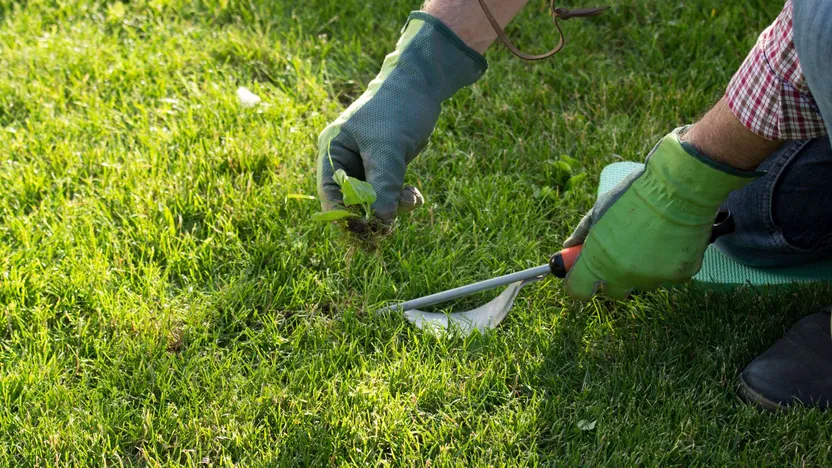
Manual weeding is the cheapest and most eco-friendly way to go about weeding a lawn. This process basically involves pulling out weeds by hand making sure to remove the whole root system of each plant. You can also use a weeding knife to simplify the task. It's worth noting that some types of plants, like purslane, don't need to be removed as they will disappear as your lawn gets more lush.
Selective weeding
Selective weeding involves removing any unwanted weeds without affecting any surrounding plants. This targeted action can be performed using chemical or natural products. Here are two environmentally friendly options.
Nettle slurry as a weed killer
It is possible to buy nettle slurry in shops or to make your own in a corner of the garden. Nettle slurry has natural weed-killing properties. It's can also be a great repellent, fungicide and fertiliser, as long as you adapt the recipe to match your needs.
Making a nettle slurry in 6 steps
Grind down about 1.5 kg of young nettles that haven't yet gone to seed.
Put the shredded nettles into a plastic container; avoid the use of metal.
Cover the nettles with 10 litres of rainwater (or tap water).
Leave the mixture to ferment for one to two weeks making sure to mix it on a regular basis.
At this point you can filter the mix keeping only the liquid. The nettle leaves themselves can be added to your compost pile.
Then, simply spray the slurry onto weeds.
Other types of homemade potions, such as angelica root slurry or sawdust solution, can also work to kill weeds.
Flame weeding
Flame weeding is another approach to selective weeding.
It involves using a tool called a flame weeder which runs on propane gas just like a blow torch. The idea is to apply the flame directly to the weeds to create a thermal shock that instantly destroys the plant's cells.
An effective method, the results of flame weeding are also durable.
Flame weeding
You may be also interested in these guides
Guide written by:
Crystal, Owner of a small gardening business, Oxford
From a background in waste transportation, I became a farmer specialising in organic gardening. A graduate of Horticultural Production, I tried for several years as a young farmer to settle in the beautiful region of Oxfordshire. After many disappointments, I finally started a small-business in home services, specifically in gardening, assisted by my loving, dear husband. Passionate about nature and wild edible plants, I am very attentive to ecological solutions and respectful of our environment in all aspects of my daily life. From the vegetable garden to the flower beds, from seed to harvest, I have all kinds of advice up my sleeve. Do not hesitate to ask me your questions.
'/%3E%3C/svg%3E)