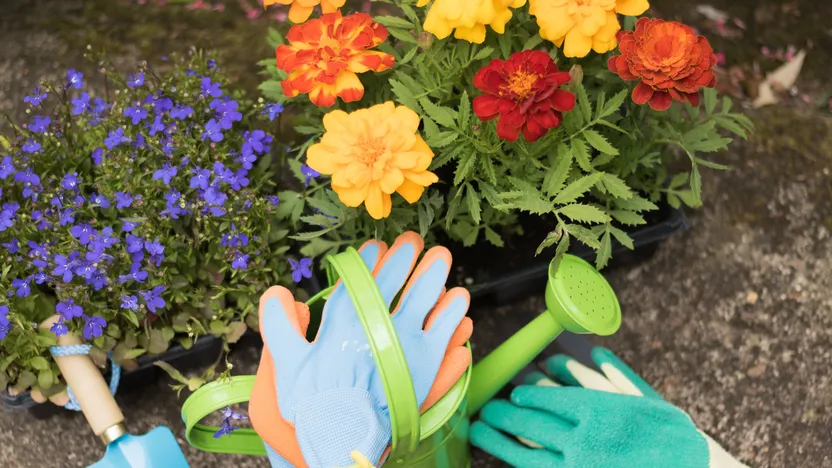
Flowers to plant and sow in April
'/%3E%3C/svg%3E)
Guide written on 25 September 2026 by:
John, Passionate gardener, Cambridge
Important features
- Pots and planters
- Pond flowers
- Climbing flowers
- Flowerbeds and borders
- Shaded areas
- Rock garden flowers
Best sellers in this category
Flowers for flowerbeds and borders
Some flowers are perfect for filling an empty or unsightly spot in the garden and many flower seeds can be sown directly in the ground without any protection. What's more, they won't need to be transplanted at a later date. Such varieties include poppies, nasturtiums, marigolds, larkspurs, love-in-a-mists, knapweeds, sweet peas, Virginia stock, cone-flowers, pheasant's eye and morning glories.
The following varieties, however, are best sown towards the end of the month or indoors: baby's breath flowers, marigolds, sweet William, snapdragons, beardtongues, Mexican marigolds, tobacco plants, carnations, zinnias, verbena and annual lavaterus.
Any seedlings that you already started indoors or purchased in pots can be planted directly in the ground in the latter half of the month. This includes things like acanthus, lily of the nile, dahlias, gladioli, lavaterus, amaryllis, coppertips, foxgloves and freesias.
Shop our flower seeds
Flowers for shady spots
Touch-me-nots are perfectly suited to rich, cool soil. Periwinkle is a flowering ground cover perennial that can easily be used to embellish any area of undergrowth or a shaded slope. It even works well in shaded spots beneath shrubs but watch out: it can be invasive. Epimedium, otherwise known as barrenwort, is another perennial ground cover plant that works very well in shaded, rocky terrain; it puts out subtle flowers in mid to late spring.
Alumroot boasts colourful foliage and produces beautifully delicate flowers that are often used in bouquets. Also known as coral bells, these flowers can also survive in sunny spots. Plaintain lilies, while usually grown for their variegated leaves, also put out a beautiful summer bloom. They can be planted all year round – except during periods of frost – but spring is by far the best season to get started.
You might also want to save a shady spot for tuberous begonias. Finally, rhododendrons can also be planted in the spring, although you will get better results in autumn.
Best sellers in this category
Flowers for pots and planters
Flowers grown in pots or planters on decking, balconies or dotted along sunny walls are generally well protected from cooler weather. You can therefore sow or plant these flowers earlier than any flower seeds you plan to sow directly in ground. If you get hit by a sudden cold spell or frost using some form of plant protection, such as a horticultural fleece, should be enough to keep your flowers safe.
It can be really effective to mix up different varieties in the same pot. Don't hesitate to mix upright plants like beard tongues, petunias, bell flowers, false goat's beard and zonal geraniums with hanging plants such as verbena, surfinia, lobelias, burr marigolds or water hyssop. To add a bit of volume, go for things like diascia, beeblossom or lantanas.
It is possible to mix annual plants, bulbs, perennials and even small shrubs in the same pot or planter. But of course, you might prefer to grow your varieties in separate pots. The following plants will work well in containers: carnations, nemesia, widow's thrill, perennial cranesbills, anemones and coneflowers.
Planters
Flowers for the pond
While most aquatic plants require a bit of warmth for planting, you may be able to start sprucing up your pond or lake in April.
Yellow irises is are stunning upright plants with bright yellow flowers. If you want to plant your irises in aquatic baskets, you can do so both in autumn and at the start of spring. Lotuses should be planted in spring and this can be done as early as April in mild weather. However, if the weather is still cool, you may need to wait for the water to warm up first and this can take you up to June. If you are planting in containers or aquatic baskets, make sure you handle the root ball with a great deal of care.
Water crowfoot can be placed in full sun or part shade and can withstand cool temperatures, unlike lotus and arrowheads which will need to be placed in water that has been given the chance to warm up. It's worth noting that most aquatic plants require full sun so should be planted out at some point from the end of April to June.
Garden pond
Flowers for rock gardens
Sweet alyssum and baby's breath are both annuals that can be sown in April. Thrifts, basket of gold plants and aubrieta also work well in rock gardens and can be sown or planted in April.
Other varieties can only be planted in April; this includes maiden pinks, Tussock bellflowers, candytuft or common houseleek.
Climbing flowers to start in April
If you're looking to cover a fence, trellis or pergola with plants, you'll need climbing varieties which are able to either wrap themselves around their support or grow in spirals to climb higher and higher. Honeysuckle is a great example of a climbing plant; it is fast-growing and gives off a heady fragrance.
Passion flowers produce large, unique flowers while clematis is chosen for its abundant blossom and wide range of colours. Trumpet vines, another climbing variety, put out beautiful yellow or orange trumpet-shaped flowers. Not finding what you need? Here are some more climbing plants you can get started in April: jasmine, climbing nasturtium, sweet peas and morning glory (among others...!).
Trellises and arches
More information
You may be also interested in these guides
Guide written by:
John, Passionate gardener, Cambridge
When I was young, I was already working in the family garden. Perhaps that is where my interest in plants and gardening came from. So, it was logical for me to study plant biology. At the request of various publishers I have, over twenty-five years, written many books on the subject of plants and mushrooms (a subject that is close to my heart). They were mostly identification guides at first, but shortly after they were about gardening, thus renewing the first passion of my childhood. I have also regularly collaborated with several magazines specialising in the field of gardening or more generally in nature. There is no gardener without a garden, I have cultivated mine in a small corner of Cambridge for the last thirty years and this is where I put into practice the methods of cultivation that will I advise you in as well.
'/%3E%3C/svg%3E)