Food waste disposer buying guide
'/%3E%3C/svg%3E)
Guide written on 6 February 2024 by:
Lucas, Antique wood-worker
Important features
- Number of users
- Power rating
- Noise level
Best sellers in this category
What is a waste disposer?
How a food waste disposer works
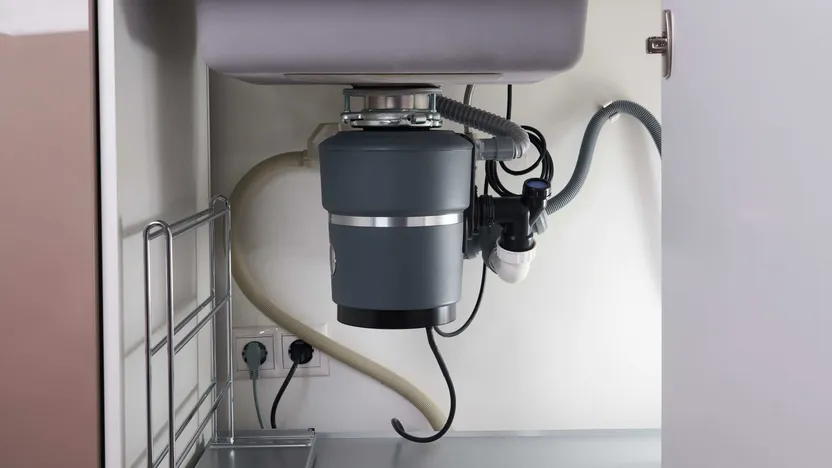
The idea behind a food waste disposer is very simple: linked up to your sink and waste water system, a waste disposer is designed to break down any food scraps into tiny particles.Waste disposers are activated by a push button on your worktop and work to break down leftovers before flushing them away via your normal waste system.
You do not require any special equipment to install a waste disposal unit – you simply need to have enough space under the kitchen sink, a power supply and a plug hole of at least 90 mm (although it is possible to find plug adapters).
Advantages
The main advantage of a food wastedisposer is that it allows you to save on your householdwaste; some manufacturers promise a reduction of at least 25%. These units also ensure your pipework is kept in good condition – especially if your pipes haven't been installed properly or tend to get blocked on a regular basis.
Be careful, however, as a food waste disposer is not without its limits. Avoid putting any hard bones or large pieces of waste into the unit at the risk of damaging it. If you find your waste disposer is not living up to your expectations, you may have to invest in a professional model – but be prepared to pay for it!
Shop our waste disposers
Main characteristics of a food waste disposer
The main factor you need to consider when choosing a food waste disposer is the number of people in your household. A small unit will soon be overwhelmed if it's constantly being loaded with material. This can cause the motor to overheat or even break down!
Power rating
Don't forget to check the power rating of your unit. This usually ranges from 300 W to over 1000 W for professional models. It's a good idea to get a unit that is slightly more powerful than you think you might need: this will ensure you don't run into any overheating issues. A waste disposer with a power rating of 550 W will be perfect for a household with three or four people. If you are running a professional kitchen, you'll need at least 1000 W. The motor power can also be given in horsepower (just remember: 1 hp = 735.5 W).
Dimensions and weight
Waste disposers are fairly bulky, so you will need to ensure you have sufficient space beneath your sink to accommodate the unit. Of course, the more powerful the unit, the bigger it will be. Most compact shredders weigh around 3 kg while professional disposal units can weigh in excess of 100 kg! Make sure that the dimensions (height, width and depth) and weight of your model are compatible with the layout of your plumbing or be prepared to alter your pipework.
Prices vary widely starting at around £200 euros and stretching to over £10,000 for professional models! If you want a high-quality unit, it's worth investing around £500.
Kitchen sinks
Best sellers in this category
How does a waste disposer work?
Waste disposal units have earned something of a bad name for themselves through horror stories on TV, but rest assured, there is absolutely nothing to worry about!
Waste disposers are no longer equipped with cutting blades but rather a high-speed rotating disc that works to break down food waste before sending it into a shredding chamber. An efficient waste disposer will turn at a rate of around 2500 rpm.
However, it goes without saying that you should still never be tempted to put your hand in a waste disposer! Waste disposers are no more dangerous than any other tool, but you still need to make sure to turn off the power supply when cleaning and keep young children far away from the unit!
Shop our waste disposers
How to pick a food waste disposer
Once you've decided how much power you need from your waste disposer, you'll need to weigh up the following factors to make sure you buy a product that is easy to use and likely to last:
Materials
A waste disposer with stainless steel parts will not corrode, guaranteeing a long service life.
Antibacterial treatment
Some wastedisposers are coated with an anti-bacterial treatment which is essential for fighting bacteria in the kitchen!
Shredding chamber
The capacity of the shredding chamber is indicated in millilitres. A model with a 1000 ml capacity is great for a household of four while a 500 ml chamber will suffice for a kitchen that's only used by two people.
Additional features
Scrapers and other similar accessories are sometimes supplied to help you remove waste more easily. You can also equip your plug with a magnetic collar to stop cooking utensils from slipping down the plug hole – a great option if you're a bit clumsy or easily distracted!
Installation
You won't need to hire an expert to install a food waste disposer, as long as you have some basic plumbing knowledge. Additionally, some waste disposers are sold with quick installation kits and plug adapters.In any case, waste disposers are quick and easy to install, and the task shouldn't take you any longer than an hour!
Disc
Household waste disposers are not really designed to cope with a lot of stringy waste as this tends to wrap around the cutting disc and inner parts of the unit. Some waste disposers are equipped with notched discs to get around the problem but it's best to use another disposal method for this kind of waste.
Noise level
Like any motorised device, waste disposers can be noisy. If the sound of the motor is likely to annoy you, go for a quiet model or look into ways to reduce the noise of the unit.
Waste recycling
Crushed food waste can usually be discharged along with the rest of your waste water. It can also be recovered to make compost and some models even offer easy waste removal for this purpose.
Shop our compost
.
.
You may be also interested in these guides
Guide written by:
Lucas, Antique wood-worker
After some time busting my hump at construction, specifically at renovation, painting, carpentry, laying kitchen and bathroom tile, I decided to get my degree as a Carpenter. And I did well because nothing is more pleasant than working on a timber frame or designing a wooden house. Everything about woodworking fascinates me, and building my own home in this material is one of my goals. I’m also a follower of construction tools: I love to learn about innovations, the way they’re used, the tips and tricks, or the performances of each new tool on the market, whether it’s for woodworking or not. I would be happy to advise you and help you with your choices. Happy Tinkering.
'/%3E%3C/svg%3E)