How to bleed a radiator
'/%3E%3C/svg%3E)
Guide written on 25 September 2026 by:
Didier, Technical manager
Important features
- Identifying radiators that need to be bled
- Bleeding a radiator
Best sellers in this category
Bleeding a radiator for optimal heating performance
If you have boiler-powered central heating it's important to maintain your radiators and this means checking that they are working correctly on a regular basis. If you notice that one or more of your central heating radiators are not heating properly, the issue isn't usually very serious.
Most of the time, the problem can be traced back to air that has enter the heating circuit and is affecting radiator performance. However, if you don't attempt to fix the radiator, you can end up running up a big energy bill and your heating system will be working less efficiently. The solution is to bleed the radiator(s) in question in order to remove the air and allow it to operate at full power once again.
Steps
Finding out whether your radiator needs to be bled
Bleeding a central heating radiator
Shop our protective gloves
1. Identifying radiators that need to be bled
It is very easy to find out whether your radiators are heating to full power or if there is air in your heating circuit.
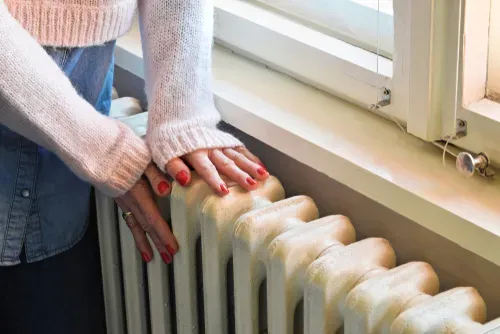
Place your hand on your radiators starting from the bottom and working slowly upwards. If there is a noticeable difference in temperature in the upper part of the radiator, it is because your radiators are partly filled with air and not with hot water. As a result, they are producing much less heat.
Shop our central heating radiators
Best sellers in this category
2. How to bleed a radiator
The bleed valve is always located at the top of the radiator. Depending on the model, you may need a bleed key, but in most cases, needle-nose pliers will be sufficient.
Put on a pair of protective gloves to ensure you don't get burnt and place a basin directly below the valve.
Gently unscrew the bleed valve until you hear a hissing sound – that indicates that the air is starting to escape. At that point, stop unscrewing.
After a while, all the air will be released from the radiator and the water will begin to flow. Let the water run for a few seconds and then close the valve.
Once this has been done, all the air will have been released from the radiator.
Repeat the process on all affected radiators in the circuit.
Removing the air from your radiators will reduce the pressure of your heating system. You will have to top up your system's water level once all radiators have been bled (see the operating guide for your boiler for instructions on how to do this and for information about operating pressure).
A few hours later, check all your radiators again to make sure they are all heating properly, and that the valves are not leaking.
Required skills
You don’t need to be a heating engineer to bleed a radiator. The process is very simple, and only takes a few minutes – a simple twist of the bleed valve and the job's sorted!
Time required
About 10 to 15 min per radiator
Number of people required
1 person
Tools and equipment
The correct type of bleed key for your radiator (or a pair of pliers);
A basin and some rags.
Personal Protective Equipment (PPE)
Please note that is a non-exhaustive list; make sure your PPE is suited to the task at hand.
Shop our protective gloves
More information
Boilers
You may be also interested in these guides
Guide written by:
Didier, Technical manager
I spent ten years working in maintenance services, first as a Technician and then as a Head Technician. For eight years, I have perfected the methods and management of subcontracting. Today, I continue my career while I work on technically versatile projects. DIY: I love it. I like having the right tools. Precise work fascinates me, I like working with wood and metal and I do not hesitate to make something myself if it doesn’t exist. In my daughter's room, for example, there is a bed built into her desk. My family and neighbours don’t hesitate to ask me for advice or troubleshooting. My experience in home renovation combined with my knowledge of the various building trades allow me to advise on tool choices.
'/%3E%3C/svg%3E)