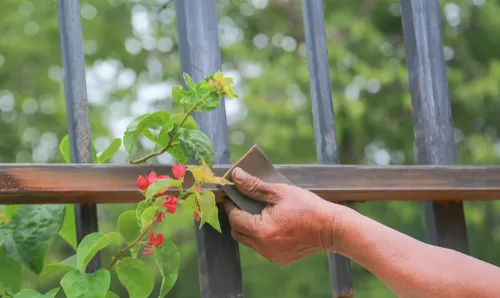
How to remove rust
'/%3E%3C/svg%3E)
Guide written on 6 February 2024 by:
Jennifer, Self-taught DIY enthusiast, Manchester
Important features
- Safety precautions
- Household products
- Removing rust by hand
- Rust removers
- Anti-rust primers
Best sellers in this category
Key methods to remove rust
Rust forms when iron oxidises after coming into contact with air and water. All metals containing iron can rust which weakens the material and causes it to become brittle.
A number of different products can be used for rust removal, including citric acid, soda crystals, bicarbonate of soda, white vinegar, lemon juice and salt and a range of off-the-shelf products, such as oven cleaner. You can even go for more unusual solutions such as onions and potatoes!
First of all, you'll need to equip yourself with gloves and a mask. You'll also need a few basic items such as a basin, scrubbing sponge and a cloth to dry the surface. You may also want to use a spray bottle, wire brush, steel wool or an electric sander (if you have a large surface to clean).
Once you're done, don't forget to prevent rust from coming back by treating your tool or object and storing it correctly.
Brushes
Safety precautions for removing rust
No matter which products you decide to use, you will need to follow a few safety precautions. Remember: if the product is strong enough to remove rust, it is likely to pose a danger to your skin and respiratory system!
It's always best to protect your hands with gloves, use respiratory protection and wear safety goggles. Ideally, you should work outdoors or in a well-ventilated room.
Best sellers in this category
Removing rust using household products
Used on their own or in combination with other products, household items can be powerful weapons for removing surface rust.
Citric acid
Citric acid occurs naturally in citrus fruits and can be used for a wide range of cleaning tasks in the home, such as removing limescale. But it's also an excellent rust remover. Put on your gloves, mix 5 tablespoons of citric acid with 1 litre of warm water.
Depending on the rusty surface you want to treat, you can apply the mixture using a scrubbing sponge or simply spray it on. Scrub vigorously, rinse then dry.
Soda crystals
Wearing a pair of gloves, pour some soda crystals onto a damp scrubbing sponge.
Give the rusted object a good scrub, use another sponge to rinse then dry carefully.
Bicarbonate of soda (and vinegar)
Bicarbonate of soda can be used for a range of tasks around the home from cooking to cleaning. It is also touted for its rust-removing properties whether mixed with water to create a paste or combined with white vinegar.
If you use vinegar, you will create a highly effervescent mixture that should ideally be applied to your rusty surface with apaint brush.
Either way, the baking soda mixture should be left for about fifteen minutes to soak in before you rinse and dry the surface.
White vinegar and salt
Pour some salt into a basin and add roughly equal parts of white vinegar.
Be careful: when mixed, these products produce a chemical reaction that produces effervescence. Dip a sponge into the mixture, then rub the rust vigorously. Rinse, then dry carefully.
Lemon juice and salt
Lemon is a powerful weapon against rust and salt only makes it more effective. Squeeze the juice from a lemon into a basin.
Add two or three spoonfuls of salt and dip your sponge into the mixture. Use it to scrub the rust. You can leave the mixture to soak for a few hours before rinsing and drying.
Onion or potato
A surprising but effective old-fashioned trick involves cutting an onion or potato in half and rubbing it directly onto the rusted surface until the rust disappears!
Shop our bathroom cleaning products
Removing rust by hand
As is often the case, nothing beats a bit of elbow grease for removing rust.
Wire brush
It is sometimes possible to get rid of rust simply using a wire brush and a lot of effort!
Steel wool
Simply scrub any affected surfaces with some fine grade steel wool.
Tinfoil
Ideal for small areas of rust or tricky-to-reach spots, tinfoil can be balled up or rolled around the tip of your finger to lift off rust.
Electric sander
If you are dealing with a particularly large area of rust, you can use an electric sander or grinder fitted with sandpaper. Start with a coarse grit and work your way towards a fine grit.
Sanders
Rust remover products
Oven cleaner
While usually used to clean grimy ovens, oven cleaner can also be used as a rust treatment.
Spray it onto the surface and leave for a few seconds before rinsing and drying.
Rust remover
Rust removers can usually be applied to all types of surfaces to remove rust in a matter of seconds, without the need for sanding or scrubbing.
How to prevent rust from returning
Once you've eliminated the issue, you will have to make efforts to ensure rusting doesn't come back. An anti-rust primer, varnish or a special paint can be applied to prevent rust from reappearing.
Additionally, you should ensure that any tools or metal objects are properly dry before you store them to keep them rust-free. You can also place a piece of charcoal or some rice in the box or kit where you keep your tools. This helps to absorb humidity. Chalk will also do the trick! Finally, smaller tools can be dipped in olive oil and wiped off to form a protective coating.
You may be also interested in these guides
Guide written by:
Jennifer, Self-taught DIY enthusiast, Manchester
I didn’t receive any special training, I learned everything on the job. And what a joy it is to be able to do little jobs around the house that we love so much. That is, until the moment we decided to move and had to do everything; from the floor to the ceiling, from the kitchen to the bathroom...In short, you become as good as a pro. So today, my friends don’t hesitate to call me when they need help. And when you dip your toe in, there’s no turning back. It’s a true passion that drives us to take on the challenges, to have an idea in mind and see it come alive with just a few tools. And a passion is even better when you can share it. So, whenever I can give you a little advice, it’s with great pleasure.
'/%3E%3C/svg%3E)