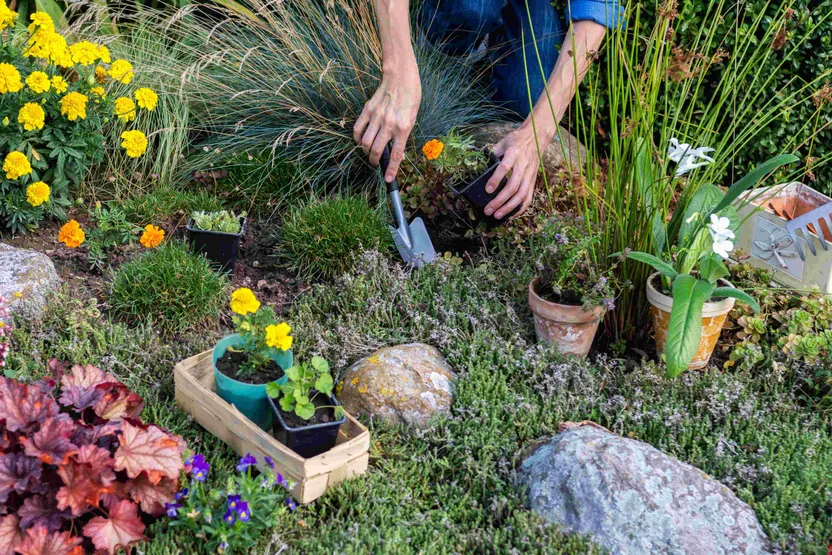
The 5 best plants to put in a rock garden
'/%3E%3C/svg%3E)
Guide written on 6 February 2024 by:
Christelle, Micro-entrepreneur in the gardening sector
Important features
- Plant type
- Sun exposure
- Watering requirements
- Flowering
- Cold-hardiness
Best sellers in this category
Rockery plant characteristics
The term 'rockery' in landscaping refers to an ornamental feature made up of plants and rocks. These features work particularly well in rugged or difficult terrain. Rock garden plants have a few features in common:
they are usually perennials meaning they are expected to last at least several years and their roots are able to withstand winter conditions;
they grow in dry, poor, stony but free-draining soil;
they are often small in size;
they are usually of Mediterranean or alpine origin.
Rock gardens are designed to recreate the natural growing conditions of rockery plants. When creating a rock garden, you must consider the needs of every plant that will be contained within it. For example, you will need to think of the watering requirements of each variety to avoid over- or under-watering your plants. Doing so can compromise the health of your bed. Below you'll find a brief introduction to the most popular rockery plants in an ornamental garden.
Shop our perennial plants
1. Sage
Sage is a perennial plant that works perfectly in rock gardens. Some varieties are edible and have medicinal properties. Sage is widely used in herbal teas or added to recipes. It is also known for its antioxidant properties.
The growing conditions of sage are as follows:
sage naturally grows in shrub and grasslands around the Mediterranean;
it requires little care;
it requires very little water;
it enjoys full sun to part shade;
it is cold tolerant (down to -10°C);
it flowers from May to December.
Best sellers in this category
2. Lavender
Lavender is an aromatic perennial which makes a wonderful addition to a rock garden. It has been used for millennia for its aromatic and medicinal properties. It is still widely grown and sold with new varieties being introduced all the time.
Lavender grows in the following conditions:
it naturally grows in lowland, mountainous and coastal environments;
it can easily be grown by novice gardeners;
it has very limited watering needs;
it must be planted in full sun;
it is cold tolerant and can be planted up to 800 metres in altitude (depending on the variety);
it flowers from April to September.
3. Geraniums
Geraniums are highly versatile perennial plants which can work in a variety of locations, including in rock gardens. Some varieties are used in aromatherapy and cosmetics thanks to the various benefits of this plant. Geraniums also work well at repelling flies and mosquitos.
Geraniums can grow in the following conditions:
they work in any climate across the UK;
they can easily be grown by inexperienced gardeners;
they require regular watering;
they can grow in full sun or part shade;
they are cold hardy (down to -20°C);
they flower from May to November.
Shop our perennial plants
4. Marigolds
Marigolds are annual plants that regularly feature in rock gardens. Their flowers are edible. They are often used in health supplements and teas to relieve digestive issues and other complaints. Marigolds can also be used externally to help heal superficial sores and boils.
Lavender grows in the following conditions:
they can grow in any climate;
they are easy to care for and do not require any particular skill to grow;
they have minimal watering needs;
they must be planted in full sun;
they are not cold tolerant;
they provide a lot of blooms from May to October.
5. Calendula
Calendula is an annual herb grown for its medicinal benefits. It has anti-inflammatory and calming properties, and can be used in teas, in mother tinctures or as an essential oil. Calendula can also be used in cooking (for example, as an alternative to saffron) or as an antioxidant in cosmetics. Calendula has the following growing requirements:
it grows well in mountainous, lowland or coastal environments around the Atlantic and Mediterranean;
it is easy to care for;
it requires regular watering;
it can grow in full sun or part shade;
it is cold tolerant enough to grow in mountainous regions;
it blooms from April to October.
More information
You may be also interested in these guides
Guide written by:
Christelle, Micro-entrepreneur in the gardening sector
From a background in waste transportation, I became a farmer specialising in organic gardening. A graduate of Horticultural Production, I tried for several years as a young farmer to settle in the beautiful region of Oxfordshire. After many disappointments, I finally started a small-business in home services, specifically in gardening, assisted by my loving, dear husband. Passionate about nature and wild edible plants, I am very attentive to ecological solutions and respectful of our environment in all aspects of my daily life. From the vegetable garden to the flower beds, from seed to harvest, I have all kinds of advice up my sleeve. Do not hesitate to ask me your questions.
'/%3E%3C/svg%3E)