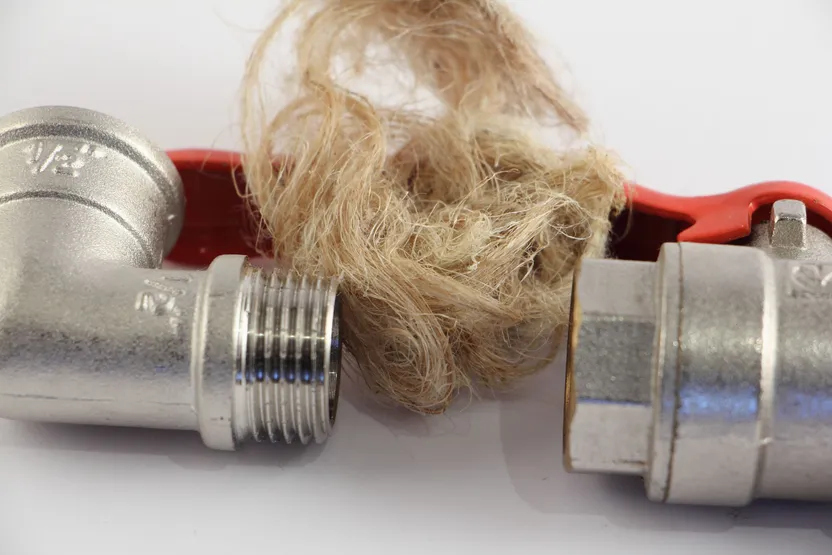
How to apply hemp to a threaded joint
'/%3E%3C/svg%3E)
Guide written on 6 February 2024 by:
Jérôme, Construction site supervisor, Cardiff
Important features
- Pipe fittings
- Thread design
- Applying hemp and paste to a pipe thread
Best sellers in this category
Where can I use a hemp sealed joint?
There are a few different types of pipe fittings:
fixed threaded fittings;
compression fittings;
lock nut fittings.
Plumber's hemp, also known as oakum, can only be applied to fittings with fixed female and male threads.
When it comes to lock nut or compression fittings, it is the nut that compresses the thread (or the olive in the case of a compression fitting) and makes the connection watertight. It would therefore be counter-productive to apply hemp or pipe sealing cord to the connection as it would prevent the joint from being compressed correctly.
Steps
Jointing compound
1. Prepare the pipe threads
Let's take a quick look at the two parts involved when applying a hemp seal. It's important to note that the seal should always be applied to the male thread. The male fitting may feature a regular thread or you may occasionally come across a thread with grooves. The image above sets out the two types of thread:
grooved threads;
regular threads (if you are in any doubt, pass your nail over the thread – you should clearly be able to feel if there are grooves or not).
If there are no notches on the thread, you will need to roughen the surface of the thread yourself.
Use water pump pliers or a hacksaw to mark the thread all around to create small grooves. You are looking to create a rough surface as this will help the hemp to stay in position and prevent it from turning when the fitting is secured. Having small grooves or a rough texture will help the hemp to stay in place. This step is very important as if the hemp turns as you tighten the fitting, the connection may leak and you'll have to start the process all over again.
Saw blades and accessories
Best sellers in this category
2. Apply the hemp and paste to the threaded joint
Once you have roughened the threads, it's time to tackle the hemp seal.
Plumber's hemp can come in various types of packaging: it can be bought in bulk or rolled up on a spool. It's up to you to pick the best option for your needs. We find that a spool dispenser is more practical for smaller pipes (e.g. 3/8", 1/2" and 3/4") while bulk bought hemp in packets is best for larger pipe sizes.
Roll the hemp around the fitting
The hemp must be rolled around the male thread in the direction of tightening (i.e. clockwise). This way, when the fitting is secured, the seal will be compressed to create a watertight seal. If the hemp is rolled in the opposite way, it will come undone and ball up as soon as the fitting is tightened. This will cause the coupler to leak.
Identify the edge of the thread. Position the end of the hemp at this side of the fitting and roll it around the thread as shown in the image.
Just before you get to the end of the thread, pull out a bit of extra cord and cut before rolling the remaining length around the thread. Ensure that the entire thread is covered and that no part of it is visible. However, be sure not to apply too much hemp as this will make the fitting too difficult to tighten.
If a few strands of material seem to be blocking the brass fitting, take a lighter and burn away any extra threads. It is important to get rid of any excess material inside the fitting as this could create a surface for impurities like limescale and other debris to cling to once water is running through the connection.
Apply the sealant paste
Sealant paste can come in a tube or in a pot:
Tubes work really well for one fitting or a handful of fittings.
Pots provide more product and work better for multiple applications. A pot is therefore the best option for professional plumbers.
Take a bit of paste on your index finger and coat the hemp that you have wrapped around the fitting. The material should be completely covered with the paste but not excessively so.
Jointing compound
3. Tighten the fitting with the hemp in place
Take the male part of the connection, insert it into the female part and tighten the fitting using the appropriate tools. It's up to you to choose the right tool for the task from adjustable pliers or an adjustable spanner to an open ended spanner or even a Stillson pipe wrench.
At this point, your connection should be sealed. When you tighten the fitting, some sealing paste will be forced out. Simply wipe away the excess with your finger.
The advantage of buying a pot of sealant paste is that any excess can be returned to the pot which will help to cut down on waste.
Stillson pipe wrenches
Applying hemp to a threaded joint: 7 FAQs
Is it possible to loosen a hemp sealed joint to correct a misaligned thread? Yes, it is possible to rotate the connection a quarter turn without any risk of leaking (which is not possible with a PTFE joint).
The hemp rotated when the connection was tightened – will the fitting leak? Yes. It is likely that you forgot to roughen the surface of the threads first which is really the key to a secure hemp sealed joint. Loosen the connection, remove the hemp, roughen the surface of the thread and start again. It is much easier to sort out the problem just after sealing the joint rather than discovering you have a leak later on when the water is running, in which case you would have to drain the pipe before disconnecting the joint and starting again.
The hemp balled up when tightening but the connection seems okay – do I have to start again? Yes, remove the seal and start again. You have likely wrapped the hemp around the threads in the wrong direction and there is a chance the fitting will leak. The hemp seal must be wrapped around in the direction of the threads (which is clockwise).
Can I apply a hemp seal to plastic threads? This is not recommended. Hemp pipe seals need to be tightened firmly which doesn't really work with plastic threads. PTFE tape is the best option in this case.
Is it a good idea to add a washer to make a hemp sealed joint more watertight? No, the hemp should ensure a watertight connection on its own. A washer is designed to sit between the flat edge of each fitting. You should one option or the other, but never both at the same time.
Can I add extra hemp to an existing hemp sealed joint? No, not unless you want a leak on your hands! You will have to remove everything and start again using a longer length of hemp.
How do you know how much hemp to use? This depends on two factors: the diameter of the connection and the length of the thread. You must always take a greater length of hemp than required and cut it before you get to the end of the thread. This will let you know how much you need to use as you work. None of the metal should be visible – it must be completely covered by the hemp. However, you are not looking to create a raised lip on the threads as the connection will be too difficult to tighten.
Generally speaking, it is fairly straightforward to apply hemp to a threaded joint. You just need to follow all the steps and practise your technique.
PTFE tape
How to apply hemp to a threaded joint
Time required
5 minutes
Number of people required
One person
Tools and equipment
Open ended spanner
Water pump pliers or adjustable spanner depending on the fitting
Jointing compound
You may be also interested in these guides
Guide written by:
Jérôme, Construction site supervisor, Cardiff
Electrician by trade, I first worked in industrial estates where I installed, wired and fixed a large number of electrical installations. After this, I managed a team of electricians for this type of work. 10 years or so ago, I turned to building and construction. From the modest family home, to gyms and theatres, I have been able to coordinate, audit and organise all sorts of construction sites. For 4 years now, I am restoring and building an extension to a bungalow in the heart of the Welsh countryside. My experience in manual work and my knowledge means I am proud to be of service. Terraces, interior design, roofing, plumbing, electrics, anything goes! My wife, daughter and I, built almost everything we have from scratch! So to answer all of your questions and advise you on choosing your tools? Easy!
'/%3E%3C/svg%3E)