How to feed fish while you're on holiday
'/%3E%3C/svg%3E)
Guide written on 6 February 2024 by:
John, Passionate gardener, Cambridge
Important features
- Duration of absence
- Holiday feeders
- Automatic fish feeders
Best sellers in this category
How to feed fish during short absences
Fish tanks and aquariums are small, sealed ecosystems and should be able to survive without any human intervention for at least a few days. However, if you plan to be away for a bit longer, you do need to make a few provisions.
If your fish are healthy, an absence of up to eight days shouldn't do your freshwater fish any harm. Most fish can happily go two to three days without food – even if they are a bit hungrier than usual upon your return!
But be sure never to give your fish extra food before you leave or when you arrive back home. There's no need to do so and it may even be dangerous for your fish. Fry, on the other hand, must be fed regularly as they are not equipped to fast.
There are a few different types of holiday feed including special fish food blocks designed to provide enough food for just a few days. However, this type of food isn't strictly necessary because, as mentioned above, most fish can happily fast for a few days at a time. However, if you have young or sensitive fish, this can be a good option.
If you do want to provide a 'weekend' feeder, go for fish food sticks and divide the recommended amount by two. Manufacturers often exaggerate the amount we should be feeding our fish which often leads to a build-up of pollution in the tank. It's also worth noting that the white blocks typically on offer are often really high in calcium which can alter the parameters of your water including hardness and pH level. These blocks should be avoided.
Fish food
How to feed fish during long absences
Some fish can fast for up to 8 days at a time. For others, this can be dangerous. Please note that saltwater fish can never go for more than a week without food.
If you plan to be away for any longer than a few days, you have three solutions:
Special holiday feed or blocks.
Automatic fish feeders.
Ask a friend to feed your fish.
Shop our automatic fish food dispensers
Best sellers in this category
Holiday fish feed
Just like weekend feeders, you can find blocks of fish food designed for longer absences. These products are usually called things like 'holiday fish food' or 'slow release fish food' and can feed your fish for up to two weeks.
These blocks are made up of compressed fish food. The idea is that your fish will nibble at the food gradually when you're not there to feed them. The main draw of these products is that they put your mind at rest while you're away. However, there are a number of downfalls to these products and they should generally be avoided.
Firstly, fish tend to eat these blocks too quickly meaning they'll end up with nothing to eat before you get back.
Secondly, in a tank with several species, one type of fish usually ends up eating most of the food leaving the others without any.
Finally, these blocks can also go off in a matter of days which will pollute your tank water.
Holiday fish food
Automatic fish feeders
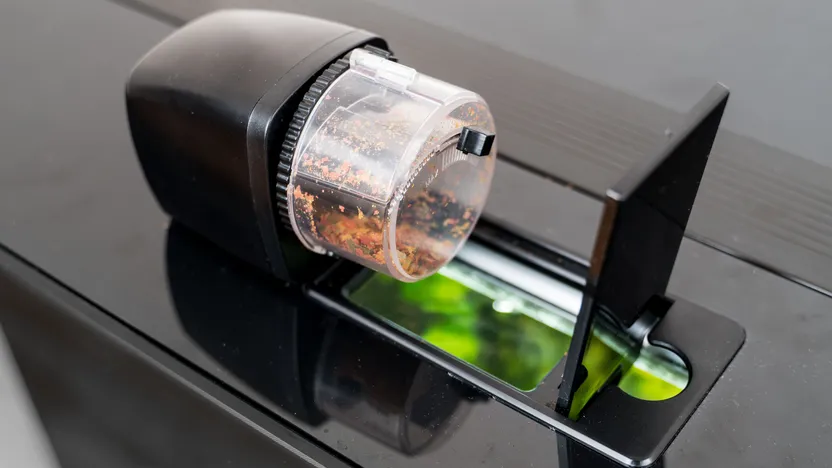
Automatic fish feeders are designed to tip fish food into the water at set times. These dispensers can only be used with dry food. Most models will last about three weeks. Some feature two separate compartments for two different types of fish food.
It's best to set up the fish food dispenser a few days before you leave. This way you can check that the system is working correctly and you'll have time to adjust the settings (i.e. feeding times and quantity of food).
Automatic fish feeders usually run on batteries. It's a good idea to use new batteries to make sure that the dispenser won't run short while you're away.
Here are a few tips to help you choose and use an automatic feeder.
Choose a model that allows you to fine-tune settings especially if you are going to be installing it in a small fish tank.
Go for a model with an anti-condensation system to prevent the food from getting clogged up inside the feeder.
To avoid blockages, fill the dispenser with fish food pellets rather than flakes or crisps. Flakes and crisps tend to form a compact layer if they come into contact with humidity which will prevent the dispenser from distributing the food into the water.
Shop our automatic fish food dispensers
Get a friend to feed your fish
Ideally, you should call on the help of a friend who has experience feeding fish as feeding the wrong amount of food can have serious consequences for your tank mates.
That said, you can quickly remedy this issue by explaining the importance of feeding the right amounts. In fact, most people tend to overfeed fish.
You can also make their job easier by preparing little sachets of dried or frozen food in advance with the correct daily ration. At the same time, you do not have to ask someone to come and feed your fish every day – two to three times a week should suffice.
If you plan to be away for a while, it goes without saying that you also ask your friend to give your tank a quick clean!
Fish flakes, pellets and tablets
Tips for feeding fish before going away on holiday
Avoid any major changes in the aquarium before you leave such as changing the water or introducing a new fish. This could stress your fish and even put your pets in danger.
Check that all equipment is in good shape before you leave including the filtration system and lights.
Do not give an extra portion of food to your fish to make up for an absence. Fish are only able to eat small amounts of food at a time and any extra food will simply float to the bottom of the aquarium. This can pollute your aquarium or encourage your fish to eat algae that they should not be eating.
You may be also interested in these guides
Guide written by:
John, Passionate gardener, Cambridge
When I was young, I was already working in the family garden. Perhaps that is where my interest in plants and gardening came from. So, it was logical for me to study plant biology. At the request of various publishers I have, over twenty-five years, written many books on the subject of plants and mushrooms (a subject that is close to my heart). They were mostly identification guides at first, but shortly after they were about gardening, thus renewing the first passion of my childhood. I have also regularly collaborated with several magazines specialising in the field of gardening or more generally in nature. There is no gardener without a garden, I have cultivated mine in a small corner of Cambridge for the last thirty years and this is where I put into practice the methods of cultivation that will I advise you in as well.
'/%3E%3C/svg%3E)