How to maintain a fish tank
'/%3E%3C/svg%3E)
Guide written on 6 February 2024 by:
John, Passionate gardener, Cambridge
Important features
- Cleaning up
- Vacuuming the gravel
- Monitoring and changing water
- Checking equipment
- Frequency
Best sellers in this category
What kind of maintenance does a fish tank require?
Your fish tank provides a habitat to your fish and keeping it clean is vital for your pets. If this mini ecosystem is neglected, the life expectancy of its residents will be drastically shortened. An unclean fish tank will put your fish under stress and can even lead to a lack of oxygen.
A well-maintained aquarium not only ensures your aquatic pets will survive in the tank, it also preserves their well-being. To keep your tank clean and healthy, you need to carry out daily, monthly and bi-annual maintenance.
Daily care: monitoring the aquarium
As you admire your aquarium each day, be sure to check its general condition and ensure that your fish are acting normally. The presence of pollutants will usually make fish lethargic but it can also make them restless and reluctant to eat. If this happens, proceed as follows:
Check that all equipment is working correctly including lights, filters and air pumps.
Remove any large debris or uneaten food.
Check the temperature of the water.
Fish tanks
Best sellers in this category
Weekly care: checking water quality and equipment
Once a week, you should carry out a few routine maintenance tasks. The aim here is to ensure the aquarium is thoroughly clean. This involves sponging down the tank walls, vacuuming the gravel and replacing some of your water. Here are the cleaning tasks to be carried out weekly:
Clean the walls of the aquarium
Remove debris from the bottom of the tank
Replace part of your fish tank water
Monitor water quality parameters
These steps are essential if you want to keep your fish in good health. The aim here is to ensure you have high-quality water and to prevent algae and bacteria growth.
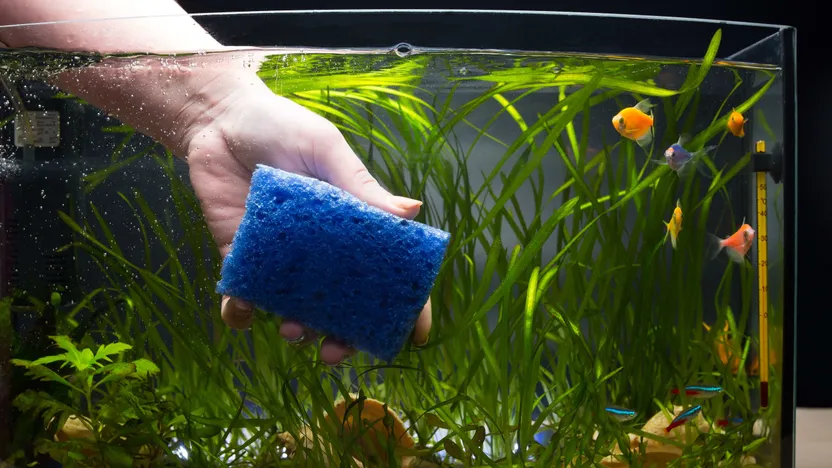
1. Clean the walls of the aquarium
Clean the walls of the fish tank from the inside to eliminate algae which will otherwise colonise the entire surface of the glass. Do not use any cleaning products at the risk of seriously harming your fish.
Use a sponge, squeegee or magnet cleaner used only for this task. Double-sided magnetic cleaners, with a magnet on each side of the tank wall, are handy but may scratch the glass if a grain of sand manages to rub against the surface. Aquarium sponges, scrapers, squeegees and other cleaners prevent this problem but are less practical to use.
2. Remove debris from the bottom of the tank
Vacuum the bottom of the aquarium to remove any waste. To do so, you will need a gravel vacuum or siphon. Most gravel vacuums are fitted with siphons which allows them to deep clean the gravel by moving it around without sucking it up. Focus on the areas that don't have a lot of water movement as this is where waste tends to build up.
3. Replace part of your fish tank water
Fish tanks are closed environments and any materials that are not entirely recyclable will build up. Changing the water helps to eliminate any excess compounds. It's always best to replace a moderate amount of water twice rather than replace a large volume at once. The amount of water you need to replace and how often depends on the size of the fish tank, the number of fish and plants you have and the quality of your filtration system.
You can replace more water in a smaller tank compared to a large tank. As a general rule, it's best to change 15% of the water once a week or 30% every two weeks for a fish tank with a capacity of 100 litres and an average fish population. You can siphon out some of the water using a section of garden hose.
When replacing the water, be sure to use water that is roughly the same temperature to prevent diseases like white spot from setting in. You can also treat the water by adding a water conditioner or dechlorinator. This will help to remove chlorine from your tap water which is added to the supply to make it safe to drink.
4. Monitor water quality parameters
Tests can be used to monitor water parameters. These tests come in the form of liquids or paper strips which change colour depending on the concentration of the parameter you want to measure. It is especially important to check the water for nitrates and ammonia.
Test for these two elements every 2 to 3 days for the first six weeks after setting up your fish tank. In a freshwater tank, pH level and water hardness are somewhat less important. However, it is very important to check pH level in a saltwater fish tank.
Aquarium glass cleaners
Monthly care: deep cleaning the fish tank
Monthly maintenance must be performed in addition to weekly care for a deeper clean of the aquarium. This type of maintenance involves cleaning the filter, air pump and all other aquarium equipment, and caring for your aquarium plants.
1. Maintain the filter system
For this, you'll need a small brush such as a toothbrush. Clean half your foam filter sponges. Do not attempt to clean all at once in order to avoid disrupting the bacteria level too much. Rinse out the aquarium filters and remove a bit of water but do not use tap water for the reasons outlined above. Instead, clean using the water from the aquarium you are going to replace.
Perlon wool filters cannot be cleaned and must be changed. Biological filters made of ceramic or any other porous material must also be washed using aquarium water.
2. Check and clean the air pump
Check that there are no blockages in the pump filter inlet. If the filter is clogged, change it. Wood air stones should be changed every two months. Ceramic air stones can be dried out before being quickly passed through a flame to burn off any matter that could block the pores of the material.
3. Clean other aquarium equipment
All other equipment, as well as your aquarium ornaments, must be cleaned and cared for. Here is what needs to be done.
Clean the outside of the fish tank using a product designed for this purpose.
Clean your tube lights or lamp and reflectors using a cloth dipped in white vinegar.
Remember to brush all decorative items in the aquarium that algae and other debris tend to stick to.
4. Tend to your aquarium plants
Trim any aquarium plants that need it and replant anything that has uprooted by your fish. Feed the plants with a liquid fertiliser and a solid fertiliser on an alternating basis.
Do not over-fertilise your aquarium plants. It's important to use the bare minimum as any excess fertiliser will feed the algae you want to eliminate.
Aquarium filters
Bi-annual cleaning: replacing the filter and lights
Twice a year, you need to care for two essential pieces of equipment: the aquarium filter and lighting system. After a few months, the filter sponge becomes too porous to function and must be changed. Your tube lights will also lose power and should be replaced.
1. Change the filter media
Never attempt to remove more than half of your filter media at once to avoid destroying too much bacteria. You can cut your filter sponge in two if it is in one piece. Change the other half after about two weeks.
2. Replace the tube lights
Replace half of your tube lights. By doing so, you will help to keep the lighting spectrum and power at the same level as this does alter over time. It is best not to change all your tube lights or bulbs at once as harsh lighting can encourage algae growth.
Aquarium lighting
You may be also interested in these guides
Guide written by:
John, Passionate gardener, Cambridge
When I was young, I was already working in the family garden. Perhaps that is where my interest in plants and gardening came from. So, it was logical for me to study plant biology. At the request of various publishers I have, over twenty-five years, written many books on the subject of plants and mushrooms (a subject that is close to my heart). They were mostly identification guides at first, but shortly after they were about gardening, thus renewing the first passion of my childhood. I have also regularly collaborated with several magazines specialising in the field of gardening or more generally in nature. There is no gardener without a garden, I have cultivated mine in a small corner of Cambridge for the last thirty years and this is where I put into practice the methods of cultivation that will I advise you in as well.
'/%3E%3C/svg%3E)