How to kill weeds naturally
'/%3E%3C/svg%3E)
Guide written on 25 September 2026 by:
John, Passionate gardener, Cambridge
Important features
- Vinegar and bicarbonate of soda
- Boiling water and salt
- Slurries and ash
Bicarbonate of soda
Bicarbonate of soda is the more commonly used name of sodium bicarbonate. Biodegradable, efficient and easy to sprinkle onto garden weeds such as dandelions, bicarbonate of soda is best for smaller areas such as terraces, the gaps between paving stones and paths.
Simply sprinkle onto any unwanted plants, spray with water and wait for the young plants to dry up. You can also try mixing 2 tablespoons of bicarb with a litre of water and spraying this onto the weeds using a spray bottle.
While very effective on seedlings and young plants, bicarbonate of soda will have little effect on getting rid of well-established and deep-rooted annual weeds and perennial weeds.
Only use on an occasional basis as, like all salts, bicarbonate of soda can have a negative impact on the environment.
Boiling water or cooking water
The hot water used to cook vegetables, potatoes, rice or pasta can be used for weed control. This chemical-free solution works well for killing off unwanted weeds but can only be used on paving stones or gravel.
Starchy water from cooking potatoes or pasta seems to be more effective than hot water alone. However, the starch can leave an unattractive film on your surfaces. For this reason, some gardeners prefer to use pure hot water.
Avoid using this type of water if it has been salted.
Plant slurries
Some plant extracts, or slurries, are great for killing weeds.
Nettle slurry, for example, can be used as both a weed killer and fertiliser! While more commonly associated with fertilisation, nettle slurry can be mixed to different ratios for different purposes. Its high nitrogen content will poison plants when applied undiluted. Be careful, however, as it will also contaminate your soil with nitrates. For this reason, nettle slurry should never be applied in great quantities.
It is possible to find nettle slurry in shops, but it is also very easy to make yourself using young nettles.
The slurry is prepared in the same way as an Angelica root slurry. It can be sprayed undiluted onto the plant leaves and stems.
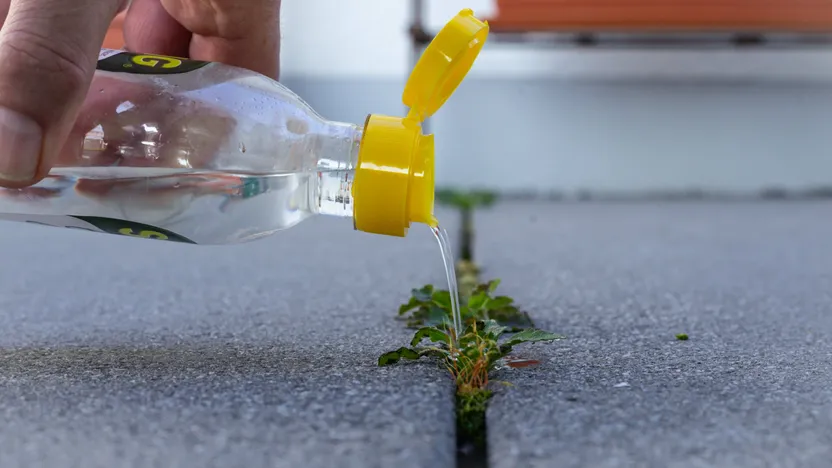
White vinegar
White vinegar is an effective weed killer and is the main ingredient for many modern 'natural' weed killers. While we know that it doesn't pose any danger to humans (we do eat it after all!), it will have a harmful impact on your soil, vegetable garden and desirable plants if applied in large doses. This is because it is very acidic and will destroy micro-organisms in the soil.
Vinegar is a contact weed killer meaning that it will kill any parts of the plant it is sprayed on. Use a spray bottle to apply a good amount to the plant leaves. Vinegar works best on young plants but several applications may be required to kill off the most stubborn annual and perennial weed growth. White vinegar is even more effective if used in the sunlight.
You'll find a wide range of recommendations when it comes to ratios. Some apply neat vinegar to weeds while others dilute it or even add salt to the mixture. If you want to make the mixture stick to the leaves, it's a good idea to add a foaming product such as an eco-friendly washing up liquid or black soap (using a tablespoon of soap per litre of water).
Bleach
Bleach is a powerful biocide that kills bacteria.
It goes without saying that the micro-organisms in your soil will not appreciate this household product and it should never be used in the garden under any circumstances.
Wood ash and lime
One or both of these solutions can be applied to lawn weeds, especially moss.
Both rich in calcium, these products make the soil less acidic which makes for less optimal conditions for moss growth.
Salt
Table salt is a good example of an entirely natural product that is not great for the environment; natural it may be, but it will sterilise the soil!
In the olden days, pickling barrels would be emptied out into courtyards so that the salty brine could double as a weed killer! That said, all living things are sensitive to salt whether in their habitat or in the ground. Even if applied to uncultivated land, it can be carried away by rainfall and end up in groundwater.
Salt should therefore never be added to flower beds, land used to grow crops or if there is any risk of rain.
Elbow grease
Last but certainly not least, a spot of elbow grease is potentially the best option of all: it's efficient, non-toxic and absolutely free.
Sadly, in terms of natural solutions, the best way to weed is by hand! Simply pull out unwanted plants using your hands or a weeding tool for a weed-free garden.
Shop our weeding tools
You may be also interested in these guides
Guide written by:
John, Passionate gardener, Cambridge
When I was young, I was already working in the family garden. Perhaps that is where my interest in plants and gardening came from. So, it was logical for me to study plant biology. At the request of various publishers I have, over twenty-five years, written many books on the subject of plants and mushrooms (a subject that is close to my heart). They were mostly identification guides at first, but shortly after they were about gardening, thus renewing the first passion of my childhood. I have also regularly collaborated with several magazines specialising in the field of gardening or more generally in nature. There is no gardener without a garden, I have cultivated mine in a small corner of Cambridge for the last thirty years and this is where I put into practice the methods of cultivation that will I advise you in as well.
'/%3E%3C/svg%3E)