Natural weed killer buying guide
'/%3E%3C/svg%3E)
Guide written on 6 February 2024 by:
Christelle, Micro-entrepreneur in the gardening sector
Important features
- Active ingredients
- Non-selective weed killers
- Non-residual
- Packaging
- Applications
Best sellers in this category
Active ingredients in natural weed killers
Biocontrol products are something of a recent addition to the weed control market and more products are sure to emerge in the years to come. It is, however, too early to have an idea of their effect on the environment. While the active ingredients contained in these products are natural, this doesn't mean that they are not harmful. The use of most of these products is not allowed in organic agriculture.
Pelargonic acid: a herbicide that occurs naturally in geraniums (Pelargonium).
Acetic acid: the primary active ingredient in vinegar.
Caprylic and capric acid: these saturated fatty acids are found in substances like vegetable oils and certain milks.
These products work upon contact by destroying the waxy layer that covers the plant stems and leaves and works to protect the plant from UV rays. The weeds will dry up and die within a few hours. There's no doubt that these products have an impressive effect as systemic weed killers usually take a few days to work.
In order to be effective, these products must be applied under certain conditions.
They can only be used in dry, sunny weather.
The temperature must be at least 15°C.
The product should be applied all over the plant.
These products are only recommended for treating young, growing plants that ideally haven't reached over 12 cm in height. Larger plants will require a second application one to two weeks after the first treatment. However, well-established perennials are likely to grow back as their root system will remain intact under the soil. To tackle these plants, several applications will be required.
Non-selective herbicides
Selective herbicides are used to get rid of weeds surrounding a particular type of crop. For example, if you are finding it tricky to weed around your carrots, you can find a special weed killer designed for carrots, and the same goes for potatoes, and so on.
The types of natural weed killers that are emerging these days are not selective; they work to destroy all plants they are sprayed on upon contact.
These weed killers will only destroy the upper parts of the plant that have come in direct contact with the product. The weed will be able to regrow if the root system is well-established.
Best sellers in this category
Non-residual
Natural weed killers don't linger in the soil. They break down quickly which means you can replant fairly soon after application. However, they won't stop weeds from cropping up a few days after application.
These products can be used in a vegetable patch or flower bed before you add seedlings or crops. You can find information on how long to wait before planting on the product label.
Concentrated or ready-mixed weed killers
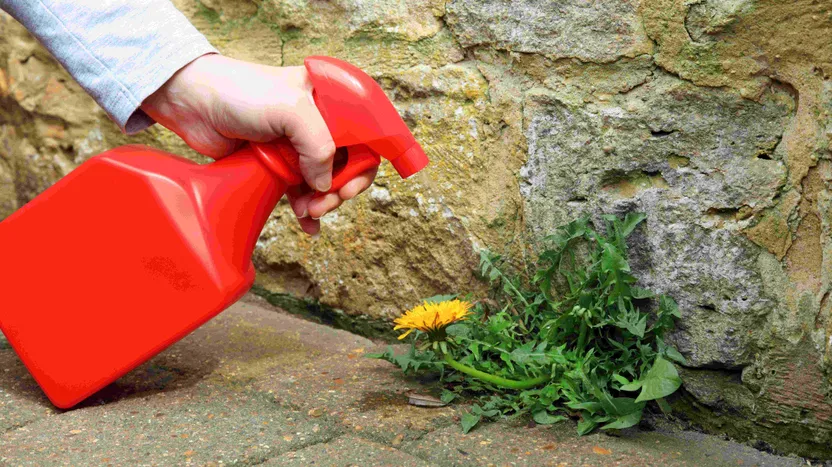
Some products are sold ready-mixed in a spray bottle. This is ideal for smaller areas or for directing the product towards a specific patch.
You can also opt for a highly concentrated formula, which will be more cost-effective. These products are designed to be diluted and sprayed.
If you have more than 30 m2 to tackle, go for a concentrated product and dilute it yourself before applying it using a spray bottle.
If you're dealing with an area measuring less than 30 m2, or if you just want to treat a small area of your garden, a ready-mixed weed killer can be really handy. You can find these products in fairly large bottles for medium-sized gardens. However, bear in mind that a spray bottle is better suited to smaller areas. It also allows you to be more precise in your application.
Some brands even offer a weed killer in gel form designed to be applied directly to the leaves to pinpoint specific weeds without causing any damage to surrounding plants.
Natural weed killer uses
Prices can range from a few pounds to about £40 depending on the format, formula and the brand name. You'll need to think about the cost in terms of m². However, bear in mind that you won't be applying the product to your entire garden but rather directly to the weeds. It is tricky to provide a ranking of the products currently available on the market (in terms of cost, for example) as, some products are much more effective than others on particular plant varieties.
Active ingredients | Product name | Brand | Time required * | Note |
Pelargonic acid | Herbistop spray | Clairland | 3 hours | Seeding after 3 days |
Beloukha Garden | Solabiol | 3 hours | Seeding after 3 days | |
Finalsan | Neudorff | 1 hour | 2 applications per year max. Effective at low temperatures. Shrubs, trees, bushes, roses | |
Herbatak express | Fertiligène | 3 hours | Comes in a ready-to-dilute tube | |
Acetic acid | Herbatak contact | Fertiligène | 1 hour | Patio, pathways, decks |
Naturen express | Naturen | 1 hour | Seeding after 3 days | |
Caprylic and capric acid | Herbiclean | Bayer | 24 hours | Trees, shrubs, roses. Suitable for organic agriculture |
Herbiclean | Bayer | 24 hours | Pathways, borders, paving. Effective on moss and algae. Suitable for organic agriculture | |
Multi-purpose weed killer | Solabiol | 24 hours | Trees, rose bushes |
* Estimations based on optimal weather conditions
You may be also interested in these guides
Guide written by:
Christelle, Micro-entrepreneur in the gardening sector
From a background in waste transportation, I became a farmer specialising in organic gardening. A graduate of Horticultural Production, I tried for several years as a young farmer to settle in the beautiful region of Oxfordshire. After many disappointments, I finally started a small-business in home services, specifically in gardening, assisted by my loving, dear husband. Passionate about nature and wild edible plants, I am very attentive to ecological solutions and respectful of our environment in all aspects of my daily life. From the vegetable garden to the flower beds, from seed to harvest, I have all kinds of advice up my sleeve. Do not hesitate to ask me your questions.
'/%3E%3C/svg%3E)