How to maintain a brushcutter
'/%3E%3C/svg%3E)
Guide written on 6 February 2024 by:
John, Passionate gardener, Cambridge
Important features
- Clean the air filter
- Maintain the spark plug
- Grease the gearbox
- Maintain the cutting accessories
- Clean the guard and cutting head
- Prepare the brushcutter for winter
Best sellers in this category
Maintaining a brushcutter: make your tool last
Like all gardening machinery, a brushcutter needs to be properly maintained. Maintenance helps to prolong the service life of the machine and ensure the tool can run efficiently, as well as limiting the risk of breakdowns. Some tasks should be performed regularly and others periodically (for example, when preparing for winter storage).
Steps
Clean the air filter
Maintain the spark plug
Grease the gearbox
Maintain the cutting accessories
Clean the guard and cutting head
Prepare the brushcutter for winter
Grease
1. Clean and maintain the air filter
Below you'll find instructions on how to clean and maintain the air filter of your brushcutter:
Dust the air filter using a stiff brush or hand brush.
If the filter is made of foam, wash it in soapy water, rinse it and wring it out. Leave it out to dry before fitting it to your brushcutter.
If you have a paper cartridge filter, bend the filter and clean between the pleats using a soft brush.
You can then use an air blow gun to finish the job.
Before replacing the air filter, clean the edges of the filter compartment using a cloth.
Take care to clean inside the compartment using degreaser.
This task should be carried out at least once a year. It is recommended to replace the air filter entirely every two years.
Air blow guns
Best sellers in this category
2. Maintain the spark plug
Clean the spark plug once a year. Remove the spark plug using the tool provided with the machine. The colour of the deposits on the spark plug electrodes indicates the condition of the engine: a light brown colour indicates good combustion.
Brush the electrodes using a small wire brush to remove combustion deposits. It is possible to use sandpaper for a more abrasive clean. Don't forget to carefully clean between the two electrodes. Use this time to check the electrode gap using a spark plug gauge (this should generally be 0.7mm).
3. Grease the gearbox
All the components in the gearbox are in constant friction which is why it's important to grease this mechanical device regularly.
Please note that this process isn't necessary for all brushcutters since the gearbox on some models comes pre-lubricated. In this case, the grease is designed to last as long as the machine.
Some other models feature a grease compartment where lubricant can be added. This compartment is opened using a nut or a screw. Use a special grease designed for brushcutter gearboxes.
You should grease the gearbox every 15 hours or so of operation. Make sure to follow the manufacturer's intructions at all times.
Brushcutters
4. Maintain the cutting accessories
Nylon trimmer line should be kept in a slightly moist environment where possible. If your storage space is too dry, leave the nylon line in a bucket of water for several hours once or twice a month. This should help the trimmer line to retain its properties over time.
Sharpen blades once a year (if the brushcutter is only used occasionally). Use a flat file for tooth blades and a round file for circular blades.
Grease the blades or apply a bit of penetrating oil if the blades haven't been used in a long time. This should help to protect the blades from moisture and rust.
Nylon line
5. Clean the guard and cutting head
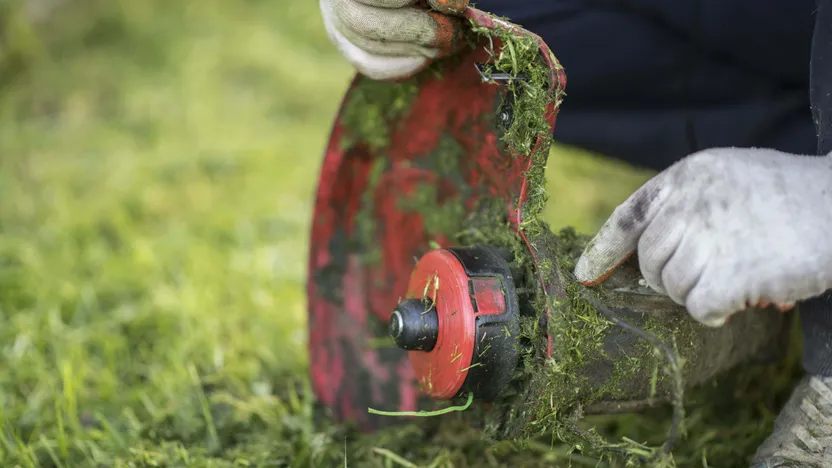
While not essential to the operation of the brushcutter, the cutting head and guard should be given at least a quick clean after each use. Use a wood or plastic scraper tool to remove stuck-on or built-up deposits.
You can also give it a spray with a pressure washer but take care to protect the motor from the water jet.
6. Prepare the brushcutter for winter
Once you have completed all the steps outlined above you can move on to draining the fuel from the machine. Old fuel mixes will lose properties over time and can end up clogging fuel lines and filters. That is why it is not recommended to mix fuel too far in advance and not to keep fuel for over two months. Proceed as follows:
Open the drain plug to drain the fuel tank.
Turn the machine on low to empty the remaining fuel inside the carburettor until the engine stalls due to lack of fuel.
Brushcutter maintenance tasks
Every 15 hours of operation | Clean the air filter. Lubricate the gearbox. |
Once a year | Clean the spark plug. Check the condition of the fuel lines. |
Every 2 years | Change the air filter. Change the spark plug. |
Pre-winter care | Drain the fuel tank and engine of fuel. Lubricate blades. |
Safety precautions
When working with brushcutter blades or the cutting system of any petrol-powered machine, it is essential to disconnect the spark plug before you start work This is the only way to guarantee that the engine won't turn on unexpectedly.
If you have a mains-powered electric brushcutter, you must check that the machine is not plugged in. If you have a cordless brushcutter, check that the battery has been removed.
Petrol brushcutters
How to maintain a brushcutter
Required skills
The mechanical skills to maintain a brushcutter are minimal: you will need to recognise the basic components that make up your brushcutter and be able to identify the air filter and spark plug. You won't need any special tool to remove an air filter but you do need a spark plug wrench to remove the spark plug.
Time required
30 minutes for all tasks
Number of people required
1 person
Tools and equipment
Spark plug wrench
Small wire brush (for spark plug)
Sandpaper
Lubricant spray
Degreaser (optional)
Gearbox grease
Air blow gun (optional)
Petrol brushcutters
More information
You may be also interested in these guides
Guide written by:
John, Passionate gardener, Cambridge
When I was young, I was already working in the family garden. Perhaps that is where my interest in plants and gardening came from. So, it was logical for me to study plant biology. At the request of various publishers I have, over twenty-five years, written many books on the subject of plants and mushrooms (a subject that is close to my heart). They were mostly identification guides at first, but shortly after they were about gardening, thus renewing the first passion of my childhood. I have also regularly collaborated with several magazines specialising in the field of gardening or more generally in nature. There is no gardener without a garden, I have cultivated mine in a small corner of Cambridge for the last thirty years and this is where I put into practice the methods of cultivation that will I advise you in as well.
'/%3E%3C/svg%3E)