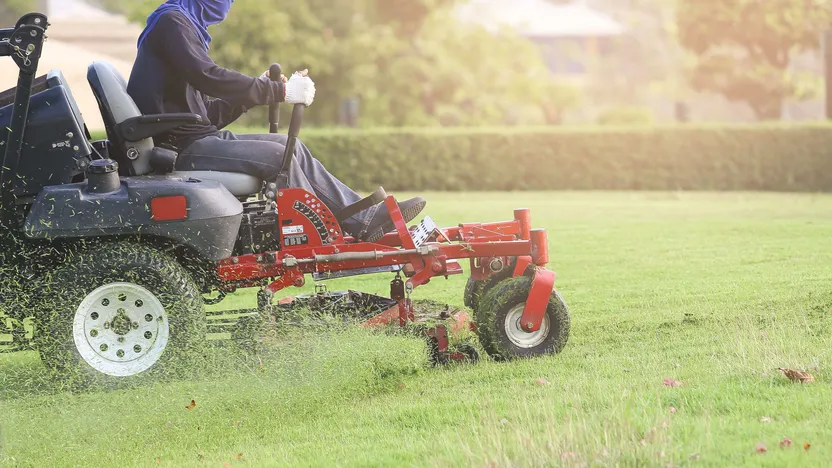
How to maintain a ride-on mower
'/%3E%3C/svg%3E)
Guide written on 25 September 2026 by:
Michael, Professional and passionate welder, Sheffield
Important features
- Routine maintenance
- Seasonal maintenance
- Winter storage
- Engine care
- Blade sharpening
Best sellers in this category
Why maintain your ride-on mower?
Considering the costly initial investment of a ride-on mower, it is a good idea to set up a maintenance schedule to keep it in perfect working condition. You can even keep a little maintenance diary to help you stay on track!
Not caring for your mower properly may mean having to replace expensive components sooner than you might like. Cleaning the mowing deck and checking the engine and all components are all essential steps to maintaining your ride-on mower.
Mower maintenance can be categorised in two main groups:
Cleaning after each use.
Annual maintenance before winter storage.
Steps
Regular ride-on mower maintenance
Securing your mower
Putting your mower into position
Remove and sharpen the blades
Replacing the blades
Preparing a ride-on mower for winter storage
Cleaning the deck
Lubricating wheel axles and adjusters
Draining oil and checking spark plugs
Cleaning or replacing the air filter
Checking the pull cord, battery and tyres
Covering up your mower and disposing of waste
Required skills
While a fairly straightforward process, it is essential to follow the manufacturer's instructions carefully when working with your ride-on mower. You need to be extra careful to follow all safety advice. You will need to use the correct tools and read all instructions properly especially when it comes to tasks like disconnecting a spark plug, using a blade clamp and setting up a mower lifter.
Time required
1 to 3 hours
Number of people required
1 person
Tools and equipment
Blade clamp
Ratchet spanner
Spark plug
Flat file
Bench grinder (optional)
Cloths
Basin or drain pan
Tyre pressure gauge
Safety wear
Please note: this is a non-exhaustive list; be sure to match your personal protective equipment to the job at hand.
Safety footwear
Regular ride-on mower maintenance
1. Secure your mower
As a safety measure, you need to disconnect the spark plug wire if you have a petrol engine. If you have a diesel engine, ensure it is turned off and put a blade clamp in place.
Never attempt to turn the blade by hand: there may be just enough compression for the blade to turn slightly and injure you.
2. Put the mower into position
Provided your tank is empty or almost empty, tilt your ride-on mower using a lawnmower lifter or jack. While doing so, ensure that the air filter is facing skyward to avoid oil or petrol leaking which will cause problems when you next try to fire up your mower.
3. Remove and sharpen the blades
Use a ratchet or special blade removing tool to unscrew the central bolts and remove each blade. If you have a vice, place each blade into position and use a flat file to sharpen the blades working in a downward motion.
If you have a bench grinder, the task will be quicker and more efficient.
4. Replacing the blades
Before you set about replacing the blades double check that you are installing them in the right direction. Use the instructions supplied with your mower to install the blade safely ensuring that it is tightened properly.
If you notice any vibrations when the engine is on, this means that the blade has not been correctly sharpened and is off balance or that the blade is bent. In this case, resharpen or replace as necessary as this issue will make your ride-on mower very unpleasant to use. Any delay in treating the problem will also run the risk of making your mower dangerous to use.
Shop our bench grinders
Best sellers in this category
Preparing a ride-on mower for winter storage
1. Clean the mower deck
Preparing a ride-on mower for winter storage involves a much deeper clean than your regular wash down.
Remove and sharpen the blades as described above.
The cutting deck features one or several pulleys that control several blades.
The drive belt guard should be removed so you can check the condition and tension of the drive belt. The pulleys should also be greased and the gear box must be cleaned and lubricated.
2. Grease and lubricate wheel axles and adjusters
In order to grease the wheel axles, you'll have to remove the wheels.
Check the condition of your adjusting levers and ensure they are working correctly.
Apply a few drops of lubricating oil to the throttle and control cables.
3. Drain the oil and check the spark plug
Check that the oil level and drain the oil according to the manufacturer's instructions (if the time has come to do so). Drain the fuel tank.
Remove the spark plug and brush it. Check the electrode gap using a feeler gauge. If you don't have a feeler gauge, the width of your thumb nail should roughly correspond to the right gap.
4. Clean or replace the air filter
If you have a paper air filter, remove it and blow it using compressed air or simply replace it. If you have a foam filter (like most mowers), clean using a brush and some petrol, diesel or water.
If your filter is damaged or has holes, it is best to replace it entirely to avoid your mower losing power.
5. Check the pull cord, batteries and tyres
If your ride-on mower has a pull start, check the condition of the cord. If your mower has an electric start, it's best to disconnect the battery and reconnect it when you take your mower out in the spring.
Don't forget to brush the battery terminals as these parts can rust and cause start-up issues. If your battery has run out of charge, charge it up (if the model allows).
Check the condition of your tyres and replace them as required. If they are in good condition, check the tyre pressure using a tyre pressure gauge. Use a foot pump or air compressor to inflate if required.
6. Cover up your mower and throw away any rubbish
At this point, your mower and grass box should be shipshape. If you don't have a garage or shed, you'll need a lawnmower cover.
If you have any rubbish, such as dirty cloths, petrol or engine oil, dispose of it responsibly. Seal your waste in bottles or watertight bags and take it to the appropriate waste sorting facility where it can be recycled.
Shop our air compressors
You may be also interested in these guides
Guide written by:
Michael, Professional and passionate welder, Sheffield
I was trained as a pipe worker and a pipe-welder and after having travelled for 35 years working around the UK, I became the head of a metal shop, then a designer and in the end the head engineer. I have designed and built a workshop where I make metal sculptures: I managed to find a piece of paradise where I can let my imagination run wild. Auctions and garage sales are no secret to me. I find unusual objects and old tools there that I collect or transform into works of art. I also like decoration, painting on canvas, and gardening. I am developing new technologies concerning tools. To share my passion and advise you in your choice of materials is a real pleasure.
'/%3E%3C/svg%3E)