How to paint kitchen cabinets
'/%3E%3C/svg%3E)
Guide written on 6 February 2024 by:
Julie, Interior Designer, Manchester
Best sellers in this category
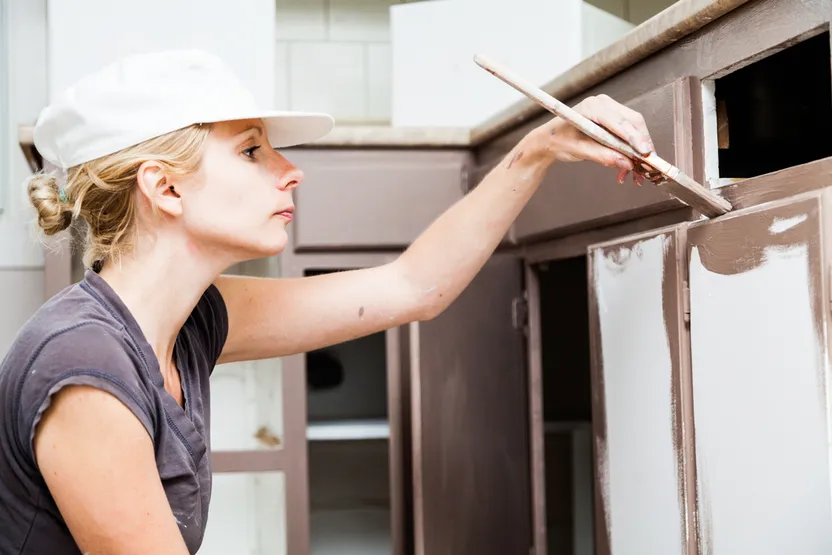
Applying a new coat of paint to your kitchen cabinets
Upcycling your kitchen is a trend that has become increasingly common in recent years. This is no surprise, when it allows you to make massive savings on giving your kitchen a new look without undertaking large scale renovations.
Painting your kitchen cabinets is therefore a good alternative, with speciality paints being available in a wide variety of colours. After the kitchen surfaces have been prepared correctly they can be painted with your preferred colour and can last for many years. With this being a relatively modest investment, you will also be able to match your home decor to your kitchen's new colour. This gives you options you've never had before!
Lacquer and paint for interior woodwork
Painting kitchen cabinets in 3 steps
Steps
Preparing for the job
Applying the primer and paint
Final steps and cleaning
1. Preparing to paint your kitchen cabinets
Before starting, you need to remove all handles, hinges and other visible metal parts, so they won't be damaged. Use masking tape on the joints and cover your workspace with tarpaulin.
The surface of the kitchen doors, as with all other painting jobs, must be well prepared for the paint to adhere well to it. You can start by sanding down all surfaces being painted, preferably with fine sandpaper (180 grit) so that the shape of the doors are not damaged.
Now is the time to improve these areas, so that the paint adheres firmly to the surface. Cover these areas with paint filler using a putty knife and sand the areas down so they are smooth after the filler has dried. This way they will not be visible beneath the new paint. Wipe all newly coated surfaces down with a damp cloth before you continue.
2. Applying primer and paint
To ensure that the final coat of paint adheres well and doesn't rub off, the cabinets should first be coated with a suitable primer. This tends to be white so that there is a uniform underlying surface beneath the coloured paint. To achieve optimal results, the primer can be sanded down using fine sandpaper (e.g. 400 grit) once it has dried completely. This ensures that the upper surface is as smooth as a mirror, providing optimal conditions for it to stick.
Wipe everything down once more with a damp cloth and then it's time to apply coloured paint! We recommend applying multiple primer coatings (at least two), and lightly sanding down the base layer with fine sandpaper (400 grit) each time, in order to remove any remaining unevenness. Prior to applying the next layer, wipe the sawdust away using a damp cloth each time so that it doesn't dry in the paint, creating an unappealing goose pimple effect.
It is best to apply the coloured paint using a fine-pored foam paint roller, as this ensures that the surface is painted evenly. Ensure not to apply the paint too thickly, as applying multiple thin layers, as opposed to one very thick layer, is always preferable!
3. Final steps and cleaning
The paintbrush and paint roller need to be cleaned either with water or white spirit, depending on the type of paint used. This should be done immediately after you have finished painting, as once the paint has dried it cannot be washed out. This is important if you wish to use your painting tools again for your next project.
Tip: Wrap two layers of cling-film airtight around your brush and paint roller to avoid time-consuming cleaning afterwards.
We recommend wrapping the masking tape around a carpet knife whilst removing it from the corners. This will prevent the tape from attaching to the freshly painted furniture and removing the paint, which would mean you would have to paint the furniture all over again! Also consider enquiring at your nearest recycling centre about how best to dispose of leftover paint and waste, in order to care for the environment.
Finally you can reattach the old or new handles, hinges and other metal parts to the kitchen doors. Your kitchen will now have a beautiful new shine to it.
Interior wall paint
Best sellers in this category
How to paint your kitchen cabinets
Required skills
Painting your own kitchen cabinets is a relatively simple task, which doesn't require any specialist knowledge. You simply need to know how to use sandpaper, a paint brush and a paint roller, as well as how to protect yourself throughout the job.
Paint brushes
Time required
1 to 2 days, depending on drying times and the size of the kitchen.
Number of people required
1 person (although it would be quicker with 2 people)
Tools and equipment
Fine sandpaper (180 and 400 grit)
Paint brush (plastic or mixed bristles) and a (fine-pored) painting sponge
Primer (varies according to painting surface)
Acrylic or hybrid paint
Scrapers and wooden mixer
Bucket or paint tray and sponge
Soft cloth
Water and cleaner
Carpet knife
Tarpaulin
Personal protective equipment (PPE)
Dust mask (depending on the type of paint used)
Please note: this is a non-exhaustive list; be sure to match your personal protective equipment to the job at hand.
More information
Are you renovating your kitchen? You can find helpful ideas and advice for your kitchen in the following guides:
You may be also interested in these guides
Guide written by:
Julie, Interior Designer, Manchester
After years of DIY, renovation and designing, I decided to turn my passion into a career. Starting in 2006, in the South-West, I helped people with renovation or construction projects. My expertise and curiosity led me to look further into innovative ideas for myself and my clients. Indeed, to live your passion is also to transform the space you live in and the objects you use daily. My family love my creations and ideas that I bring into their lives! My favourite thing to do: use colour to brighten up interior space. But also tips to hide away clutter. Your home is just never big enough, is it? It is therefore a great pleasure to share my tips with you, so that you also can take as much pleasure as I do when starting up your next project!
'/%3E%3C/svg%3E)