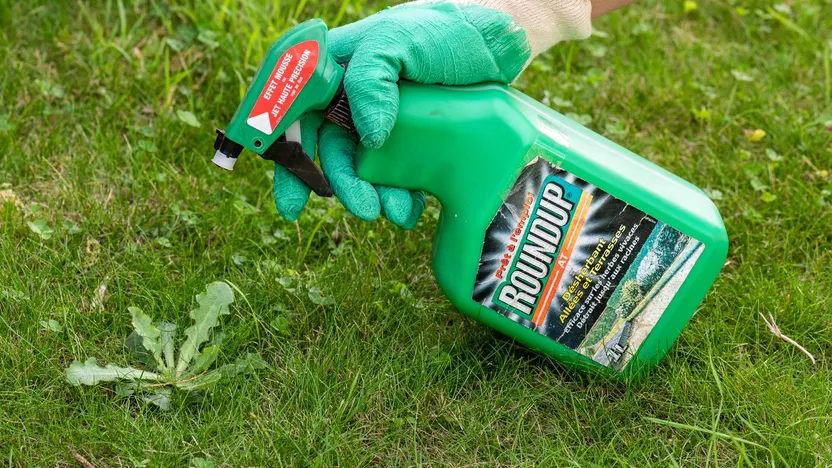
Roundup: a glyphosate-based herbicide
'/%3E%3C/svg%3E)
Guide written on 6 February 2024 by:
John, Passionate gardener, Cambridge
Important features
- Herbicide ingredients
- Global sales and usage
- GMO crops
- Dangers for health and the environment
Best sellers in this category
What is Roundup?
Originally manufactured by Monsanto (now Bayer), Roundup is a commercial weed killer that has been on the market since 1974.
Roundup is a non-selective, systemic herbicide which destroys plants by moving through their sap stream. This means that even if the product isn't sprayed on all plant leaves, it will still move through the plant and kill it entirely.
The active substance of Roundup is glyphosate which has been the subject of much debate. Surfactants are also added to the glyphosate to allow the product to adhere to leaves and penetrate the plant more easily. Glyphosate is then carried down to the plant's growth system through the stems, leaves or roots. Glyphosate inhibits the synthesis of amino acids in the plant killing it off. A pelargonic acid-based weed killer was also released under the brand name Roundup in 2017. It is designed to burn weeds upon contact.
Plant care
Roundup: a short history of global success
Glyphosate was invented by a Swiss chemist in 1950, but its herbicidal properties were only discovered 20 years later.
Roundup was first sold in Malasia for use on rubberwood plantations, then in the UK for wheat production. In the US, it was first used as a weed killer in non agricultural settings before then being used on crops.
Roundup then became hugely popular. Produced in enormous quantities, the product is relatively affordable and very effective, in the sense that very few weeds will resist it.
At the time, Roundup was seen as the perfect eco-friendly solution. Customers were told that it was made entirely of natural products like carbon dioxide, phosphoric acid and ammonia, and that it was completely harmless for human health, as well as for flora and fauna. From an environmental stance, Roundup was sold to the public as the safest herbicide in history. Quickly enough, the product made up 30% of all Monsanto's product sales.
Easy-to-use, this broad spectrum herbicide became the most used weed killer in the world — and sometimes on a very large scale. 'Plan Colombia', for example, was a United States-led initiative aiming to destroy coca fields in southern Colombia and eliminate drug crops. Roundup was sprayed onto the fields by plane and damaged a significant amount of forest in the process. In May 2015, Colombia made the decision to ban Roundup following a warning by the World Health Organisation (WHO) that the product had been deemed 'probably carcinogenic'.
It is estimated that 2 million tonnes of pesticides are currently being used annually around the globe. In Europe, France has the highest rate of pesticide use in tonnes while the UK is ranked at 25th globally. According to DEFRA statistics, 2.5 million hectares in the UK were treated with a total of roughly 2.2 million kilograms of glyphosate in 2016 which equates to about a quarter of all farmland across the country. While glyphosate – and therefore Roundup – has not been approved for use in the EU since 22 December 2022, it is approved until at least December 2025 in the UK under post-Brexit government policy.
Best sellers in this category
Roundup's genetically modified crops
In 1996, Monsanto released its line of genetically modified crop seeds under the trademark Roundup Ready (RR). These crops, including maize, soy and rapeseed, have been modified by the insertion of a herbicide-resistant gene which allows them to tolerate glyphosate-based weed killers.
These genetically modified crops are sold along with a contract setting out the terms under which a farmer may plant the GM seed.
In the United States, 65% of cotton crops and 10% of maize contain the Roundup Ready gene. The use of GM crops is linked to an increase in herbicide use by farmers across the country.
Roundup Ready crops contain higher herbicide residues than non GMO crops.
Some countries have increased the maximum legal level of pesticide residues allowed in line with these crops. This level is referred to as maximum residue levels (MRL) and refers to the maximum concentration of a pesticide residue in or on food or feed of plant and animal origin that is legally tolerated. MRLs are used to set specific import tolerances.
In the EU, the maximum concentration of glyphosate in soy crops increased 200 fold from 0.1 milligrams per kilogram to 20 mg/kg in 1997 following the introduction of genetically modified Roundup Ready soy in Europe.
As a result, the MRL of lentils went from 0.1 mg/kg to 10 mg/kg in 2012 despite international standards recommending a maximum level of 5 mg/kg.
Glyphosate: a danger for health and the environment
The effects of glyphosate, the active substance in Roundup, are much disputed. The World Health Organisation (WHO) deems glyphosate as a probable carcinogen while The European Food Safety Authority has assessed glyphosate as unlikely to pose a carcinogenic hazard to humans. Glyphosate is suspected of being an endocrine disruptor capable of impairing fertility. It is also thought to trigger biodiversity loss and to play a part in declining bee populations.
Furthermore, Roundup also contains various adjuvants, the health and environmental effects of which are still not exactly clear. There is also the possibility of a so-called 'cocktail effect' whereby chemicals combine to become more toxic.
A report carried out by the Soil Association entitled 'The Cocktail Effect' showed that "around a quarter of all food, and over a third of fruit and vegetables, consumed in the UK contain a cocktail of pesticide, with some items containing traces of up to 14 different pesticides." Roundup has been involved in a number of high profile lawsuits with plaintiffs stating that the product caused them to develop Non-Hodgkin's Lymphoma.
Natural alternatives to glyphosate
Hoes, push pull weeders, weed burners, boiling water, salt... there are lots of accessible options for anyone looking for an environmentally friendly alternative to pesticides. To find out how to weed without the use of chemicals check out our full guide of natural weed killers!
Weed burners
More information
You may be also interested in these guides
What are the impacts of chemical fertilisers and pesticides?
Eco-friendly weeding: alternatives to glyphosate-based weed killers
Guide written by:
John, Passionate gardener, Cambridge
When I was young, I was already working in the family garden. Perhaps that is where my interest in plants and gardening came from. So, it was logical for me to study plant biology. At the request of various publishers I have, over twenty-five years, written many books on the subject of plants and mushrooms (a subject that is close to my heart). They were mostly identification guides at first, but shortly after they were about gardening, thus renewing the first passion of my childhood. I have also regularly collaborated with several magazines specialising in the field of gardening or more generally in nature. There is no gardener without a garden, I have cultivated mine in a small corner of Cambridge for the last thirty years and this is where I put into practice the methods of cultivation that will I advise you in as well.
'/%3E%3C/svg%3E)