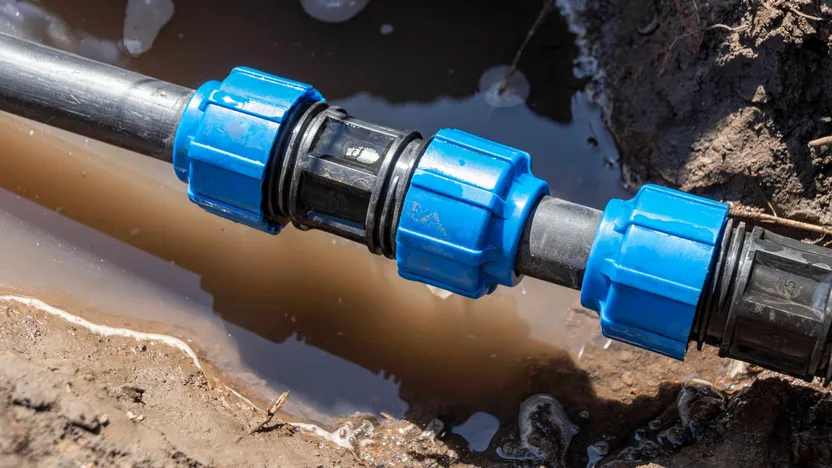
How to use PE pipe fittings
'/%3E%3C/svg%3E)
Guide written on 6 February 2024 by:
Jérôme, Construction site supervisor, Cardiff
Important features
- Fitting a PE compression fitting
- Fitting a PE push fit fitting
- Fitting a welded PE fitting
Best sellers in this category
PE pipe fittings: a perfect seal guaranteed
A polyethylene (PE) pipe network is made up of a series of pipes and fittings and can be used to carry drinking water, gas or any other type of fluid. With the exception of welded connections, which should only be used for very large pipes, PE fittings are very easy to use and can be fitted in a matter of minutes.
PE fittings can be made of brass or plastic and can form any type of leak-proof connection including couplers, elbows and reducers. If installed correctly, a PE pipe fitting should ensure a more or less perfect watertight seal for a very long time.
Steps
Fitting a PE compression fitting
Fitting a PE push fit fitting
Fitting a welded PE fitting
Deburring tools
1. How to fit a PE compression fitting
Cut your PE pipe to size using a pipe cutter and deburr the ends carefully. No matter what type of fitting you are using (e.g. coupler, elbow, reducer, end cap, etc.) or the material (i.e. plastic or brass), you should aways start by loosening the screw cap.
Next, remove the rubber seal and the plastic washer.
Lubricate the PE pipe and fit the screw cap, rubber seal and finally the plastic washer. Be sure to do so in this order.
Slot the fitting onto the end of your PE pipe and put the plastic washer in place.
Screw the cap over the rubber seal to compress the whole fitting. You should be able to do this by hand. Ensure that your assembly is secure by pulling on the fitting.
Shop our PE pipe
Best sellers in this category
2. How to fit a PE push fit fitting
Unlike compression fittings, push fit fittings do not have to be disassembled to be fitted.
Start by marking out the halfway point of the fitting (the fitting will usually be pre-marked no matter whether you are using a plastic or brass fitting).
Transfer this measurement to the PE pipe to ensure you know how far to push the pipe into the fitting.
Lubricate your pipe and insert it firmly into the fitting until you reach the mark.
Check the connection is secure by pulling on the fitting.
To remove the fitting, use a spanner to unscrew the lock mechanism on the fitting. Undo the twist lock and pull on the pipe to release it from the fitting. The washers and O rings will usually come away with the pipe.
3. How to fit a welded PE fitting
Used only by professionals, welded PE fittings require special skills and costly materials to install. They are generally only used on large plastic pipes or in industrial settings for pressurised pipe.
These fittings are welded into place by electro-fusion, extrusion welding or poly fusion. They cannot be removed once in place and create a perfectly sealed connection. They are most commonly used to carry gas, drinking water or special fluids like hydrocarbons.
How to use PE pipe fittings
Required skills
Fitting a PE pipe fitting does not require any particular skills. However, you will be have to be able to take accurate measurements if you have to cut your pipe.
It is essential to pay attention to the order in which the different parts are assembled and to have a pipe cutter and the appropriate spanners to hand. Welded fittings are used exclusively for large pipes and require special training and materials to fit. These fittings should only be used by professionals.
Time required
Approx. 5 minutes depending on the fitting (with the exception of welded fittings)
Number of people required
1 person
Tools and equipment
Pipe wrenches
PE pipe deburring tool
Pipe lubricant
Deburring tools
More information
You may be also interested in these guides
Guide written by:
Jérôme, Construction site supervisor, Cardiff
Electrician by trade, I first worked in industrial estates where I installed, wired and fixed a large number of electrical installations. After this, I managed a team of electricians for this type of work. 10 years or so ago, I turned to building and construction. From the modest family home, to gyms and theatres, I have been able to coordinate, audit and organise all sorts of construction sites. For 4 years now, I am restoring and building an extension to a bungalow in the heart of the Welsh countryside. My experience in manual work and my knowledge means I am proud to be of service. Terraces, interior design, roofing, plumbing, electrics, anything goes! My wife, daughter and I, built almost everything we have from scratch! So to answer all of your questions and advise you on choosing your tools? Easy!
'/%3E%3C/svg%3E)